Florida’s bold push for a second remote immigrant detention center is igniting fierce debate over state sovereignty, public safety, and the limits of federal power in the new Trump era.
Story Highlights
- Florida, under Governor DeSantis, is preparing a second detention facility for undocumented immigrants following the launch of the Everglades’ “Alligator Alcatraz.”
- The expansion comes as the Trump administration accelerates mass deportation, pressuring states to partner in enforcement amid a national detention bed shortage.
- Democratic lawmakers and advocacy groups allege inhumane conditions and political motives, while state leaders defend the move as vital for security and rule of law.
- Remote, high-security sites spark further debate over constitutional rights, local impacts, and federal-state dynamics.
Florida Doubles Down on State-Led Immigration Enforcement
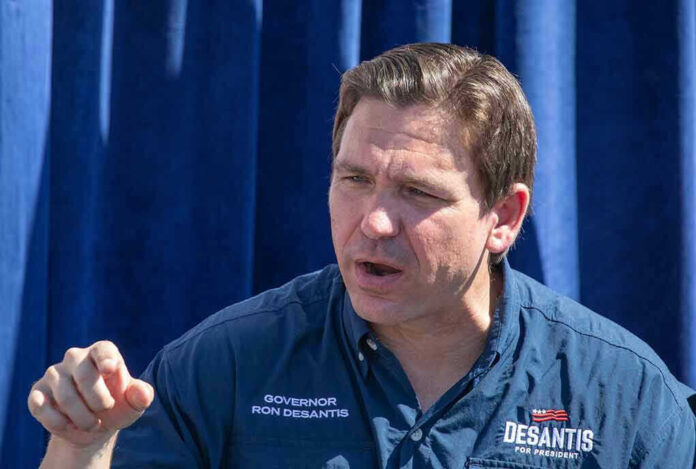
Governor Ron DeSantis and the State Board of Immigration Enforcement are moving rapidly to establish a second detention facility for undocumented immigrants, this time in North Florida. This follows the operational launch of the Everglades site—dubbed “Alligator Alcatraz”—earlier this summer, a facility chosen for its remoteness and natural security barriers. With the Trump administration’s renewed focus on mass deportation and an ambitious goal to remove one million immigrants annually, Florida is positioning itself as a model for aggressive state cooperation in federal enforcement. The expansion reflects conservative demands for decisive action after years of what many saw as federal inaction, open borders, and the chaos of the previous administration’s “woke” immigration policies.
Public records and media reports confirm that the new “North Detention Center” is in the early planning stages, with state agencies like the Florida Department of Emergency Management coordinating site selection and logistics. The Everglades facility itself is already at or near capacity, with 5,000 beds and operations managed by private vendors at an annual cost of $450 million. State and local law enforcement—empowered by new state funding and authority—are ramping up arrests, exacerbating the detention bed crunch that has plagued both federal and state systems throughout 2025. The state’s approach aligns with President Trump’s executive actions, which have expanded expedited removal, established daily arrest quotas, and threatened sanctuary jurisdictions with steep penalties for noncooperation. These moves are designed to restore order, enhance public safety, and relieve overcrowded local jails, all while reinforcing the principle that the rule of law applies to everyone—including those here illegally.
Supporters Cite Security, Critics Cry Foul Over Conditions and Motives
Governor DeSantis and his allies frame the expansion as essential for public safety and the integrity of the legal immigration system. They argue that remote locations like the Everglades and North Florida not only provide maximum security through natural barriers but also help deter future illegal crossings by signaling that Florida will not serve as a sanctuary state. The facilities are a direct response to years of surging illegal immigration and the resulting strain on state resources—a reality that many conservative voters have long demanded be addressed. The Trump administration’s “One Big Beautiful Bill Act” further backs this approach, providing billions in new federal funds for detention and enforcement and explicitly supporting the use of family detention to prevent “catch and release.” For many, these actions are long overdue corrections to years of failed border and immigration policies that undermined the Constitution, strained local communities, and fueled public frustration with government overreach from Washington.
However, the rapid expansion and use of remote, environmentally sensitive areas have drawn fierce opposition from Democratic lawmakers, advocacy groups, and some local communities. Critics allege that these facilities are inhumane, limit access to legal counsel, and are motivated more by political theater than sound policy. Reports from congressional site visits have cited overcrowding, lack of medical care, and barriers to due process—issues that advocacy groups claim should alarm anyone concerned with basic constitutional rights. Environmental groups and Native American tribes have also raised concerns about land use and ecological impact, while local residents worry about the long-term social and economic effects on their communities. The debate has quickly become a flashpoint in the ongoing culture war over immigration, state autonomy, and the fundamental values that define American society.
Federal-State Tensions and the Road Ahead
While Florida’s aggressive approach has drawn national attention and applause from conservatives, it also exposes potential fault lines between state and federal priorities. Although federal reimbursement for facility costs is expected, President Trump has signaled plans to phase out FEMA’s disaster response role after the 2025 hurricane season, casting uncertainty on future support. Legal challenges are already brewing, as critics question the constitutionality and humanitarian impact of the state’s detention strategy. Nonetheless, for many on the right, Florida’s moves represent a long-awaited restoration of sovereignty and common sense in immigration enforcement—a sharp contrast to the permissive, “open borders” approach of years past. As the nation heads toward the 2026 election cycle, the outcome of Florida’s experiment could set the tone for other states and the future of American immigration policy.
Ultimately, the expansion of detention centers in Florida is more than a local controversy—it is a test of how far states can and should go in protecting their communities, enforcing the law, and defending the principles enshrined in the Constitution. With both sides marshaling legal, moral, and political arguments, the battle over “Alligator Alcatraz 2.0” is far from over, and its results may shape the national debate on immigration, federalism, and American identity for years to come.
Sources:
Stamford Advocate: “Florida prepares to build a 2nd immigration detention facility” (2025-07-26)
WLRN: “Immigration enforcement faces detention bed crunch in Florida” (2025-07-23)
CBS Miami: “DeSantis considers second immigrant detention facility in NE Florida” (2025-06-25)
DHS: “Making America Safe Again – Press Releases”