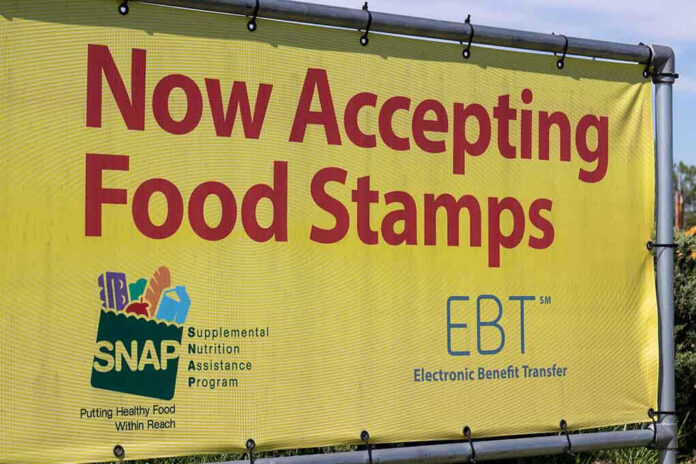
Political brinksmanship in Washington has put 41 million Americans on the edge of a food security cliff, with their grocery lifeline set to vanish in a matter of days.
Story Snapshot
- The USDA warns that SNAP benefits for 41-42 million Americans will expire on November 1, 2025 if the government shutdown continues
- Congressional Democrats and the USDA clash over whether emergency contingency funds can legally be used to prevent the benefit lapse
- September and October benefits remain unaffected, but the November 1 deadline looms as lawmakers remain deadlocked over a continuing resolution
- The USDA argues that redirecting funds would jeopardize other critical programs including school meals and infant formula assistance
- This represents one of the largest threats to food assistance in the program’s history, affecting roughly 12 percent of the American population
The Countdown to Crisis
The calendar reads October 27, 2025, and Washington’s political machinery remains frozen in partisan gridlock. In just five days, the Supplemental Nutrition Assistance Program will hit a funding wall that threatens to leave more than 41 million Americans without their primary means of purchasing food. The USDA has issued stark warnings: without Congressional action, no benefits will be distributed starting November 1. This isn’t hyperbole or negotiating posture. It’s the administrative reality of a safety net program caught in the crossfire of a government shutdown that shows no signs of resolution.
The Legal Battle Over Emergency Funds
At the heart of the impasse lies a bitter dispute over money that may or may not exist. Congressional Democrats insist that contingency funds are available and were established precisely for emergencies like this one. The USDA counters with a different legal interpretation, arguing that tapping into those reserves would require raiding other nutrition programs. The agency maintains that using contingency funds would directly threaten school meal programs and infant formula assistance, creating a cruel choice between feeding hungry children in classrooms or hungry families at home. This bureaucratic chess match carries real consequences for millions of Americans who depend on SNAP to keep food on their tables.
The legal argument exposes how federal appropriations law can become a weapon in political warfare. While Democrats argue the statute allows for emergency use of contingency reserves, USDA lawyers read the same law differently. Neither side appears willing to budge, and the November 1 deadline approaches with mathematical certainty. State agencies continue processing applications and distributing benefits as though nothing is wrong, but they’re operating on borrowed time. New York State officials confirmed in late September that benefits would continue through October, but conspicuously avoided making promises about November.
Who Pays the Price
The 41 million Americans facing benefit loss aren’t a monolithic group. They’re low-income families struggling to make ends meet, elderly citizens on fixed incomes, disabled individuals unable to work, and children who didn’t choose their economic circumstances. In states like New Mexico, where 21 percent of residents depend on SNAP, the impact would be catastrophic. These aren’t people gaming the system or looking for handouts. They’re Americans who’ve fallen on hard times in an economy that increasingly leaves working families behind, even when they play by all the rules.
The ripple effects extend far beyond individual households. Grocery stores and farmers markets that accept SNAP benefits will see dramatic drops in revenue. Food banks and charitable organizations will face overwhelming demand they cannot possibly meet. Healthcare systems will bear the costs of malnutrition-related illnesses. Local economies will contract as SNAP dollars, which generate significant multiplier effects in communities, suddenly evaporate. This is what happens when politicians treat essential services as bargaining chips rather than moral obligations.
The Shutdown Leverage Game
Government shutdowns have become a disturbingly routine feature of American politics, but this one carries unique dangers. Previous shutdowns threatened SNAP funding but ultimately contingency measures prevented benefit disruptions. Those reserves have been depleted, and the legal constraints have tightened. What makes this situation particularly galling is the nakedness of the political calculation. Both parties understand the stakes, yet neither will blink first. Congressional Republicans appear willing to use SNAP recipients as leverage to extract concessions on unrelated policy priorities, while Democrats refuse to negotiate under what they view as hostage-taking conditions.
The Trump administration’s role in this standoff deserves scrutiny. Rather than finding creative administrative solutions or pushing congressional allies toward compromise, the USDA has essentially thrown up its hands and declared the situation impossible to resolve without full funding. That may be legally accurate, but it reflects a troubling abdication of responsibility. Previous administrations facing similar crises found ways to keep benefits flowing, even temporarily. The current approach suggests that protecting vulnerable Americans ranks lower than maintaining bureaucratic procedures and political positioning.
The November 1 Reckoning
Five days remain before theory becomes reality. If Congress fails to act by November 1, millions of Americans will wake up to empty benefit accounts and no clear timeline for restoration. Food pantries will be overwhelmed within days. Families will face impossible choices between paying rent and buying groceries. Children will go hungry not because of natural disaster or economic collapse, but because their elected representatives couldn’t find common ground on a continuing resolution. This isn’t governance. It’s abandonment dressed up in parliamentary procedure and constitutional theory.
The solution exists and everyone knows it. Pass a clean continuing resolution that funds SNAP and other essential programs while broader budget negotiations continue. This isn’t complicated policy or novel procedure. It’s standard practice that’s worked countless times before. But standard practice requires politicians who prioritize governing over posturing, and those seem to be in short supply in Washington right now. The 41 million Americans counting on SNAP benefits don’t care about the procedural arguments or the partisan blame game. They just want to know if they’ll be able to feed their families next week. That’s not an unreasonable expectation in the wealthiest nation in human history.
Sources:
Trump admin warns 42 million Americans could lose food stamps as shutdown drags on – Fox News
New York State OTDA Policy Document on SNAP Benefits During Shutdown