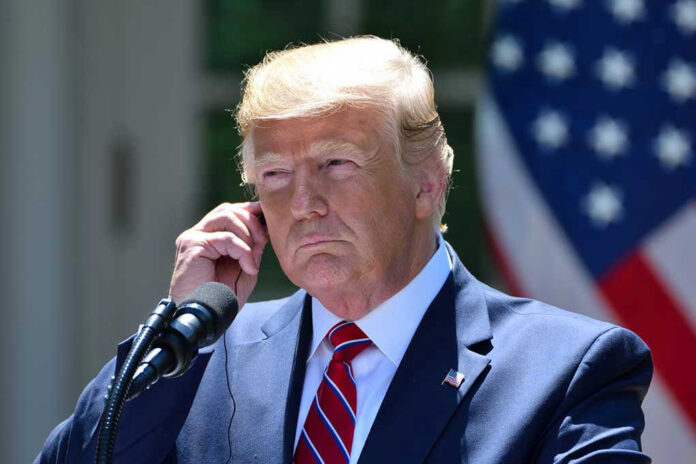
President Trump’s executive order labeling Antifa as a ‘domestic terrorist organization’ marks a pivotal escalation in the fight to restore law and order, igniting fierce debate over constitutional rights and national security.
Story Snapshot
- Trump formally designates Antifa as a domestic terrorist organization, a first in U.S. history.
- Federal agencies are directed to investigate and dismantle Antifa’s operations under expanded authority.
- Critics warn of civil liberties concerns, noting Antifa’s decentralized structure complicates enforcement.
- The move intensifies national debate on free speech, protest rights, and government power.
Trump’s Executive Order Targets Antifa as Domestic Terror Threat
President Donald Trump signed an executive order officially designating Antifa as a domestic terrorist organization. This landmark directive instructs federal agencies to investigate, disrupt, and dismantle Antifa’s operations, citing their alleged involvement in organized violence, obstruction of law enforcement, and efforts to suppress lawful political activity. The administration frames this action as a necessary response to escalating political violence and unrest, emphasizing the need to restore order and protect American communities.
The order marks the first time a U.S. president has formally applied domestic terrorism designations—typically reserved for foreign groups—to a decentralized, ideology-driven movement within the United States. The move follows years of rising political tensions, high-profile confrontations between Antifa-affiliated activists and law enforcement, and mounting calls from conservative leaders to crack down on what they describe as coordinated political violence. Immediate public and media reactions have included praise from law-and-order advocates and sharp criticism from civil liberties groups.
Background: Antifa’s Structure and the Path to Federal Action
Antifa, short for “anti-fascist,” is not a traditional organization but rather a loosely affiliated movement with roots in twentieth-century European anti-fascism. In the U.S., Antifa collectives have been active since the 1980s, primarily opposing white supremacist and far-right activities. The movement gained significant visibility during the 2010s and 2020s as participants engaged in protests against police brutality and right-wing rallies. Despite its decentralized nature, Antifa has been at the center of political discourse due to violent confrontations and the broad rhetoric attributed to its adherents.
Prior to Trump’s order, congressional efforts—such as a 2019 Senate Resolution—called for designating Antifa as a terrorist entity, but those actions were non-binding and lacked executive force. No previous administration had used executive authority to label a domestic group in this way, making the current action unprecedented. The heightened polarization of recent years, combined with public concern over extremism and disorder, set the stage for this drastic measure.
Constitutional Questions and Enforcement Challenges
The order’s implementation immediately raised significant legal and constitutional questions. Legal scholars and civil liberties organizations argue that designating Antifa as a terrorist organization threatens First Amendment protections, including free speech and assembly. Experts emphasize that Antifa is an ideology rather than a formal group, complicating enforcement and raising doubts about the order’s legal foundation. Critics warn that broad definitions of domestic terrorism could chill lawful protest and dissent, setting a troubling precedent for future administrations.
Security analysts also highlight the practical difficulty of targeting a non-hierarchical, decentralized movement. Law enforcement agencies are now tasked with adapting investigative methods to scrutinize individuals and loosely connected collectives, rather than dismantling a clear organizational structure. This enforcement challenge underscores the ongoing debate: supporters see the order as a necessary step to restore public safety, while opponents fear it may open the door to government overreach and abuse of power.
Broader Impacts: Civil Liberties, Law Enforcement, and Public Debate
Federal agencies have begun coordinating investigations and potential prosecutions under the new directive, signaling a new era in domestic security policy. Short-term effects may include increased scrutiny of protest movements and potential arrests under expanded definitions of domestic terrorism. In the long term, the order is likely to face legal challenges, with courts asked to weigh executive authority against constitutional protections. The move is expected to heighten polarization, strain relationships between federal and local law enforcement, and deepen the national debate over the balance between security and liberty.
President Trump on September 22, signed an executive order formally labelling Antifa—commonly understood as a loosely connected, far-left, anti-fascist movement—as a “domestic terrorist organization.” https://t.co/GuqG4ig3Qb
— Ops_Intels News (@OpsIntels) September 23, 2025
While the White House insists the order is essential for protecting American lives and upholding the rule of law, critics remain deeply concerned about its implications for civil society. The action sets a precedent for the use of executive power against domestic political movements, raising urgent questions about how the government defines and responds to perceived threats. As public debate intensifies, Americans face a critical moment in the ongoing struggle to defend both safety and constitutional freedoms.
Sources:
Designating Antifa as a Domestic Terrorist Organization – White House
Q&A: Antifa Is Not a Single Group, So What Is It? – ACLED
Trump’s Anti-Antifa Executive Order – Cato Institute
Senate Resolution 279 – Congress.gov
Executive Orders – White House