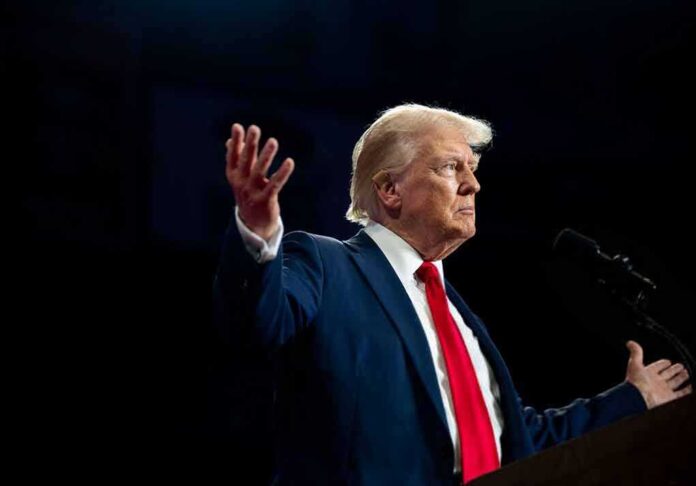
When President Trump appeared on the jumbotron during Monday night’s College Football Playoff National Championship in Miami, the crowd’s thunderous response revealed something fascinating about the intersection of politics and America’s most beloved sport.
Story Highlights
- Miami crowd roared with approval when Trump waved during the national anthem at the CFP Championship
- Trump’s appearance came just days after issuing an executive order protecting the Army-Navy game from playoff expansion conflicts
- The moment highlighted growing political influence over college football amid stalled expansion talks between commissioners
- Power conference leaders remain deadlocked on expanding from 12 to 16 or 24 teams, with ESPN’s January 23 deadline looming
Miami’s Presidential Reception
The Hard Rock Stadium crowd erupted when cameras panned to Trump during the championship game. Unlike the hostile receptions he has received at other sporting events, Miami’s football fans delivered a markedly different response. The president waved to spectators during the Star Spangled Banner, creating a moment that captured national attention and sparked widespread social media discussion.
This reception stands in sharp contrast to previous sporting event appearances where Trump faced mixed or negative crowd reactions. The college football setting, with its traditionally conservative fanbase, provided a more welcoming environment for the president’s surprise appearance alongside UFC president Dana White and other high-profile guests.
Presidential Intervention in College Football
Trump’s championship appearance followed his unprecedented executive order just three days earlier, specifically designed to protect the Army-Navy game’s broadcast window from potential College Football Playoff expansion conflicts. This marked the first time a president has directly intervened in CFP formatting decisions through executive action, demonstrating how deeply college football has penetrated American political discourse.
The timing was no coincidence. College football commissioners had gathered in Miami for crucial expansion talks, facing an ESPN deadline of January 23 to finalize playoff format changes. Trump’s order sends a clear message about preserving military academy traditions while commissioners debate expanding from the current 12-team format to either 16 or 24 teams.
Commissioner Stalemate Threatens Expansion
Behind the scenes of Monday’s championship celebration, a high-stakes battle rages between the sport’s most powerful figures. Big Ten Commissioner Tony Petitti and SEC Commissioner Greg Sankey hold veto power over expansion decisions, but they remain fundamentally divided on the path forward. Petitti pushes for an ambitious 24-team playoff, while Sankey favors a more conservative 16-team approach with five conference champions plus eleven at-large selections.
This deadlock has frustrated other conference commissioners and ESPN executives, who see massive revenue potential in expansion. The current ESPN contract worth $7.8 billion incentivizes growth, but the two most powerful conferences cannot agree on implementation details. If no decision emerges by January 23, the playoff remains at 12 teams through 2026, with another deadline looming December 1.
Politics Meets Pigskin Tradition
The crowd’s enthusiastic response to Trump reflects college football’s unique position in American culture, where tradition and patriotism intersect with big business and entertainment. Unlike professional sports, college football maintains stronger connections to regional identity and conservative values, making it fertile ground for political moments. Trump’s executive order protecting Army-Navy resonates with fans who prioritize military respect and historical preservation over pure commercial expansion.
This dynamic creates interesting pressures on commissioners who must balance tradition with financial opportunity. The president’s intervention adds another layer of complexity to already difficult negotiations, where billions of dollars and decades of tradition hang in the balance. College football’s political significance extends far beyond the field, influencing everything from university funding to regional pride and now presidential policy.
Sources:
President Biden invites national champions University of Georgia to White House after backlash
College Football Playoff meetings end without expansion decision
College Football Playoff expansion hearing
Controversy on the 2026 College Football Playoff Selection
Another year, another controversial College Football Playoff