A single choreographed pause in the House chamber handed Trump a made-for-campaign clip and forced Chuck Schumer into a defense that sounded like a detour.
Story Snapshot
- Trump asked lawmakers to stand if they believed government should prioritize American citizens over illegal immigrants; most Republicans stood while most Democrats stayed seated.
- Trump called out the non-standers in real time from the podium, turning a policy line into a televised loyalty test.
- Schumer defended Democrats afterward on CNN by arguing Trump’s immigration enforcement, especially ICE, harms Americans.
- The dispute quickly became a midterm-ready optics fight, not a legislative one, with both sides betting the video matters more than the fine print.
The SOTU moment that turned immigration into a stand-up referendum
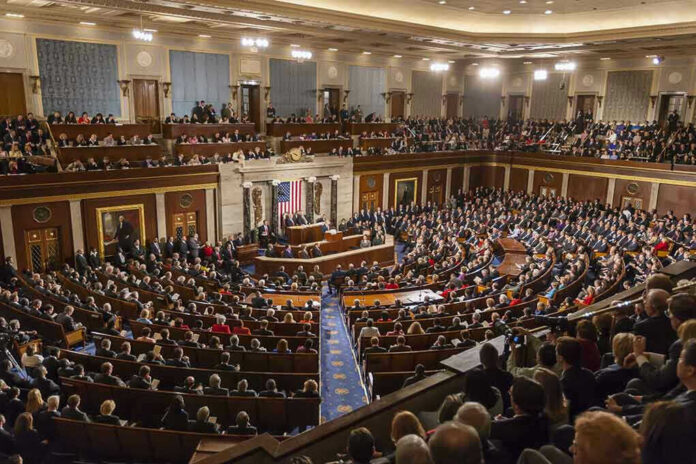
President Trump used a familiar SOTU trick: convert a complex issue into a simple physical gesture that reads clearly on television. He asked members to stand if they believed the U.S. government should prioritize American citizens over illegal immigrants. Republicans rose and cheered. Most Democrats remained seated. Trump didn’t let the image speak for itself; he narrated it, scolding the holdouts and locking the moment into viewers’ memory as a moral contrast, not a policy debate.
That live commentary matters because it strips Democrats of their usual escape hatch: “We were reacting to a specific line, not the principle.” When the president frames the gesture as “Americans first,” every seated lawmaker becomes a character in his story. For voters over 40 who still expect basic patriotic symbolism in public life, the message is blunt. The burden immediately shifts to Democrats to explain why they didn’t stand for the prompt as stated.
Schumer’s CNN defense: pivot from optics to an indictment of ICE
Schumer’s defense on CNN tried to move the conversation from the question to the enforcement machinery behind it. He argued that Trump’s immigration approach and ICE practices fail to protect Americans and instead harm them, citing alleged abuses and even claiming that ICE actions in Minnesota resulted in two Americans being killed. He cast Democrats’ refusal to stand as “legitimate and right,” essentially saying the applause line itself was the trap.
Schumer’s problem wasn’t that he criticized ICE; oversight of federal power is legitimate in any serious republic. His problem was the mismatch between what the camera captured and what he asked viewers to consider afterward. The public saw a yes-or-no prompt about prioritizing citizens. Schumer offered a broader critique of enforcement culture, due process, and agency conduct. If his Minnesota claim lacks immediate verification in the public’s mind, the defense starts to sound like a lawyerly dodge.
Why Trump set the trap, and why Democrats walked into it
SOTU applause lines have become a partisan weapon because they generate instant “proof” of values: stand for this, clap for that, stay seated for the other. Immigration is especially ripe for this because it blends safety, sovereignty, and fairness—issues that feel personal even when details are fuzzy. Trump’s line also works because it sounds like common sense. Most Americans believe a government should prioritize citizens, even while arguing about what humane enforcement requires.
Democrats likely calculated that standing would validate Trump’s broader narrative: “open borders,” sanctuary policies, and a permissive attitude toward illegal immigration. In modern politics, refusing symbolic participation is a way to deny the other side a victory lap. That tactic can work when the symbolism is niche. It fails when the symbolism maps onto a core civic instinct. The older the audience, the more the gesture looks like contempt for the very idea of national preference.
The conservative common-sense lens: citizens first, enforcement accountable
American conservative values can hold two truths at once: the nation has a right to control its border, and federal agencies must be accountable when they overreach. “Citizens first” isn’t a taunt; it’s the basic job description of a constitutional government. If Schumer wanted a stronger case, he needed to separate principle from implementation: stand for prioritizing Americans, then argue for reforms, transparency, and consequences for misconduct inside ICE.
Instead, his approach effectively fused the principle with the agency, making it sound like the only way to oppose alleged ICE abuses is to reject the prioritization prompt itself. That’s politically risky and logically unnecessary. Voters hear “prioritize Americans” and think about wages, schools, fentanyl, crime, and national cohesion. They don’t start with agency process arguments. When politics ignores that ordering of concerns, it usually loses the room.
What this clip does next: midterm ammunition, not legislation
No major policy action flowed from the moment because it wasn’t designed to produce legislation. It was designed to produce footage. Republicans immediately treated the image as a campaign asset, with allies calling it historic and framing Democrats as siding with “foreign” interests. Democrats, in turn, tried to reframe the moment as resistance to reckless enforcement and fear-driven rhetoric. The polling context makes the strategy obvious: immigration remains potent even when approval of Trump’s handling sits around 40%.
The deeper lesson is about political communication in the age of short attention spans: symbolism is policy for many voters, especially when institutions feel distant and outcomes feel insecure. Democrats can oppose Trump’s tactics, but they can’t afford to look allergic to the concept of national preference. If Schumer wants to win persuadables, he needs cleaner distinctions and verifiable claims. Otherwise, the clip keeps playing, and the explanation keeps losing.
Chuck Schumer Steps in It When Asked About the Refusal to Stand for Americans During the SOTU https://t.co/jwyJPMndFh
— Marlon East Of The Pecos (@Darksideleader2) February 26, 2026
Expect this moment to reappear in attack ads, town halls, and debate zingers because it compresses immigration into a single image: one side standing, the other side not. The only effective counter isn’t outrage; it’s a better, clearer story that starts where most Americans start: protect the country, prioritize citizens, enforce the law, and punish any agency that violates rights while doing it.
Sources:
Schumer defends Democrats who refused to stand during Trump State of the Union