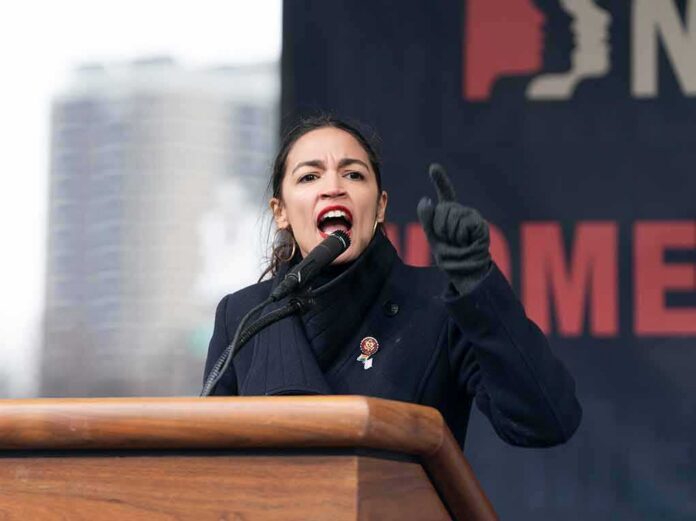
Alexandria Ocasio-Cortez has a rare political problem: the people who built her brand now accuse her of only sparring with critics who already agree with her.
Story Snapshot
- AOC faces intra-left heat as activists and commentators question her willingness to take tough criticism from her own side.
- Reports describe her trying to rebuild relationships with far-left groups while also keeping a foothold with mainstream Democrats.
- Her Munich Security Conference remarks triggered a fresh wave of liberal criticism focused on preparedness and messaging discipline.
- The larger story isn’t one comment or one clip; it’s a long-running fight over whether progressive “purity tests” destroy coalitions.
The “friendly critics” charge is really about control of the microphone
The headline accusation that AOC only engages “100% friendly” critics lands because it fits a familiar pattern in modern politics: leaders curate their audiences, then call the backlash “unfair” when they step outside the bubble. The closest reporting around this episode paints a broader picture of left-on-left disappointment, with AOC described as frustrated that her own coalition never seems satisfied, even when she shifts positions to appease them.
That dynamic matters more than the insult “weak.” Public figures survive name-calling; they struggle when their base starts questioning courage and authenticity. For voters over 40, this feels like a rerun of older political movements that ate their young: the activist class wants a tribune, not a negotiator, but Congress rewards dealmakers. AOC sits in the tension point, where performance and governing collide.
From insurgent hero to institutional player: the price of growing up in Congress
AOC’s rise after her 2018 upset win turned her into a symbol bigger than a House seat: Green New Deal ambition, Medicare for All energy, and the sense that a new generation could outfight the party machine. The same movement that celebrated that insurgency also set the trap. When a politician becomes a vessel for hopes, every compromise looks like betrayal. That’s not unique to her; it’s a structural problem for any “movement candidate.”
Her critics on the left often interpret pragmatism as “class collaboration” or careerism, while defenders argue she’s learning the constraints of power and choosing battles. Conservatives can recognize the underlying math: you can’t pass big policy with slogans alone. The country runs on institutions, budgets, and votes counted one at a time. The left’s internal demand for ideological purity can feel less like principle and more like a power contest over who gets to define “real” progressivism.
Israel, Gaza, and the purity-test machine that never shuts off
Israel policy has become a high-voltage litmus test inside the Democratic coalition, and AOC has taken heat for perceived softness at different points. Reporting describes her moving to shore up support with far-left activists while navigating the reality that Congress funds allies and weapons systems through messy, must-pass vehicles. The result is permanent suspicion: vote one way, you’re accused of selling out; vote the other, you’re accused of opportunism.
Common sense says elected officials should listen to constituents and still keep America’s interests front and center. The conservative critique of the progressive ecosystem is that it often incentivizes outrage over results. When activists demand maximalist gestures, they get headlines but risk strategic loss. AOC appears to be trying to avoid being trapped on either side of that equation, and that balancing act is exactly what makes her an inviting target for intra-left media scolding.
Munich was a stress test: foreign policy exposes what slogans can’t cover
AOC’s Munich Security Conference moment drew pointed criticism from liberal commentators who framed her remarks as sloppy and damaging. Foreign policy is where rhetorical shortcuts go to die. Audiences outside U.S. domestic politics tend to punish vagueness, conspiracy-flavored language, and moral grandstanding without operational detail. Critics highlighted that the stakes in that arena are higher than a viral clip: allies listen, adversaries listen, and the press translates everything into reputational cost.
Her defenders can argue she speaks to moral urgency; her critics counter that she sounded unprepared for a global stage. Conservative readers may not agree with her worldview, but the lesson travels: seriousness shows in precision. Voters can tolerate ideological difference; they recoil at the impression of amateur hour when the topic is war, alliances, and deterrence. That’s why the Munich backlash didn’t stay confined to the right.
What the left is really fighting over: coalition-building versus permanent revolution
This story works because it’s not only about AOC. It’s about whether the modern left can function as a governing coalition or only as a protest brand. The “friendly critics” jab is a proxy for a deeper resentment: some activists believe elected progressives rise by movement energy, then protect their careers by refusing real internal accountability. Others believe constant internal firing squads are the fastest way to hand power to political opponents.
From a conservative values lens, the impulse to silence unfriendly voices looks like elitism dressed up as activism. Free debate, even within a party, should be a feature, not a bug. If AOC truly limits herself to safe critics, she weakens her own case for leadership. If her critics demand purity that no politician can maintain, they confirm the suspicion that the movement prefers moral posturing over governing adults.
AOC sure is gaining a lot of weight. Is she pregnant ?
Left-wing host blasts AOC as 'weak,' says she only engages critics who are 100% friendlyhttps://t.co/0s93aAB23p— Birdman59 (@Lessweforget57) April 17, 2026
The next chapter is predictable and still compelling: AOC will likely keep trying to satisfy two masters, the activist left and the party institution, while commentators keep scoring points off every misstep. The real question is whether she learns to take hostile questions without flinching, because that’s what presidents do, or whether the progressive brand keeps rewarding safe rooms and curated applause.
Sources:
ocasio-cortez-deserves-support-and-solidarity-not-one-sided-criticism-from-the-left
aocs-munich-stumbles-draw-criticism-from-liberal-critics-admitting-comments-were-not-great
ocasio-cortez-seeks-shore-support-democratic-far-left-amid-internal-party-criticism-596560