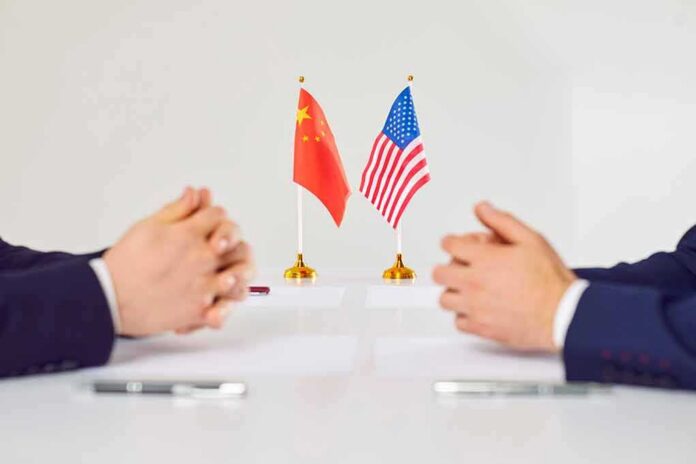
Two men walked toward an ancient Beijing temple, but it was the armed American at their shoulder who turned a photo-op into a thirty‑minute test of power.
Story Snapshot
- Chinese guards blocked top U.S. officials and an armed Secret Service agent during the 2026 Trump‑Xi summit.[1][3][4]
- Badge rules and gun bans at the Temple of Heaven triggered a prolonged, heated standoff.[1][3]
- The dispute exposed how clashing security cultures become geopolitical leverage, not mere logistics.[1][3][4]
- Recurring frictions show a larger pattern: Beijing uses protocol to control optics; Washington insists on protection and press freedom.[1][3][4]
How A Badge And A Gun Jammed A Global Summit
Treasury Secretary Scott Bessent did not get stopped over policy, Iran, or Taiwan; he got stopped at the door.[1][3] Chinese security at the Great Hall of the People physically barred him, insisting he needed the correct summit badge before entering.[1][3][4] Cameras captured the moment that reduced a cabinet‑level official to a man waiting on a plastic credential. For Beijing, it looked like standard procedure. For many Americans, it looked like a host using “rules” to humble a guest.
Later, the real showdown shifted from a marble hall of power to the wooden serenity of the Temple of Heaven. As the U.S. press pool tried to follow Donald Trump and Xi Jinping, Chinese security insisted that an accompanying Secret Service agent could not enter with a firearm.[1][3][4] A gun on an American agent is normal; a gun in a Beijing religious complex is not. The clash over which norm prevailed froze everyone outside the gate for close to half an hour.[1][3][5]
The Temple Of Heaven Standoff And Its Unspoken Message
Reporters on the ground described an “intense” back‑and‑forth as U.S. officials argued the agent’s weapon was non‑negotiable while Chinese guards held the line on their no‑guns rule at the temple.[1][3][5] The press pool, already corralled and tightly managed all day, stood in limbo while the two sides negotiated.[1][3][5] Eventually, the compromise came: a different Secret Service officer, pre‑cleared by Chinese security, escorted reporters inside while the original armed agent stayed behind.[3][5]
From a purely technical angle, Chinese authorities can argue they enforced their domestic gun laws at a religious and historic site. From a common‑sense American conservative view, the president’s protective detail and access for the free press are not optional add‑ons; they are core to how the United States conducts itself abroad. When a foreign power can dictate which armed American stands closest and which reporters move where, it brushes up against sovereignty and basic respect for a visiting head of state.
Pattern Or One‑Off? This Has Happened Before
Reporters traveling with Trump noted multiple confrontations across the visit, not just at the temple.[4][5] Chinese officials tried to stop American journalists and staff from leaving fixed positions to join the presidential motorcade, and American media complained about confinement, bathroom restrictions, and even confiscated water bottles during long events in warm weather.[4][5] None of this was random chaos. Beijing had turned the capital into a fortress for the summit, and that fortress mentality extended to the guests’ movements and optics.[2][4][5]
‘Intense standoff’ erupts between Secret Service, Chinese officials during Trump-Xi event: reporthttps://t.co/F5R5nlv55n
— Scott Stewart (@sestewart44) May 14, 2026
Prior Trump‑era trips to China also saw scuffles over the “nuclear football” briefcase and security positioning near leaders, which U.S. agencies later downplayed.[1][4] The repetition matters. When the same categories of friction keep resurfacing—guns, credentials, media access—it suggests not a misunderstanding but a contest. Beijing prioritizes absolute control of its spaces and images. Washington insists its president travels with armed guardians and independent cameras. Those values do not reconcile neatly, so the fight shifts to hallways and temple gates.
What The Standoff Reveals About Power, Pride, And Boundaries
These incidents did not derail the summit; Trump and Xi still talked about Iran, trade, energy, fentanyl, and Taiwan.[1][4][5] Yet the standoff scenes became part of the public story because they were visible, concrete expressions of a deeper struggle. China used procedures to remind everyone whose turf it was. The United States pushed back to show that its security posture and press freedoms travel with the president. Neither side could yield without signaling weakness to its own audience.
For American readers who care about national strength, the lesson is not that U.S. agents should storm foreign doors. The lesson is that details decide dignity. A plastic badge, a holstered weapon, or a blocked camera can say more than a joint statement. Every time Washington accepts tighter foreign control over its delegation and media, it nudges the baseline a little closer to Beijing’s comfort zone and a little farther from traditional American expectations of openness and assertive self‑protection.
Sources:
[1] YouTube – Huge Embarrassment for Trump As Xi’s Security Stops US Officials …
[2] YouTube – Trump China Visit 2026: BEIJING LOCKS DOWN! Security Beefed …
[3] Web – Huge embarrassment for Trump as Xi’s security stops US officials …
[4] Web – ‘Xi said China won’t send military help to Iran,’ claims …
[5] Web – Trump arrives in Beijing for summit with China’s Xi on trade …