When a New Black Panther Party member showed up outside a Texas courthouse for a teen murder trial, the real fight was not only about one stabbing—but about who controls the story on race, crime, and justice in America.
Story Snapshot
- Supporters and critics packed the street outside the Karmelo Anthony murder trial, turning a stabbing case into a battle over race and self-defense[1][3].
- Chants, drums, and signs raised real free speech questions and real concerns about pressure on jurors walking into court[1].
- The New Black Panther Party’s presence let activists frame the trial as racial injustice, while critics saw it as raw intimidation.
- The clash shows how courthouse sidewalks now double as cable-news sets where public opinion can tilt faster than any jury.
How a High School Track Meet Became a National Flashpoint
Karmelo Anthony, a young Black man, stands accused of murdering 17-year-old Austin Metcalf during a track meet in Frisco, Texas[2][3]. Prosecutors say Anthony stabbed Metcalf, while the defense claims he acted in self-defense, a phrase that now appears on protest signs and in chants outside the courthouse. The case quickly drew national attention because it mixes race, teens, and deadly violence, the same ingredients that have fueled earlier culture-defining trials[1][3].
The jury selection alone lit the fuse. Local coverage confirmed more than 500 possible jurors were screened, but none of the final jurors are Black, despite the case being racially charged[2][3]. That fact became the rallying cry for supporters who see a young Black defendant facing judgment from a panel that does not share his background. From that moment, courthouse steps became a stage for claims that the system was already stacked against him[1][2].
Why Protesters Chose the Courthouse Steps
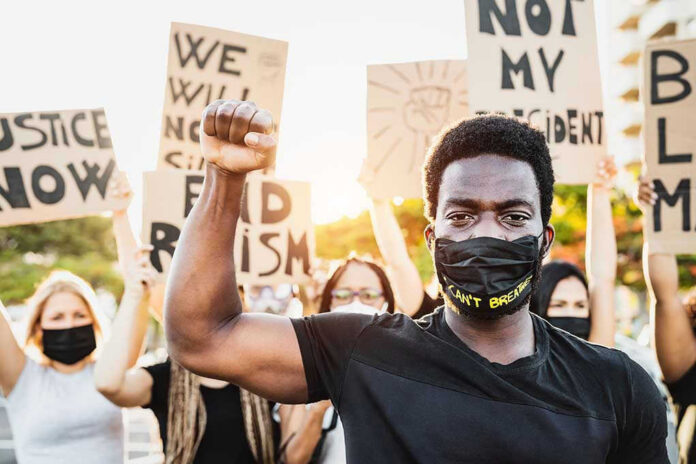
Supporters of Karmelo Anthony gathered outside the Collin County Courthouse in McKinney on the first day of jury selection, chanting “Karmelo is free” and other slogans[1]. Videos and reports show demonstrators waving signs, playing instruments, and repeating messages that match the defense theme that self-defense is not a crime[1]. Their timing was not random. They came when the jury was being picked and stayed as testimony unfolded, tying their protests directly to the legal process[1].
The New Black Panther Party’s presence fits that pattern. Members of the group, known for fiery racial politics, positioned themselves as guardians and advocates for Anthony on the courthouse grounds, not blocks away. Their stance sends a clear signal: this is not just a local murder trial; this is a racial justice fight. From a civil liberties view, they are using the same public sidewalk that every activist group uses. From a common-sense law-and-order view, standing “guard” at a courthouse looks a lot closer to pressure than simple support.
Free Speech, Jury Intimidation, and the Line in the Sand
Courthouse protests are legal speech, but they are not harmless background noise. Reporters noted that demonstrators from rival camps stood on opposite sides of the street, chanting at full volume while jurors entered and left the building[1][2]. Fox News raised concerns that activists wanted to “get in the jurors’ heads,” which echoes a wider fear: that street pressure will twist the outcome of a case that should rest only on evidence, not emotion[1]. That worry is not paranoid; it is basic trial integrity.
Members of the New Black Panther Party have gathered outside the Texas courthouse where Karmelo Anthony is on trial for the fatal stabbing of Austin Metcalf.
One question: Why?
A young man lost his life. His family is seeking justice. What purpose does turning a murder trial… pic.twitter.com/tUhl8Jc8Pg
— 🎹 Ames™ 🎹 (@Real_Ames) June 9, 2026
For conservatives who value both the First Amendment and the rule of law, this is the tension. On one side, citizens have the right to show up, speak out, and criticize a justice system they view as biased. On the other side, the community has a duty to protect jurors from real or perceived threats and to keep justice blind, not bullied. When masked or militant-branded groups frame their presence as “standing guard,” many Americans see that as crossing the line from protest to intimidation.
Race, Narrative Warfare, and What This Trial Really Represents
The Karmelo Anthony case plugs straight into the national script: a Black defendant, a white victim, a self-defense claim, and no Black jurors on the panel[2][3]. Activists outside the courthouse are not just arguing about one stabbing. They are fighting over which story will define this moment. One story says this is another example of the system targeting a young Black man. The other says this is a clear-cut murder case that must not be hijacked by racial politics[1][2].
Media outlets amplify those competing stories. Some frame the protests as a justified response to a racially charged jury and a way for a community to demand fairness[1][3]. Others highlight the noise, the threats to “get in jurors’ heads,” and the presence of groups like the New Black Panther Party as proof that activist mobs now hover over every high-profile case[1]. From a common-sense standpoint that many right-leaning Americans share, the more trials look like street referendums, the harder it is to trust any verdict, guilty or not guilty.
Sources:
[1] Web – New Black Panther Party members are now gathered outside the Texas …
[2] Web – Texas teen stabbing trial draws dueling protests during jury selection
[3] Web – Demonstrators clash outside Karmelo Anthony trial as opening …
© partiallypolitics.com 2026. All rights reserved.