A single chant—“Arrest Hegseth!”—turned Washington’s most glittery journalism party into a referendum on war, media access, and accountability.
Quick Take
- CODEPINK and allies protested outside the White House Correspondents’ Dinner, renaming it the “War Crimes Correspondents’ Dinner.”
- Protesters accused Secretary Pete Hegseth of responsibility for a U.S. strike on a school in Minab, Iran, and demanded his arrest.
- Live coverage showed protesters disrupting the red-carpet flow and being removed from the immediate arrival area.
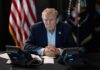
- President Trump’s attendance, framed as his first WHCD appearance as sitting president, heightened the symbolism and the temperature.
The red carpet became a pressure test for power and press
Protesters gathered outside the Washington Hilton as cameras and gowns funneled into the annual White House Correspondents’ Dinner, but they treated the scene as something darker than a media gala. CODEPINK billed it as a “War Crimes Correspondents’ Dinner,” aiming its sharpest message at Secretary Pete Hegseth and at the journalists and executives who share tables with the officials they cover. Chants and signs targeted arrivals and the optics of celebration.
The point wasn’t subtle: activists tried to force a question the dinner format almost never asks. Who pays when government force kills civilians, and who in the press corps insists on answers when the people in charge show up in tuxedos? Live scenes captured crowd noise colliding with the choreography of arrivals. Reports described protesters being removed from the red-carpet area, a familiar end to an unfamiliar accusation aimed directly at a named official.
Why Hegseth became the face of the protest, not just the war
CODEPINK’s campaign centered on an allegation with a specific place-name and a moral gut-punch: a U.S. bombing of a school in Minab, Iran, said to have killed nearly 200 children, mostly girls. Organizers tied that incident to Hegseth’s oversight and also to his refusal to answer congressional questions about it, using that silence as both proof-of-concept and fuel. Their demand for “arrest” functioned as indictment language, not a realistic expectation of handcuffs on-site.
Limited independently verified details circulated in the materials behind the protest compared with the certainty of the slogans, so readers should separate what’s claimed from what’s confirmed. The confirmed elements sit closer to the ground: a planned protest, a launched “Arrest Hegseth” campaign, and disruptive demonstrations outside the dinner. The disputed core claim—criminal liability for a specific strike—matters because it tests how quickly American politics turns moral outrage into legal conclusion without a public evidentiary process.
The dinner’s real story: access journalism meets its critics
The White House Correspondents’ Dinner began in 1921 as a press-and-politics get-together and has evolved into a television-friendly symbol of proximity: journalists, celebrities, and government officials in the same room, laughing at the same jokes, swapping the same small talk. Critics argue the event blurs the line between watchdog and courtier. Protesters exploited that tension by putting the charge of “complicity” on the curb where cameras had to see it.
That critique lands differently depending on your politics. A conservative, common-sense view can accept two truths at once: the press needs access to do its job, and the press also risks getting domesticated by access. The dinner is catnip for that second danger. When officials become social companions, hard questions tend to migrate to “later.” CODEPINK’s approach weaponized that cultural weakness: if journalists won’t interrogate power in the ballroom, activists will do it at the barricades.
Trump’s appearance raised the stakes, and the contradictions
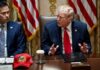
President Trump’s attendance amplified everything. Even supporters who enjoy seeing the press uncomfortable should recognize why protesters picked this night: a sitting president showing up at an event that symbolizes establishment détente makes the dinner an irresistible stage. Meanwhile, reports and commentary focused on which outlets hosted which officials at their tables, including figures seen by critics as central to the administration’s hardball approach to media and government power.
The predictable response from institutional Washington is to treat this as theater—noise outside, jokes inside, and everyone goes home. That dismissal misses why these protests keep returning. Americans over 40 have seen the cycle: war begins as policy, becomes background, then ends as a footnote with few careers harmed. The WHCD sits at the intersection of that cynicism and the public’s desire for accountability, which makes it a recurring target no matter who holds power.
What the removal of protesters really signals
Removal from the red carpet area reads like a security footnote, but it also signals the boundary line the system enforces. The dinner can absorb almost any controversy as long as it stays conversational and inside the room. The moment protest becomes physically proximate to the event’s glamour—audible, visible, interrupting—the system pushes it back. That doesn’t prove protesters right, but it does prove they found the nerve: the image-control perimeter.
CODEPINK’s longer game appears less about the dinner itself and more about forcing follow-up: press questions, congressional scrutiny, and public attention that outlasts one night’s broadcast. From a conservative standpoint, accountability should run through verifiable facts, not slogans, especially when accusations involve war crimes. Still, the media shouldn’t hide behind party lighting. If officials attend for normalcy, journalists owe viewers clarity on what’s alleged, what’s proven, and what remains unanswered.
The “Arrest Hegseth” moment will fade fast unless someone answers the open loop it created: when activists allege mass civilian deaths tied to a named decision chain, will the press pursue the paper trail with the same energy it covers the spectacle, or will it file the footage under “protest” and move on?
Sources:
Trump White House Correspondents’ Dinner live updates