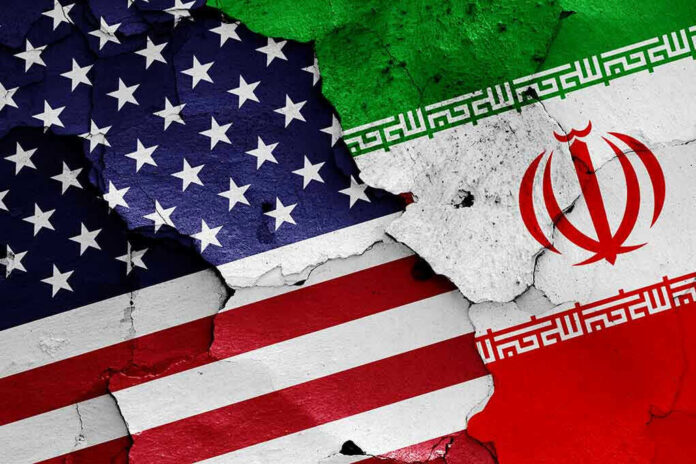
Six Vermont National Guard F-35 stealth fighters just slipped toward the Middle East with their home-state markings masked—an unmistakable signal that the Iran talks now have real teeth.
Quick Take
- Six F-35A jets from Vermont’s 158th Fighter Wing departed RAF Lakenheath on Feb. 11, 2026, heading toward the Middle East while obscuring “VT” tail markings.
- President Trump publicly tied the growing U.S. force buildup to whether Iran agrees to limits on its nuclear and ballistic missile programs.
- The Vermont unit includes a specialized suppression of enemy air defenses capability, a key tool for penetrating sophisticated Iranian air defenses.
- Officials have not confirmed the jets’ final destination, and CENTCOM declined to comment on their mission.
What the Vermont F-35 deployment tells Iran—and America
Six F-35A Lightning II fighters from the Vermont Air National Guard’s 158th Fighter Wing were tracked leaving RAF Lakenheath in the United Kingdom on Feb. 11, 2026, headed toward the Middle East. Observers reported the aircraft used callsigns “Tabor 41–46,” and their “VT” tail identifiers were obscured. U.S. Central Command declined to discuss the mission, and Vermont Guard public affairs did not provide details.
The timeline matters because it aligns with the Trump administration’s renewed push for direct negotiations backed by visible military leverage. President Trump told Axios that talks would resume “this week,” and he referenced an “armada” moving into position, adding that the U.S. would either make a deal or do “something very tough like last time.” On Feb. 11, Trump also met Israeli Prime Minister Benjamin Netanyahu at the White House as Iran remained the central topic.
Operational security: why the tail markings were covered
Masking unit identifiers is not a political stunt; it is a standard operational security practice when planners want to reduce public clarity about which specific units are moving and how many assets are in play. Reporting noted the Vermont jets’ markings were intentionally obscured as they transited from RAF Lakenheath, a long-used staging point for U.S. aircraft headed to forward locations. The choice also underscores that Washington is keeping mission details tight while the diplomatic clock runs.
Key unknowns remain. Public reporting and flight-data analysis suggested a likely destination could be an air base in Jordan, but no official confirmation has been provided. That uncertainty is not trivial: where the jets bed down affects sortie rates, tanker requirements, and the message to Tehran about how quickly the U.S. could act if negotiations fail. For now, what is confirmed is the direction of travel and the refusal of commanders to brief the public.
Why these jets matter: SEAD capability and layered strike power
Not all F-35 deployments carry the same meaning. The Vermont unit’s 134th Fighter Squadron has been described as having a suppression of enemy air defenses focus—exactly the kind of mission set required to neutralize advanced radar and missile networks. Aviation analysts noted that pairing stealth aircraft with electronic attack support in theater can create a potent package against sophisticated air defenses. In practical terms, that combination can open corridors for follow-on strikes and reduce risk to pilots.
The air movement is also only one slice of the broader buildup. Reporting indicated aerial refueling support from KC-135 Stratotankers out of Maine helped move the fighters across the Atlantic, and a second carrier strike group was ordered to prepare for deployment, though it would take weeks to arrive. That layered approach—land-based stealth fighters plus carrier aviation—gives U.S. planners more options, including sustained operations if deterrence fails.
Diplomacy backed by force: the Trump approach versus past drift
The administration’s public posture is blunt: the goal is to end Iran’s pursuit of weapons-grade nuclear capability and constrain ballistic missiles, with force presented as the alternative. That clarity is a sharp contrast to the era when Americans watched inflation, border chaos, and overseas weakness pile up while Washington talked endlessly. Here, the visible movement of high-end assets is the leverage, and negotiations are framed as the off-ramp—rather than an excuse to delay decisions.
A Fleet of Vermont National Guard F-35 Fighters Are Headed to Iran’s Backyardhttps://t.co/9o0FPEJS1F
— 19FortyFive (@19_forty_five) February 12, 2026
At the same time, the available reporting does not confirm a specific U.S. strike plan, timetable, or target set. The strongest verified facts are the aircraft movement, the operational security measures, and Trump’s on-the-record linkage between a deal and the possibility of “tough” action. That leaves Americans with a clear headline reality: deterrence is being rebuilt with capability, not slogans, and Iran is being asked to choose between verifiable limits or escalating pressure.
Sources:
A Fleet of Vermont National Guard F-35 Fighters Are Headed to Iran’s Backyard
Vermont National Guard’s F-35s may be headed to Middle East, reports say
The Vermont Guard Is Redeploying — Likely to the Middle East
VT ANG F-35s Depart LN For Middle East
F-35s Deploy to Middle East as US Talks With Iran
US deploys more F-35A stealth fighters toward the Middle East amid tensions with Iran
Second Carrier Strike Group Ordered To Spin Up For Deployment To Middle East: Report