
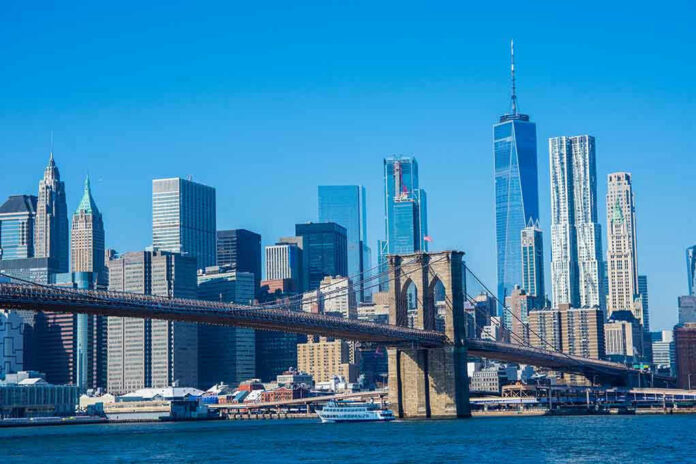
New York’s decision to illuminate One World Trade Center in green for Muslim American Heritage Month ignites a fierce controversy.
Story Overview
- Gov. Kathy Hochul declared January as Muslim American Heritage Month, leading to statewide landmark lightings.
- One World Trade Center’s lighting sparked backlash due to its association with the 9/11 attacks.
- Critics argue the gesture disrespects the victims of 9/11, while supporters cite it as a move towards inclusivity.
- The controversy highlights the ongoing tension between diversity recognition and historical sensitivities.
The Lighting Decision
On January 2, 2026, Governor Kathy Hochul announced a proclamation designating January as Muslim American Heritage Month in New York. This initiative included lighting 16 state landmarks, including the symbolic One World Trade Center, in green. The plan aimed to honor the significant contributions of Muslim Americans to the state’s cultural and professional landscape. However, the decision to include One World Trade Center, a site inextricably linked to the September 11 attacks, has stirred significant controversy.
Kathy Hochul Just Insulted the Memory of Those Killed on 9/11https://t.co/i8kgN4QCwQ
— gtslade (@gtslade) January 3, 2026
Critics, particularly from conservative circles, were quick to denounce the move. They argued that illuminating a site synonymous with the tragic events of 9/11 in green, a color associated with Islam, was tactless and disrespectful to the memory of the victims. The backlash began on social media and was amplified by conservative media outlets, framing the lighting as a politically insensitive act that overlooked the painful associations tied to the location.
Historical Context and Reactions
One World Trade Center stands on the World Trade Center site, where the 9/11 attacks by al Qaeda claimed nearly 3,000 lives. This historical backdrop makes any symbolic gestures at the site particularly sensitive. Despite the intent to celebrate diversity and inclusion, the timing and location choice have been perceived as disregarding the complex emotions surrounding 9/11. Prominent conservative figures, including Republican councilwoman Vickie Paladino, have publicly condemned the lighting as “disgusting.”
In contrast, some political and community leaders argue that the lighting represents a step towards healing and inclusivity. Mayor Zohran Mamdani, New York City’s first Muslim mayor, praised the initiative as a recognition of the resilience and contributions of Muslim Americans post-9/11. The debate underscores the broader societal challenge of balancing historical reverence with the recognition of a diverse populace.
Political and Social Implications
The controversy has not only reignited discussions about the intersection of politics and cultural recognition but also about the broader issues of Islamophobia and identity in America. Governor Hochul’s office insists the gesture was intended to affirm New York’s commitment to diversity and to combat rising Islamophobia. Nonetheless, the decision has inadvertently become a flashpoint in the cultural and political discourse.
Critics, including Representative Elise Stefanik, have used the incident to question the motives behind such gestures, suggesting potential foreign influences and drawing parallels with contentious political stances. The lighting at One World Trade Center, therefore, becomes more than a symbolic act; it is a catalyst for debates on interfaith relations, political correctness, and the legacy of 9/11.
Ongoing Controversy and Future Considerations
As of January 3, 2026, the debate continues to dominate conservative media and social platforms. There has been no official response from groups representing 9/11 victims, leaving a significant gap in the conversation. The lighting, while intended as a celebration of heritage, has instead highlighted the complex layers of memory and identity politics prevalent in today’s society.
Looking forward, this incident could have lasting implications for how cultural heritage months are observed, especially at sites of national tragedy. It raises questions about the appropriateness of certain symbols and gestures in contexts loaded with historical significance. As New York navigates the fallout, the state must grapple with the delicate balance of honoring its diverse communities while respecting the profound sensitivities tied to its history.