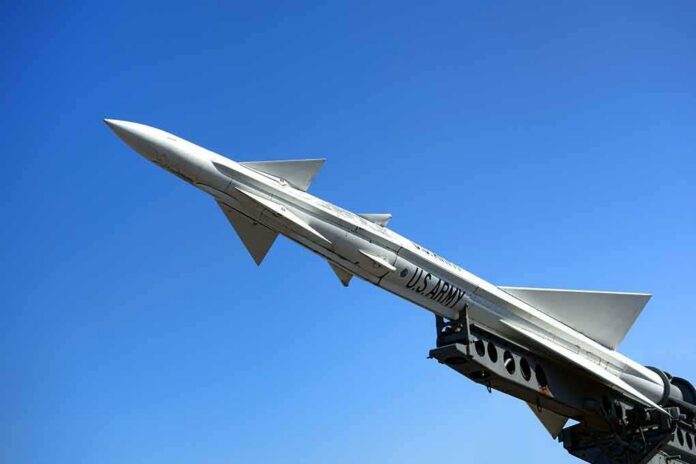
The Air Force has moved its first hypersonic missile, ARRW, from testing to production with a $694 million contract—quietly turning a near-canceled project into frontline strike power.
Story Snapshot
- The Air Force awarded Lockheed Martin $694 million to produce and field ARRW.
- The move formally shifts ARRW from prototyping and flight tests into production.
- ARRW is a boost-glide hypersonic weapon designed to fly faster than Mach 5.
- The Air Force says ARRW will hit defended, high-value targets from standoff ranges.
What The Contract Does, And Why It Matters
The Department of the Air Force announced a $694 million production-and-fielding contract to Lockheed Martin dated September 29, 2026, and revealed it publicly on October 26, 2026. The service framed this as the formal transition of the Air-launched Rapid Response Weapon, or ARRW, into production after years of development and tests. The production decision gives the Air Force its first hypersonic weapon pathway and signals intent to stock a real inventory rather than fly only prototypes.
The Air Force linked ARRW to missions that matter in a fight with a major power. Leaders said ARRW will enable high-speed strikes that can punch through advanced anti-access and area-denial systems and hit time-sensitive, high-value targets from safe ranges. That is the core promise of hypersonic weapons: speed and maneuver to compress an enemy’s response time and to avoid predictable paths. The service’s message is clear. Reach farther, hit faster, and make defenses guess wrong.
What ARRW Is Designed To Do
ARRW is an air-launched, rocket-boosted glide weapon. A bomber releases the missile, a solid rocket accelerates it to hypersonic speed, and a glide body then maneuvers at more than Mach 5 toward the target. This boost-glide profile trades a simple path for speed and agility. The Air Force has focused ARRW on hitting defended targets at long range so aircrews can fire from outside heavy air defenses. The concept aims to shrink strike timelines while raising the cost for any defender.
Production sits on years of testing and budget moves. ARRW flight testing began in 2019 and saw progress through 2022. Congress funded $362 million in fiscal 2026 procurement and the Air Force sought $452 million for fiscal 2027, signaling planned buys beyond this first award. Government watchdogs reported a mixed early test record, including a late-2022 success and a 2023 failure tied to shroud and heat-shield issues, followed by added tests to inform decisions. The production step follows that arc.
The Fine Print Officials Kept Close
The Air Force did not release how many missiles this award will buy, nor the delivery timeline, citing operational security. That choice shields unit costs and schedule from public view. The announcement came almost a month after the award date, which the public record does not explain beyond general security concerns. Budget friction also looms. Reporting at the time described the fiscal 2027 request as stalled under a continuing resolution, which can slow follow-on work. One brief caveat: a production award does not itself prove combat effectiveness.
The most curious twist is the program’s path. Roughly three years earlier, the Air Force had planned to end ARRW without a production buy, then reversed course and executed this contract. That pivot suggests leaders saw either better test outcomes, sharper need, or both. From a common-sense, conservative lens, this shift tracks with deterrence math. When rivals harden their defenses and sprint on hypersonics, you do not pause. You field what works now, improve it fast, and keep options open.
How This Changes The Strike Playbook
Hypersonic standoff turns lumbering bombers into first-hour tools again. A B-52 launching ARRW can stand far from threats and still reach urgent targets while fighters clear lanes or hold air patrols. That mix pressures an enemy to spread radars, waste interceptors, and defend everywhere at once. Even a modest ARRW inventory can reshape planning because defenses must assume any inbound may arrive too fast and from unexpected angles. That uncertainty is its own weapon.
🇺🇸 Lockheed Martin has been awarded a $694 million contract by the U.S. Department of the Air Force for the production and fielding of the AGM-183A Air-Launched Rapid Response Weapon (ARRW). @LockheedMartin @usairforce
The contract, awarded on Sept. 29, was executed under the… pic.twitter.com/VPA0Rfyh7m
— DefPost (@defpostmedia) October 27, 2026
Next steps will define impact. Integration with bomber fleets, training for aircrews, and logistics for storage and handling will turn a contract into a credible tool. Independent test reporting can validate reliability and terminal performance for those who care about proof, not promise. For now, the signal is unmistakable. The United States has moved a hypersonic air weapon into production. That choice buys time, buys reach, and buys leverage at the moment it is most needed.
Sources:
realcleardefense.com, airandspaceforces.com, twz.com, defence-blog.com, forbes.com
© partiallypolitics.com 2026. All rights reserved.