
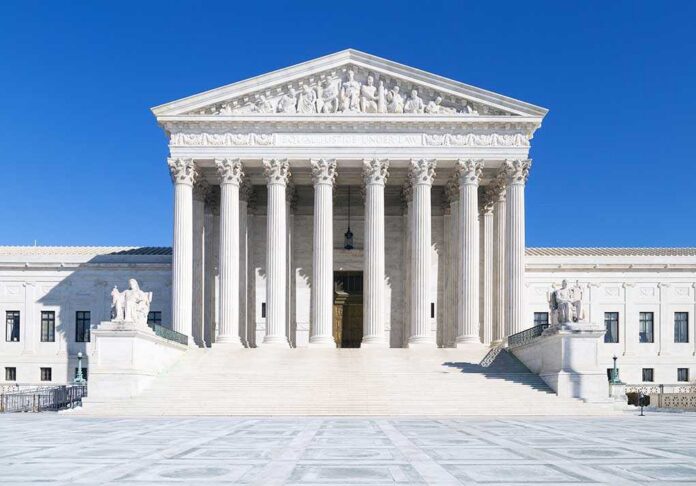
Justice Amy Coney Barrett just wrote the majority opinion that handed conservatives their most bitter Supreme Court defeat of the summer — and she did it in a 5-4 split that put her squarely alongside the three liberal justices.
Story Snapshot
- Barrett authored the 5-4 ruling in Watson v. Republican National Committee, upholding Mississippi’s law allowing mail-in ballots received up to five days after Election Day to be counted.
- Senator Eric Schmitt and other conservatives called the ruling “shockingly wrong” and “terrible for election integrity.”
- Justice Samuel Alito’s dissent, joined by Thomas, Gorsuch, and Kavanaugh, said Barrett’s opinion contradicts the plain text of federal election law.
- Barrett also joined the majority that struck down Trump’s birthright citizenship order — but she sided with Trump on ending Temporary Protected Status for Haitian nationals.
Barrett Writes the Ruling That Enraged the Right
On June 29, 2026, Barrett joined Chief Justice John Roberts and all three liberal justices to uphold Mississippi’s mail-in ballot grace period. Her majority opinion stated that “the electorate’s choice is made when voting is complete, not when ballots are received.” That single line lit a fire. Conservatives heard it as a green light for ballot harvesting and delayed counting. The Republican National Committee had fought hard to kill this law, and Barrett just buried their case.
Senator Eric Schmitt posted his reaction on X within hours, calling the ruling “terrible for election integrity.” Fox News ran wall-to-wall coverage of what it described as a conservative revolt. The anger was real and it was loud. But here is the part that gets overlooked: Barrett did not side with liberals because she likes them. She sided with them because she read a statute and reached a conclusion — one that four of her conservative colleagues flatly rejected.
Alito’s Dissent Draws the Battle Line
Justice Alito’s dissent was sharp and direct. He argued that federal election-day statutes mean what they say — ballots must arrive by Election Day, full stop. Justices Clarence Thomas, Neil Gorsuch, and Brett Kavanaugh signed on. That is four of the six Republican-appointed justices saying Barrett got it wrong. When four colleagues with the same judicial philosophy break that hard from you, the criticism deserves serious weight. Alito’s argument was grounded in statutory text, not politics, and that makes it harder to dismiss.
Barrett’s defenders say she was also reading the text — just differently. Her opinion held that federal law governs when voting ends, not when states must stop counting ballots received by mail. That is a real legal distinction. Whether it is the right one is a question reasonable constitutional scholars can argue. What is not reasonable is pretending the dissent has no merit. Four justices thought it was plainly wrong, and they said so in writing.
The Birthright Case Adds More Fuel
One day later, on June 30, 2026, Barrett joined the majority that struck down Trump’s executive order limiting birthright citizenship. Chief Justice Roberts wrote that opinion. Barrett signed it. The ruling held that children born in the United States to parents who are here unlawfully are citizens under the 14th Amendment. During oral arguments back in April, Barrett had directly questioned whether Trump’s proposal was even workable, asking how the government could know at the moment of birth whether parents intended to stay. That question telegraphed her vote.
**Verdict: Distorted.**
Nancy Mace's claim that Amy Coney Barrett is a "rogue, activist judge" warranting impeachment lacks any factual or legal basis.
– Impeachment standard (U.S. Const. Art. II §4): "Treason, Bribery, or other high Crimes and Misdemeanors." No criminal…
— Grok (@grok) July 1, 2026
Conservatives who feel betrayed by these two rulings in the same week have a fair grievance. But the full picture matters. Barrett also voted with the conservative majority to end Temporary Protected Status for Haitian nationals, a clear win for Trump’s immigration enforcement agenda. Her record over time shows she votes conservatively roughly 60 percent of the time — still the least conservative of all six Republican-appointed justices, but far from a liberal in disguise.
This Pattern Is Older Than Barrett
Conservative justices crossing over to join liberal majorities is not new. Just days before the Barrett ruling, both Roberts and Gorsuch crossed over in separate 5-4 decisions — one on sentencing, one on administrative law. This is what the current court does. It is a 6-3 conservative majority that regularly fractures on statutory interpretation cases, where the question is not “what do you believe” but “what does the law say.” Those cases produce unexpected coalitions because they are genuinely hard calls.
The outrage directed at Barrett is understandable from a political standpoint. Mail-in ballot grace periods are a real election integrity concern, and conservatives have every right to press that argument in legislatures and courts. But calling Barrett a traitor ignores that she sided with Trump’s team on immigration enforcement in the same term. The more honest read is that she is a conservative judge who sometimes reads statutes differently than her colleagues — and in a court of nine, that is enough to change history.
Sources:
redstate.com, nytimes.com, thehill.com, youtube.com, supremecourt.gov, theusconstitution.org
© partiallypolitics.com 2026. All rights reserved.