When a president weaponizes a government shutdown not just to win a negotiation, but to deliberately inflict maximum discomfort on political opponents and millions of Americans, the rules of Washington—and the livelihoods of 1.6 million workers—are rewritten overnight.
Story Highlights
- The shutdown is the third under Trump, marked by explicit threats of mass federal layoffs tied to political negotiations.
- Nearly 1.6 million federal workers are caught between furloughs and unpaid labor as both parties blame each other for the impasse.
- Trump’s strategy is to heighten pressure on Democrats by amplifying public pain and threatening workforce reductions if concessions are not made.
- The shutdown deepens partisan divides, disrupts key public services, and risks eroding faith in government itself.
Trump’s Calculated Maneuver: Shutdown as Political Weapon
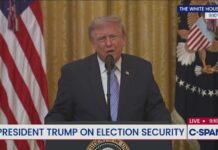
October 1, 2025, marked more than just another fiscal standoff—it signaled a new phase in the national power struggle. President Donald Trump, emboldened by a Republican-controlled House and a divided Senate, refused to back down after failed negotiations with Democratic leaders Chuck Schumer and Hakeem Jeffries. The White House’s move was not just about budgets; it was about leverage. By allowing appropriations to expire, Trump put nearly 1.6 million federal workers in the crosshairs and made no secret of his intent to use the crisis as a tool. The administration’s stated plan: force Democrats to the table by maximizing the visible pain, from shuttered offices to empty paychecks, and lay the groundwork for sweeping federal layoffs if opposition persisted.
Vice President JD Vance’s public statements left little ambiguity—Democrats, he argued, were to blame for the impasse, and layoffs were “imminent” unless their “unserious” demands were abandoned. The message to federal employees was chillingly clear: job security depended on the political fortunes of their leaders, not the value of their work. For Trump loyalists, this hardball approach embodied fiscal discipline and government reform. For critics, it crossed a Rubicon, weaponizing livelihoods and essential services for political theater.
A Nation Stalled: Workers and Services in the Crossfire
Nearly 900,000 federal employees found themselves furloughed, while another 700,000 reported to work without pay. Essential services, from Medicare processing to airport security, limped along, but the ripple effects radiated outward. NIH research was paused, CDC operations crippled, and social programs from WIC to food inspections slowed or stopped. In towns anchored by federal salaries, local businesses braced for a cascading loss of income. The Trump administration’s explicit messaging—that layoffs could become permanent—amplified anxiety not just in Washington, but in communities nationwide. The shutdown’s engineered hardship was no accident; it was the pressure point in a ruthless negotiation, with American families as collateral.
Democrats, led by Schumer and Jeffries, accused Trump of manufacturing a crisis, using federal workers as pawns to extract policy concessions. Meanwhile, Republicans asserted that fiscal responsibility—and the curtailing of a “bloated” federal workforce—was long overdue. The stalemate hardened, with no continuing resolution or appropriations bill in sight, and the only certainty was mounting uncertainty.
The Broader Stakes: Precedent, Politics, and Public Trust
This was not Trump’s first shutdown rodeo. The 2018–2019 shutdown, the longest in U.S. history, provided a playbook for using government paralysis as leverage. But the 2025 showdown broke new ground in its explicit embrace of layoffs as a negotiating tactic. The administration’s willingness to let the pain linger—both economic and psychological—signaled a shift from brinkmanship to calculated attrition.
Policy analysts and economists sounded alarms: repeated shutdowns erode not just immediate services, but the very foundations of public trust and government effectiveness. In high-federal-employment regions, the economic drag threatened to outlast the shutdown itself. Political scientists noted the escalation—a shutdown no longer just a bargaining chip, but a weaponized threat, with civil servants and the American public as hostages in a zero-sum contest. Some conservative commentators applauded the hard line as necessary discipline; others warned of a dangerous precedent that could haunt future administrations, regardless of party.
The Road Ahead: Uncertainty, Consequences, and a Nation on Edge
With Congress deadlocked and the White House unmoved, the shutdown’s endgame remains shrouded in unpredictability. Federal agencies execute contingency plans, but the specter of permanent layoffs hangs over every paycheck missed and every office darkened. The political blame game intensifies, but the costs are tangible and growing. For millions of Americans, the question is no longer when government will reopen, but what will be left when it does—and whether public service can ever mean the same again.
As the days tick by and the standoff deepens, one truth emerges: when political brinkmanship becomes policy, the stakes are measured not in headlines, but in lives disrupted and trust dismantled. The shutdown will be remembered not just for its scale, but for its strategy—a test of how far leaders will go, and how much a democracy can withstand.
Sources:
Wikipedia: 2025 United States federal government shutdown
White House: Government Shutdown Clock
Holland & Knight: Government Shutdown Advisory
SRCD: US Government Shutdown 2025 General Information and Resources