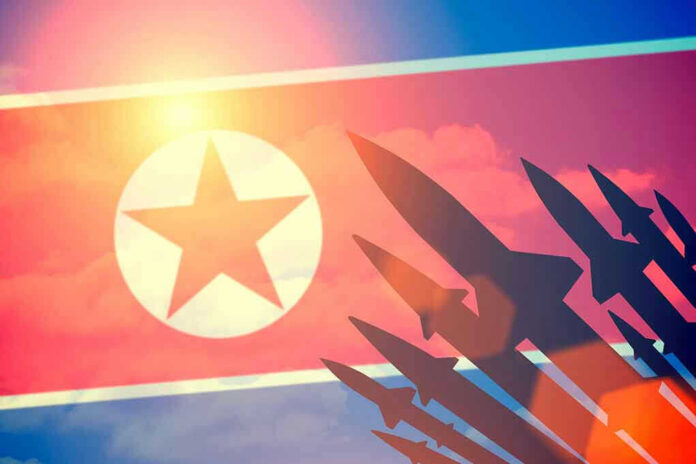
North Korea’s hypersonic missile tests signal a dramatic shift in global military dynamics, challenging the geopolitical status quo.
Story Overview
- North Korea’s hypersonic missile advancements mark a technological leap beyond traditional ballistic systems.
- Tests coincide with aggressive rhetoric about nuclear readiness, heightening global tensions.
- Regional security dynamics for Japan, South Korea, and the U.S. are significantly impacted.
- North Korea’s actions pose challenges to existing non-proliferation and defense strategies.
North Korea’s Technological Leap
The recent hypersonic missile tests by North Korea represent a significant advancement in missile technology, far surpassing the capabilities of traditional ballistic systems. These tests are part of an ongoing program that began in early 2022, with the most recent occurring on January 6, 2025. This program showcases North Korea’s ability to integrate hypersonic glide vehicles with intermediate-range platforms like the Hwasong-16, highlighting a focus on technological sophistication.
These developments are not merely technical; they also carry profound political implications. By demonstrating these capabilities, North Korea is sending a clear message to its regional neighbors and the international community about its military prowess and readiness. The implications of such advancements are far-reaching, affecting regional security dynamics and compelling neighboring countries to reassess their defense strategies.
Geopolitical Ramifications
North Korea’s missile tests are not isolated events but rather part of a broader strategy to assert its military capabilities on the global stage. The tests have triggered immediate responses from Japan and South Korea, including evacuation warnings and heightened military alertness. These countries, along with the United States, face the challenge of adapting their defense postures to counter the new threat posed by hypersonic technology.
The timing of these tests, often coinciding with U.S.-South Korean military exercises, suggests a calculated strategy by North Korea to provoke and test the resolve of its adversaries. Such maneuvers are not new, but the inclusion of hypersonic technology adds a new dimension to the threat, complicating regional defense planning and creating uncertainty in the strategic balance of power.
Technological and Strategic Challenges
The integration of hypersonic glide vehicles into North Korea’s missile arsenal presents significant challenges to existing missile defense systems. These vehicles are designed to evade traditional missile tracking and interception technologies, making them a formidable addition to North Korea’s military capabilities. The transition from liquid-fueled to solid-fueled ICBMs further enhances the speed and readiness of these systems, reducing launch preparation times and increasing their tactical flexibility.
While North Korean state media often exaggerates the performance of its missile systems, the consistent pattern of testing and development suggests genuine progress in enhancing its military capabilities. The international community, particularly the U.S. and its allies, must contend with the strategic implications of these advancements, which may necessitate a reevaluation of current defense and diplomatic strategies.
Future Outlook and Implications
As North Korea continues to develop its hypersonic missile capabilities, the potential for an arms race in the region becomes more pronounced. Countries like Japan and South Korea may feel compelled to enhance their own military capabilities in response, leading to an escalation of tensions and increased defense spending. The risk of proliferation also looms large, as North Korea’s technological advancements could be shared with other actors, further destabilizing global security.
The ongoing development of hypersonic technology by North Korea underscores the limitations of current non-proliferation efforts. Despite international sanctions and diplomatic pressure, North Korea has continued to advance its military capabilities, posing a significant challenge to the international community. As the world grapples with these developments, the need for innovative and effective strategies to address the evolving threat landscape becomes increasingly critical.
Sources:
Wikipedia – North Korean Missile Tests
Time – North Korea Ballistic Missile Tests 2023
Arms Control Center – North Korea Missile Test Activity
Army Recognition – North Korea Advances Hwasong-16B