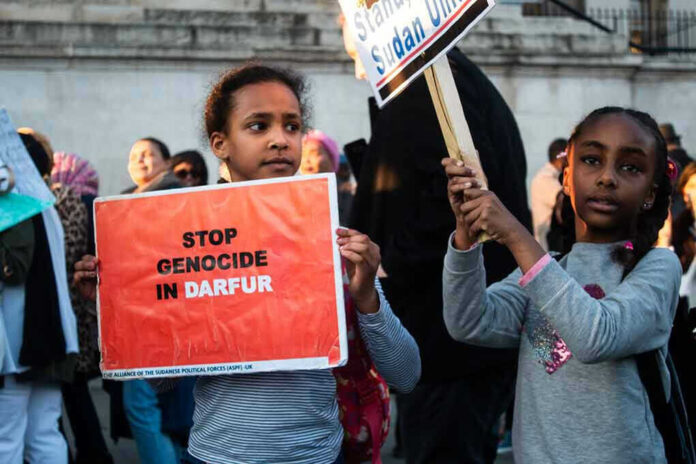
Imagine being surrounded by gunfire, cut off from the world, with no food, no water, and nowhere to run—a city of a quarter-million souls, waiting for rescue that never comes.
Story Snapshot
- El Fasher, once a beacon of hope in Darfur, has fallen to the Rapid Support Forces after a brutal siege, trapping over 260,000 civilians.
- Mass atrocities—executions, rape, starvation—are reported as humanitarian agencies are blocked from entering the city.
- Only a tiny fraction of residents have escaped, with most facing disease, hunger, and escalating violence.
- The world is watching a catastrophic echo of past genocide unfold, as international intervention remains absent.
The Fall of El Fasher: When Safety Becomes a Mirage
El Fasher, the capital of North Darfur, now stands as a grim symbol of Sudan’s unraveling. The Rapid Support Forces (RSF), infamous for their roots in the Janjaweed militias, completed a 500-day siege by overrunning the city in October 2025. Once a hub for humanitarian relief and a locus of resistance, El Fasher’s streets have emptied as violence and chaos consume its neighborhoods. For more than 260,000 civilians still inside, daily life is reduced to a desperate search for food, water, and any hope of survival.
For those who try to flee, the risks are deadly. Escape routes are choked with checkpoints, gunfire, and the ever-present threat of execution. Of the hundreds of thousands at risk, only a few thousand have made it to Tawila, a town now overwhelmed with traumatized arrivals. Humanitarian organizations report seeing the wounds of war etched into every new face: children weakened by hunger, mothers missing family members, elders haunted by what they witnessed. The rest remain trapped in a city transformed into what one aid worker calls a “hellscape.”
A Humanitarian System Pushed Beyond Its Limits
As the siege tightened, the RSF cut off humanitarian access, leaving hospitals without supplies and neighborhoods without basic necessities. The World Health Organization has condemned the killings of patients and civilians, warning of catastrophic health consequences. Cholera and malnutrition now spread unchecked, compounding the misery of those unable to flee. The International Rescue Committee describes the situation as unprecedented—even by Darfur’s tragic standards—while the United Nations has called this a “failure of protection” on the world’s watch.
International organizations, from the UN to the WHO, issue urgent pleas for safe passage and humanitarian corridors. Their warnings are clear: the longer El Fasher remains sealed off, the higher the body count will climb. Yet, insecurity and political paralysis leave these agencies with little more than words, as their convoys are turned away at the city’s edge. The collapse of local economies and services is total; markets are shuttered, health workers are gone, and entire neighborhoods are silent except for the distant crackle of gunfire.
Echoes of Darfur’s Past, Warnings for Its Future
Veteran observers see chilling parallels between El Fasher today and the Darfur genocide of the early 2000s. Mass executions, targeted ethnic violence, and starvation were the hallmarks of a crisis that drew global outrage—and International Criminal Court indictments. Now, as the RSF consolidates control, analysts warn that history is repeating itself under a cloud of international apathy. The United Nations Security Council has debated, but done little. Regional neighbors, already burdened by refugees, brace for an even greater exodus as famine and violence spread.
The humanitarian sector faces unprecedented challenges. The health system has collapsed under the weight of disease outbreaks, with malnutrition and cholera threatening thousands more. Aid groups struggle to document abuses, provide relief, and advocate for protection—often risking their own lives in the process. The trauma experienced by survivors, especially children, will shape Darfur for generations. The absence of international intervention not only deepens the crisis in El Fasher but also signals to other warlords and militias that impunity reigns in Sudan.
When the World Fails to Intervene
Sudan’s elites continue their power struggle, while ordinary people pay the price. The RSF, emboldened by its military dominance, exploits resources and crushes opposition. The Sudanese Armed Forces, once the city’s defenders, have largely retreated. Civilians are caught in the crossfire, their survival a daily gamble against starvation, disease, and violence. International experts, from the WHO to the IRC, agree on the scale and severity of the crisis—even as the world’s attention drifts elsewhere.
El Fasher’s fall is more than a tragedy for Sudan; it is a warning to the world. The echoes of Darfur’s past demand urgent action, but as of today, rescue remains a distant hope. The city’s fate hangs in the balance, a cruel testament to the consequences of indifference.
Sources:
World Health Organization (WHO)
International Rescue Committee (IRC)
United Nations (UN) Human Rights