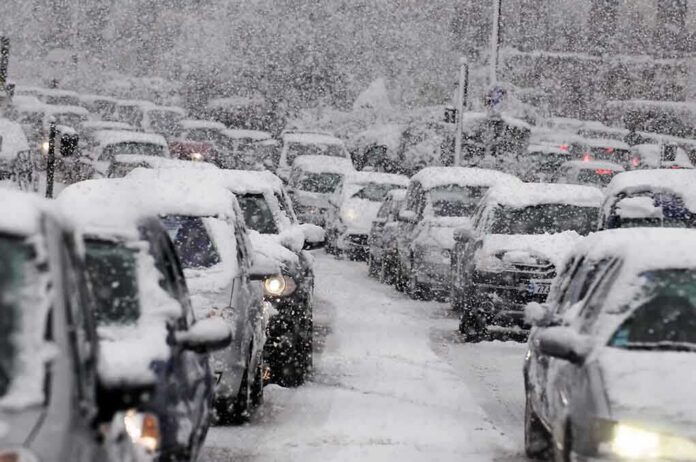
A single winter storm has triggered emergency declarations across eighteen states, grounded over eight thousand flights, and put more than one hundred eighty million Americans directly in the path of a catastrophic mix of ice, snow, and bone-chilling cold that meteorologists are calling historic in both scope and severity.
Story Snapshot
- Over 180 million people from New Mexico to Maine face dangerous winter conditions with 18 states declaring emergencies
- More than 8,300 flights canceled through the weekend, along with dozens of Amtrak trains, paralyzing travel nationwide
- The Deep South braces for up to two inches of ice while the Northeast expects up to 25 inches of snow
- Wind chills plummeting to minus 29 degrees Fahrenheit in upstate New York with dangerous cold lingering through Monday
- President Trump confirmed FEMA fully prepared as governors activate National Guard units and emergency operations centers
A Storm Born in the Pacific Becomes a Continental Menace
The weather system that would become Winter Storm Fern originated on January 22 in the Pacific Ocean, transforming into a continental juggernaut within forty-eight hours. By late January 23, snow, sleet, and freezing rain descended upon Oklahoma, Texas, and Arkansas. The National Weather Service issued warnings spanning nearly two thousand miles, an unprecedented alert footprint that underscores the storm’s exceptional reach. Governors began activating resources as early as January 18 in Louisiana, a full five days before the first flakes fell, signaling early recognition of the threat’s magnitude.
The South Faces an Ice Apocalypse
Texas Governor Greg Abbott issued blunt guidance to residents: stay home if possible. The directive reflects hard lessons from the 2021 freeze that crippled the state’s power grid and claimed hundreds of lives. This storm carries a similar ice threat, with forecasts calling for one to two inches of ice accumulation across Texas, Arkansas, Louisiana, Mississippi, Tennessee, Alabama, Georgia, and the Carolinas. Ice of that thickness snaps power lines, collapses tree limbs, and transforms roadways into skating rinks. Pretreated roads offer limited defense against such accumulations, and power outages lasting days remain a realistic concern in the hardest-hit areas.
The Deep South’s vulnerability stems from infrastructure designed for heat, not ice. Homes lack the insulation common in northern climates. Road crews possess fewer snowplows and salt trucks. Residents have minimal experience navigating icy conditions. When freezing rain strikes regions unaccustomed to winter weather, the disruption multiplies exponentially. Louisiana reported ice forming in gardens by the morning of January 24, a visual marker of conditions deteriorating in real time as the storm marched eastward.
Snow Buries the Heartland and Northeast
While the South grapples with ice, the Midwest and Northeast brace for prodigious snowfall. Hays, Kansas recorded six inches by the morning of January 24, with Norman, Oklahoma receiving three inches. Forecasters predict accumulations reaching twenty-five inches across swaths of Oklahoma, Arkansas, Kentucky, West Virginia, Pennsylvania, and New York. Washington, D.C., Philadelphia, New York City, and Boston all face potential foot-plus snowfalls as the storm tracks northeast through Sunday. Ohio deployed fifteen hundred snowplows, a mobilization reflecting the anticipated severity. Snow at these levels shuts down highways, buries vehicles, and strands travelers far from home.
The Aviation Industry Grinds to a Halt
Airlines canceled over 8,300 flights through the weekend, a cascade of cancellations that began Friday afternoon and accelerated as conditions worsened. By 4:40 PM EST on January 23, carriers had scrubbed over 560 flights for that day, nearly 2,400 for January 24, and more than 1,600 for January 25. Amtrak joined the shutdown, canceling dozens of trains as tracks became impassable. The timing compounded the misery, coinciding with a weekend travel peak when families return from trips and business travelers head home. Stranded passengers faced rebooking nightmares, sold-out hotels, and the grim prospect of sleeping in terminals.
The economic toll from such widespread flight disruptions runs into billions of dollars. Airlines lose revenue, airports hemorrhage parking and concession income, and businesses suffer from employees unable to reach work or meetings. Events fell victim to the storm’s reach: the Texas Rangers canceled their Fan Fest, and New York City postponed voting. Each cancellation ripples outward, touching vendors, attendees, and communities depending on those gatherings for commerce and civic engagement.
Eighteen Governors Declare Emergencies as Federal Support Mobilizes
Governors across eighteen states declared states of emergency, activating National Guard units, opening emergency operations centers, and urging residents to stockpile supplies and avoid unnecessary travel. Texas, Louisiana, Tennessee, Kentucky, Missouri, Kansas, New York, Maryland, New Jersey, Pennsylvania, and Delaware led the charge, joined by others as the storm’s path clarified. Washington, D.C. Mayor Muriel Bowser closed federal offices for Monday, a rare step signaling the capital’s expectation of crippling conditions. President Donald Trump received briefings on January 23 and stated publicly that FEMA stood fully prepared to coordinate with state and local authorities.
The federal response under Trump’s administration faces scrutiny in its first major weather emergency test. FEMA’s coordination role becomes critical when state resources stretch thin, particularly in regions where ice causes prolonged power outages. The 2021 Texas freeze exposed gaps in state-federal communication and resource allocation. Whether those lessons translate into smoother operations during this storm will shape public and political assessments of the administration’s competence. Governors retain primary authority over emergency response, but federal support amplifies capabilities, particularly in logistics, communications, and long-term recovery funding.
Extreme Cold Adds a Deadly Dimension
Snow and ice alone would constitute a major crisis. The addition of extreme cold elevates the danger to life-threatening levels. Wind chills are forecast to plunge to minus 29 degrees Fahrenheit in upstate New York, with single-digit and negative readings widespread across the affected region through Monday. Exposed skin freezes in minutes under such conditions. Vehicles stranded on highways become death traps without adequate supplies and fuel. Homeless populations face existential risk, prompting cities to open warming shelters and conduct outreach to bring vulnerable individuals indoors.
Rural communities in the storm’s path confront compounded risks. Longer emergency response times, greater distances between warming centers, and older housing stock with poor insulation create a perfect storm of vulnerability. Farmers must protect livestock from the cold while managing power outages that disable water pumps and heating systems. The combination of heavy snow, ice, and brutal cold has the potential to isolate rural households for days, testing self-sufficiency and community resilience in ways suburban and urban areas rarely experience.
A Historic Storm Demanding Serious Preparation
Meteorologists describe Winter Storm Fern as high-impact and far-reaching, with a geographic scope that dwarfs typical winter weather events. Nearly two hundred thirty million people fall within the storm’s influence, a number representing over two-thirds of the United States population. The National Weather Service’s warnings span from the Four Corners region to the Maine coast, an expanse that captures deserts, plains, mountains, and seaboards in a single weather phenomenon. The Weather Channel’s unofficial naming reflects the storm’s significance, though the National Weather Service does not officially name winter storms.
The convergence of heavy snow, crippling ice, sleet, and dangerous cold in a single system across such a vast area earns the “historic” label meteorologists have applied. Records will likely fall for counties under simultaneous winter storm warnings, total flight cancellations in a single event, and economic losses tied to a winter weather system. The storm’s timing, striking during a weekend when travel peaks and when many assume winter’s worst has passed in late January, amplifies its disruptive power and underscores the unpredictability that makes winter weather so dangerous.
Sources:
Winter storm live updates: At least 18 states declare state of emergency – ABC News
January 2026 North American winter storm – Wikipedia