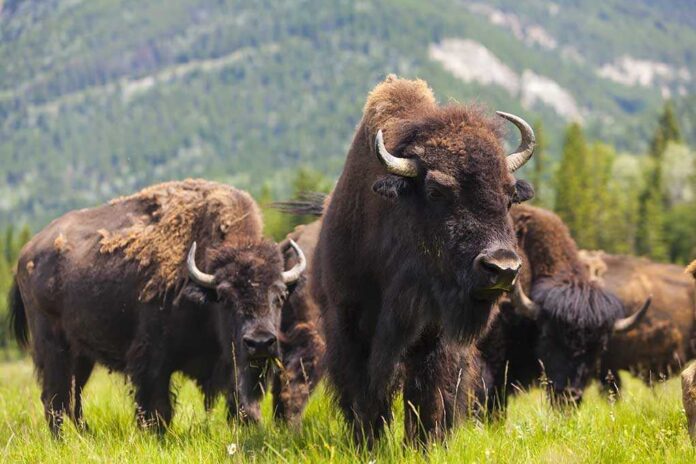
A Yellowstone bison can look calm one second and send a visitor flying the next.
Quick Take
- Yellowstone National Park says visitors must stay at least 25 yards away from bison and other wildlife, except bears and wolves, which require 100 yards.
- The park also warns that bison have injured more people in Yellowstone than any other animal.
- Yellowstone’s safety guidance says bison may bluff charge, head bob, paw, bellow, or raise their tail before a rush.
- The viral headbutt video fits a long pattern: most bison injuries follow people getting too close.
Why This Bison Clip Hit So Hard
The video lands with such force because it shows how little warning a bison can give before violence. Yellowstone’s own safety page says these animals may seem tranquil, but they can run three times faster than humans and have injured more people in the park than any other animal. That mix of size, speed, and sudden reaction turns a split second of curiosity into a hospital trip.
The key fact is not mystery. It is distance. Yellowstone says people must keep at least 25 yards away from bison at all times and should never approach one for a photo. The same guidance says that if a bison moves closer, visitors should back away, and if the animal shows warning signs, they should leave immediately. In other words, the park treats a close encounter as a preventable mistake, not a harmless thrill.
What Yellowstone Says Visitors Keep Getting Wrong
Yellowstone’s rules are simple, but people keep breaking them. The National Park Service says it is illegal to willfully remain near or approach wildlife in a way that disturbs or displaces the animal. That matters because many injuries begin with a human decision to close the gap. The park’s warning signs are meant to stop that chain early, before a calm-looking bison becomes a fast-moving hazard.
The National Park Service also gives plain behavior clues that many visitors ignore. A bison that bluff charges, stares, head bobs, paws, bellows, or raises its tail is not “being dramatic.” Yellowstone says those are signs the animal feels too close and that a charge may be coming. For a tourist with a phone out, those signals may last only seconds. For the bison, they are the last warning before action.
The Bigger Pattern Behind the Viral Moment
This is not an isolated freak event. The Centers for Disease Control and Prevention reported that bison injuries in Yellowstone usually happen when people approach the animals too closely, and that 80 percent of injured people in its study had done exactly that. The same research found that bison have injured more pedestrians in Yellowstone than any other animal since 1980. That is why this story matters beyond one dramatic clip.
Man was "seriously injured" from the bison attack, which happened yesterday in Yellowstone:https://t.co/VxBl9fnfsg
— Steven Greenstreet (@MiddleOfMayhem) July 12, 2026
The wider lesson is blunt. Yellowstone’s wildlife is not there to entertain people on demand. The park’s own rules exist because bison are powerful, fast, and easily provoked by human error. When visitors treat them like oversized cattle or seek a perfect video, they ignore the one thing that keeps them safe: space. The animal does not need to be “mean” for the result to be ugly.
Why the Safety Message Still Gets Lost
Viral wildlife clips often reward the wrong behavior. The shock gets the clicks, while the safety lesson arrives late, if at all. Yellowstone Forever says park rangers issued 63,676 warnings in 2023, including many for approaching wildlife too closely. That number suggests the problem is not a rare lapse. It is a steady habit of underestimating wild animals and overestimating human control.
The conservative common-sense reading is straightforward. Nature does not bend to ego, and the park cannot protect people who refuse to listen. Yellowstone’s rules are not about spoiling fun. They are about preventing injuries that are easy to avoid and hard to recover from. A bison does not need a reason that feels fair to humans. It only needs a few feet of bad judgment.
Sources:
thegatewaypundit.com, yellowstonesafari.com, yellowstone.org, windriverbuffalo.org
© partiallypolitics.com 2026. All rights reserved.