partiallypolitics.com — America’s 250th birthday party just turned into a tug-of-war over whether the National Mall belongs to the whole country or to one man’s brand of politics.
Story Snapshot
- Trump openly floated swapping a unifying anniversary concert for a massive Make America Great Again rally after artists walked away.
- Big-name performers say they were promised a nonpartisan celebration and discovered something far more political instead.
- Organizers still insist Freedom 250 and the “Great American State Fair” are for all Americans, even as Trump mocks “third rate” artists and pitches his rally.
- This fight exposes a deeper question: can any national ritual stay truly shared once it becomes content in a permanent campaign?
How a Unity Celebration Morphed Into a MAGA Showdown
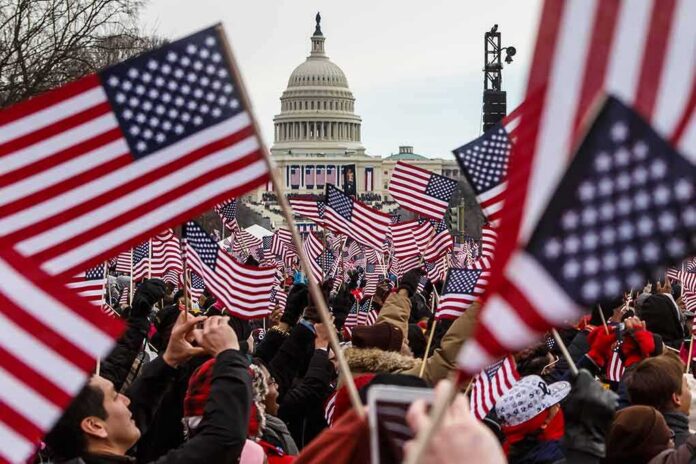
Freedom 250 and the “Great American State Fair” were sold as centerpieces of America’s 250th anniversary, a feel-good national gathering on the National Mall meant to celebrate all fifty states and 250 years of independence.[1] The White House Freedom 250 page frames the anniversary as a historic milestone, promising a once-in-a-lifetime national celebration. On paper, that sounds civic, almost old-fashioned: flags, fireworks, music, and everyone invited, regardless of party.
The problem began when the entertainment lineup collided with the reality of Trump-era politics. Country star Martina McBride, rocker Bret Michaels, Young MC, Morris Day and The Time, and The Commodores were all announced as marquee acts for the “Great American State Fair.”[1] Within days, most of them publicly bailed. Their exit turned what should have been a bland booking story into a national argument over whether this was a bipartisan jubilee or a Trump-branded political production in patriotic clothing.[1]
What The Artists Say They Were Told Versus What They Saw
Martina McBride stated that she was “presented with an opportunity to perform at a nonpartisan event” and that she “asked lots of questions” and was assured it would simply celebrate all fifty states.[1] She then called that assurance “misleading” and walked. Young MC echoed her, saying artists “were never told about any political involvement” and pointing to coverage describing the event as “Trump-backed” despite organizers’ nonpartisan claims.[1] That is not subtle language; those are performers saying they feel used as bipartisan cover.
Bret Michaels described the original pitch as a chance to honor veterans, active-duty military, first responders, teachers, and “hardworking Americans from all walks of life.”[1] He later said the event “evolved into something much more divisive than what I agreed to be a part of,” citing concerns for the safety of fans and crew.[1] The Commodores stressed they did not want to publicly affiliate with any single political party and opted out.[1] These are not fringe acts grasping for attention; they are mainstream performers recoiling from perceived politicization.
Trump’s Response: Cancel the Concerts, Bring the Rally
Trump’s reaction poured gasoline on the perception that this was never just about a birthday concert. After the exits, he posted on social media that he was working on a rally “to take the place of these highly paid, Third Rate ‘Artists.’”[1][2] He then floated having a giant “MAKE AMERICA GREAT AGAIN RALLY” for the 250th instead of “overpriced singers, who nobody wants to hear, whose music is boring.”[1][2] That rhetoric does not sound like someone guarding a neutral civic ritual; it sounds like a man reclaiming the stage for his movement.
Reports describe him calling for cancellation of the concerts “celebrating America’s 250th anniversary” and effectively swapping them with a Make America Great Again rally on the same symbolic national ground.[2] From a conservative common-sense lens, this is where it gets tricky. On one hand, a president responding to cancellations by saying “Fine, I’ll do a rally” is blunt and transparent, not covert. On the other hand, turning a planned national commemoration into another campaign-style event narrows the tent from “all Americans” to “my crowd.”
Organizers Still Claim It Is For Everyone
Freedom 250’s spokeswoman insists the “Great American State Fair is a celebration of all Americans” and says the group remains committed to a once-in-a-lifetime experience that “brings every corner of this country together on the National Mall.”[1] America 250’s own materials brand the overall initiative as bipartisan and designed to engage every American in the anniversary. On paper and in press releases, this is inclusive language, the kind of boilerplate that every taxpayer, left or right, should be able to support.
Trump considering giving ‘major’ speech, holding ‘America is Back’ rally after musicians back out of Freedom 250 concerthttps://t.co/9HHcPvhIlk
— Papa Hemingway✝️✡️ 🇮🇹 🇺🇸 🇮🇳 (@PopHemingway) May 31, 2026
The tension is that artists and Trump himself are describing something quite different in practice. When performers say the event “evolved into something much more divisive” and Trump answers by mocking them while pitching a giant Make America Great Again rally, the lived reality drifts away from the bipartisan brochure.[1][2] That gap—between formal mission and on-the-ground politics—is exactly what makes older Americans tune out national rituals as just more partisan noise.
What This Fight Really Reveals About National Rituals Now
This controversy sits in a broader pattern: highly produced “unity” events that quickly become content in a never-ending political campaign. America 250 is formally pitched as a bipartisan commemoration. Freedom 250 and the Great American State Fair were promoted as patriotic celebrations open to all.[1] Yet Trump’s own branding, from the “giant MAKE AMERICA GREAT AGAIN RALLY” to mocking “third rate” artists, pulls the entire 250th orbit into his political ecosystem.[1][2]
From an American conservative standpoint, respect for civic ritual, the separation between government ceremony and personal political branding, and honesty in how events are sold all matter. The facts available today do not conclusively prove organizers intentionally lied to performers; the booking emails and contracts are still offstage. But the public record already shows a serious mismatch: artists saying “we were told nonpartisan,” organizers insisting “for all Americans,” and Trump eagerly turning a national celebration into another rally. That should bother anyone who thinks the country deserves at least a few moments that belong to the flag, not to a campaign.
Sources:
[1] Web – Trump floats replacing 250th anniversary concert with massive MAGA …
[2] YouTube – Trump Considers Replacing ‘Great American State Fair’ With Rally …
© partiallypolitics.com 2026. All rights reserved.