
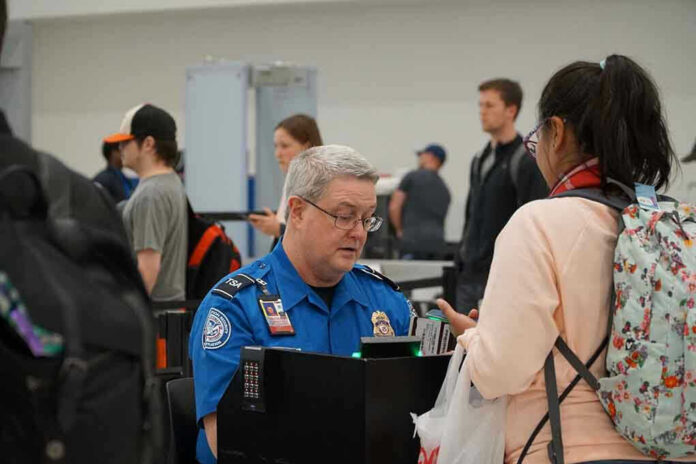
The federal government just turned your procrastination into a profit center, charging travelers $45 every ten days to fly without the compliant ID they’ve had twenty years to obtain.
Story Snapshot
- TSA now charges $45 for a 10-day window to fly without REAL ID, implemented February 1, 2026, after enforcement began May 7, 2025
- The ConfirmID system requires online biometric verification taking 10-30 minutes, with no guarantee of approval even after payment
- All 50 states, DC, and five territories now issue compliant IDs marked with a star, ending two decades of delays blamed on states
- Full enforcement arrives May 5, 2027, when the pay-to-fly option disappears and only compliant documents gain airport access
Twenty Years of Warnings End With a Payment Plan
Congress passed the REAL ID Act on May 11, 2005, riding the wave of post-9/11 security reforms recommended by the commission investigating the terrorist attacks. The law established minimum security standards for state-issued driver’s licenses and identification cards, requiring verification of identity, Social Security numbers, lawful status, and residency. What should have been a straightforward security upgrade turned into a bureaucratic saga spanning two decades, with enforcement delayed more than fourteen times due to state resistance, privacy concerns, and pandemic disruptions. Now that all states finally comply, the focus shifts from governmental foot-dragging to individual accountability, and TSA has monetized the gap.
The Cost of Convenience Adds Up Fast
Starting February 1, 2026, travelers without REAL ID who also lack a passport or other accepted alternative must complete online verification at TSA.gov before reaching the airport. The process collects biometric and biographic data, then charges $45 for a 10-day authorization. Frequent travelers face mounting costs: fly twice monthly without compliant ID and you’ll spend $540 annually, far exceeding the typical state fee for a REAL ID license. TSA markets this as modernization, but the math reveals it as a penalty for inaction. The system offers no refunds if verification fails, leaving some travelers paying for nothing while missing their flights anyway.
No REAL ID yet? You can still fly, but it may cost $45 without another form of accepted ID https://t.co/8VSaao5Uu6
— The Boston Globe (@BostonGlobe) January 31, 2026
The fee structure disproportionately impacts rural and low-income Americans who fly infrequently and may view a DMV visit as more burdensome than an occasional airport charge. Yet for families traveling together, the costs multiply quickly. A household of four without compliant IDs pays $180 per trip during the 10-day window, incentivizing compliance through financial pressure rather than outright prohibition. This approach reflects a pragmatic, if controversial, recognition that millions of Americans remain unprepared despite years of warnings plastered across state DMV websites and federal travel advisories.
Phased Enforcement Offers a Shrinking Window
The May 7, 2025, enforcement date marked the beginning of a transition period, not an absolute deadline. TSA screeners began warning travelers with non-compliant IDs but generally allowed passage through checkpoints with additional screening. This flexibility continues until May 5, 2027, when full enforcement takes effect and non-compliant IDs become unacceptable for domestic flights and federal facility access. The two-year bridge acknowledges logistical realities while maintaining pressure toward compliance. States like Texas, which issued compliant IDs since October 2016 marked with a distinctive star inside a circle, experienced minimal disruption. The holdouts and laggards now scramble as the clock runs down.
Security Gains Versus Privacy Concerns
Supporters argue REAL ID closes security gaps exploited by terrorists who used easily forged state IDs to board the planes on September 11, 2001. Standardized verification tied to federal databases reduces fraud and identity theft, strengthening national security at a relatively low cost. Critics counter that the biometric data collection through ConfirmID and compliant ID issuance processes creates vast privacy risks, concentrating sensitive personal information in databases vulnerable to breaches or government overreach. The debate mirrors broader tensions between security imperatives and civil liberties, though the phased rollout and state-level implementation have muted the fierce opposition seen in earlier years.
The $45 fee adds a new dimension to the controversy, transforming a security mandate into a revenue stream. TSA has not disclosed projected income from ConfirmID, but with millions of travelers potentially affected, the figures could reach hundreds of millions annually during the transition. This pay-to-play model sits uneasily with principles of equal access, particularly when free alternatives like passports require upfront costs many Americans cannot afford. The system effectively creates a tiered access model where wealthier, more organized travelers sail through while others pay repeatedly or face rejection.
What Travelers Must Do Now
Obtaining a REAL ID requires visiting a state DMV with documentation proving identity, Social Security number, and residency. Most states no longer require physical Social Security cards, accepting electronic verification instead, streamlining a process once notorious for bureaucratic hassle. Processing times vary, but many states issue compliant licenses on the spot or within weeks. Travelers who already hold valid passports, passport cards, military IDs, or other federally accepted documents need not rush to DMVs, as these alternatives satisfy REAL ID requirements indefinitely. The simplest solution for most Americans remains updating their driver’s license at the next renewal, a painless step that eliminates future fees and airport complications.
TRAVEL TROUBLES: Beginning Sunday, air travelers in the U.S. without a REAL ID or another acceptable form of identification, such as a passport, are subject to a new fee. https://t.co/g843fMnzA4
— WPLG Local 10 News (@WPLGLocal10) January 31, 2026
For those caught short before May 2027, the ConfirmID system provides an expensive escape hatch. Travelers should initiate online verification well before travel dates, as the process requires email confirmation and can take over thirty minutes. Airport arrival times must account for potential screening delays, especially during peak periods when checkpoint lines swell with unprepared passengers. The system represents a stopgap, not a sustainable alternative, designed to nudge compliance through inconvenience and cost rather than outright denial. As the 2027 deadline approaches, expect airport chaos to intensify among the unprepared, making early action not just prudent but essential for stress-free travel.
Sources:
Federal REAL ID Act – Texas Department of Public Safety
REAL ID Required for U.S. Travelers Beginning May 7, 2025 – Department of Defense