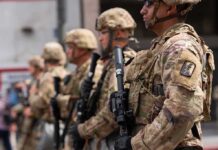
When the 82nd Airborne starts packing for the Middle East, Washington is preparing for the kind of crisis that doesn’t give you time to hold a meeting.
Story Snapshot
- At least 1,000 troops from the 82nd Airborne Division’s 1st Brigade Combat Team are preparing to deploy as the war with Iran enters its fourth week.
- Two Marine Expeditionary Units already surged toward the region, adding thousands of Marines and sailors on Navy ships to an existing U.S. footprint of roughly 50,000.
- Planners appear focused on fast missions: embassy protection, civilian evacuations, and securing airfields—jobs that can turn deadly fast.
- The Strait of Hormuz closure and attacks on shipping sharpen the stakes beyond missiles and headlines: energy markets and global trade sit in the crosshairs.
The 82nd Airborne Deployment Signal: Not an Invasion, a Warning Light
U.S. officials say the military is preparing to send at least 1,000 soldiers from the 82nd Airborne to the Middle East, with some reporting the number could run higher. Maj. Gen. Brandon Tegtmeier and division staff reportedly accompany elements of the 1st Brigade Combat Team, the kind of “ready-now” formation built for speed. The message isn’t subtle: the Pentagon wants options that work inside hours, not weeks.
The 82nd carries a particular kind of leverage because it can seize and hold terrain quickly, especially airfields. That capability matters when diplomats talk ceasefires while rockets still fly. Airfields aren’t glamorous, but they decide everything: where evacuations launch, where supplies land, and whether an embassy can be reinforced before a mob or militia arrives. If war expands even slightly, commanders need a unit that can move before the situation calcifies.
Marines on the Move: The Floating Layer of Force and Rescue
Thousands of Marines and sailors from two MEUs have already shifted toward the region aboard Navy ships, including forces tied to an amphibious assault ship group. One MEU sailed from the West Coast with roughly 2,200 Marines, while another redirected from the Pacific, with reporting that ranges from about 2,500 up to several thousand additional personnel depending on what ships and detachments get counted. Amphibious forces buy the U.S. time and flexibility offshore.
MEUs excel at what the public forgets until it’s needed: pulling Americans out, securing compounds, controlling crowds at choke points, and bringing helicopters, medical capacity, and logistics without begging for basing rights. That’s why Marine ships often appear when Washington insists it doesn’t want a ground war. Marines can come ashore for limited tasks and then leave, a politically cleaner tool than a long land campaign even when the risk on the beach stays very real.
War Since February 28: Air Power Dominates, Ground Risk Lurks
The conflict reportedly began February 28, 2026, with U.S. and Israeli airstrikes targeting Iranian military infrastructure tied to the IRGC, missile facilities, and naval assets. By mid-March, reporting described an air war measured in thousands of flights and targets struck. Air superiority can punish, disrupt, and deter, but it can’t escort a convoy of evacuees through city streets. The moment civilians need extraction, ground forces become the uncomfortable centerpiece.
Iran’s reported move to close the Strait of Hormuz and attack commercial shipping drags the world into the war’s blast radius. That narrow waterway carries a large share of global oil flows, and even temporary disruption can spike prices, rattle retirement accounts, and raise costs for families far from any desert. Conservatives tend to grasp this intuitively: energy security is national security, and a choke point held hostage becomes America’s problem whether Washington likes it or not.
Diplomacy Versus Deterrence: The Trump Administration’s Tightrope
The Trump administration has pushed negotiations and a ceasefire concept while troop movements accelerate, and Iranian officials have publicly denied at least some reported diplomatic tracks. That mismatch is familiar in war: each side uses public messaging to shape leverage. Common sense says negotiations without credible pressure usually fail, yet pressure without a clear political goal can drift into mission creep. The hard part isn’t choosing diplomacy or force; it’s preventing them from sabotaging each other.
“No boots on the ground” rhetoric collides with reality when embassies, airfields, and evacuation routes sit under threat. The honest distinction is scale and purpose. A limited deployment to secure Americans and key infrastructure differs from a campaign to occupy terrain indefinitely. Skepticism remains warranted because history shows how “temporary” missions can stretch, but dismissing every deployment as an invasion ignores what rapid-response forces exist to do.
What the 82nd Usually Gets Called to Do When the Clock Runs Out
The 82nd Airborne’s modern track record reads like a checklist of crises: reinforcing threatened diplomatic sites, supporting evacuations, and showing up fast when planners fear a sudden collapse. The division’s “18-hour” reputation matters because adversaries calculate timelines. If they believe the U.S. can’t respond quickly, they take bigger risks. Sending the 82nd signals that any attempt to overrun a facility or block an evacuation corridor could meet organized resistance fast.
The fog in current reporting—whether the deployment is 1,000 or closer to 3,000—actually underscores the point: the Pentagon can scale this up or down as conditions change. That flexibility becomes essential when the Strait remains contested and missile exchanges continue. Americans should read this as an insurance policy with teeth. You buy insurance not because you want the house to burn, but because you know how quickly fire spreads.
The Conservative Litmus Test: Clear Mission, Clear End State, and No Fantasy Thinking
Sound strategy starts with adult questions: What exactly must these troops protect, and for how long? What triggers expansion, and what triggers withdrawal? How will Washington prevent a limited airfield or embassy mission from becoming an open-ended security commitment? Conservatives tend to demand accountability because the bill comes due in blood, readiness, and debt. That instinct is healthy, especially when officials offer broad assurances but keep operational details understandably close.
The next weeks hinge on whether diplomacy produces real de-escalation or just headlines while the battlefield keeps moving. The 82nd and the Marines don’t deploy because Washington feels confident; they deploy because planners can imagine scenarios where Americans get trapped, allies get overwhelmed, or shipping disruptions spiral. That is the quiet truth behind every “precautionary” surge: someone credible has sketched a bad day, and they refuse to be late to it.
Sources:
At Least 1,000 US Troops from 82nd Airborne Set to Deploy to Mideast, Sources Say
U.S. deploy 82nd Airborne to Middle East amid Iran war
Pentagon orders troops from 82nd Airborne Division to deploy to Middle East
Part of 82nd Airborne Division poised for Middle East deployment, sources say