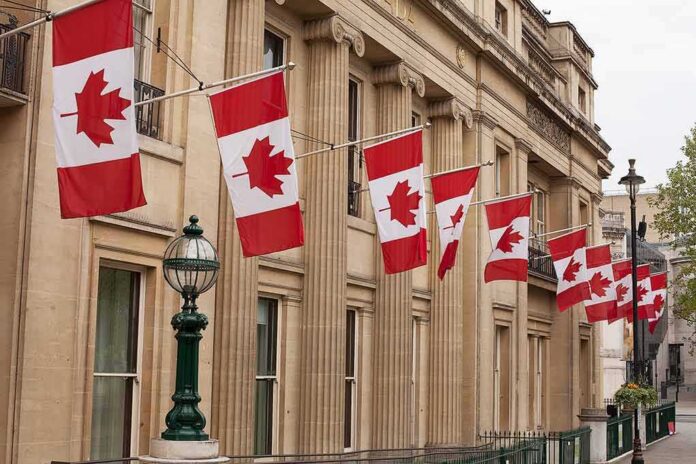
Canada just got a public invite to become the European Union’s first-ever associate member, and the clock on what that means has started.
Story Snapshot
- European Commission president urged “association without accession” for Canada, in public remarks.
- CETA trade has already grown goods by 75% and services by 97%, setting a baseline.
- Key EU capitals object to the label until rules exist, stalling the wording.
- Ottawa links the push to tariffs and U.S. pressure; critics warn on sovereignty and dairy.
The On-Record Invite That Moved the Goalposts
European Commission President Ursula von der Leyen told a Montreal audience that Canada cannot be a full member because of geography but can be an “associate member.” She called it “association without accession,” and listed work on artificial intelligence, energy, climate, security, and governance. That is not rumor or a kite-flying op-ed. It is the bloc’s top executive, on the record, launching a new category and asking Canada to step in.
Prime Minister Mark Carney echoed that aim, describing Canada’s development as an associate member. His team points to real groundwork: an Economic Security Dialogue, a defense procurement bridge through the Security Action for Europe program signed in 2026, and eased research and student flows. The case leans on facts, not daydreams. Trade under the Canada–European Union deal surged since 2017, giving the government proof that deeper ties can scale from a working base.
The Promise: Diversify Risk Without Trading Away the Keys
Officials pitch this as a hedge against shocks from the south. Most Canadian trade still runs through the United States, and tariffs bite hard. Leaders argue that wider European access lowers single-market risk and gives firms another lane when Washington turns the screws. The sales pitch claims sovereignty stays intact. The design would stop short of joining European Union institutions and would rely on cooperation pacts and sector deals, not a full political union.
Common sense says a country should never bind itself to rules it cannot vote on unless the gains are large and clear. That is the heart of the conservative test: show the upside in jobs, supply chains, and costs, and draw a hard line on who sets the rules at home. If Ottawa wants support, it must publish what Canada would align with, what it can veto, and how it can exit with no penalty if Europe moves the goalposts. Anything less invites buyer’s remorse.
The Snag: A Category With No Legal Teeth Yet
There is no agreed legal meaning for “associate member” inside Europe. That is the biggest hole in the plan. Several major capitals balked at using the label before they define it. Draft summit text reportedly replaced “associate membership” with talk of an “ever closer association.” That softer phrasing signals caution inside the European Union’s Council. Until members agree on rights, payments, and dispute tools, the brand does more to stir headlines than bind outcomes.
Label fights might seem minor, but they matter. Words become legal hooks. If the European Union cannot settle the category, Canada cannot know what it is buying. A vague badge helps politicians for a week and hurts businesses for a decade. The remedy is simple and slow: a written framework that sets market terms, safeguards on regulation, time limits, and a clean off-ramp if either side breaches. Put it in a text, then let parliaments decide.
The Risks: Dairy, Rule-Taking, and U.S. Blowback
Critics warn of two near-field hazards. First, access cuts both ways. Canadian farmers, especially in dairy, fear a flood of subsidized European goods. That is not scaremongering; experts raised it as a live risk if quotas widen. Second, if Canada aligns with the European Union’s single-market rulebook without a vote, Brussels would set standards that shape Canadian factories and farms. That trade-off must be explicit and limited by sector with review points built in.
🇨🇦🇪🇺 Canada could become the EU’s first-ever “associate member” by June 2027!
Prime Minister @MarkJCarney and @vonderleyen are pushing for an unprecedented partnership, bringing Canada closer to Europe without full EU membership.
🤝 Trade. Defence. Energy. Technology. Research.… pic.twitter.com/XnaMFyOoyE— euDebates.tv (@eudebates) October 31, 2026
There is also the American angle. The United States is still Canada’s main market. Talk of a tighter European lane drew warnings about retaliatory limits on trade with Europe. If that risk turns real, Ottawa faces a bad squeeze: a cooler U.S. partner and a still-undefined European tier. The smart play is to lock terms that do not trigger U.S. tripwires while hardening Canada’s options. That means energy, minerals, and dual-use tech rules that fit both markets without double costs.
The Test That Decides This
The case for association stands on measurable benefits that working families can see. The CETA record gives a base, but it is not proof that Europe can replace a big chunk of U.S. demand. The next step is math and mechanics, not slogans: publish sector-by-sector gains, freight time and cost to ports, compliance costs, and small-business tools. If the numbers hold, the deal sells itself. If not, keep building CETA and skip the new label until it has real meaning.
Sources:
youtube.com, audiovisual.ec.europa.eu, thecanadianpressnews.ca, international.gc.ca, cbc.ca, reporter.mcgill.ca
© partiallypolitics.com 2026. All rights reserved.