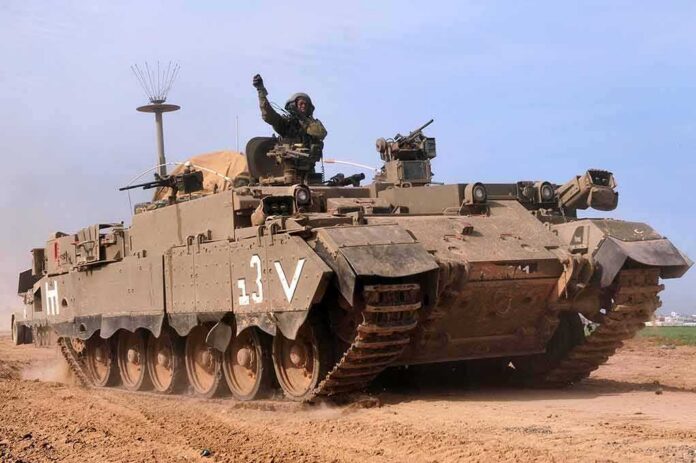
partiallypolitics.com — The U.S. Army just showed the first real “faces” of its future AI-guided XM30 fighting vehicles—and the gap between the glossy promise and the hard reality is where this story gets uncomfortable.
Story Snapshot
- The XM30 is officially planned as the M2 Bradley’s replacement, with two competing designs from General Dynamics and American Rheinmetall.
- The “big reveal” so far is digital engineering art: high-end computer renderings, not field-proven hardware.
- Billions are already committed while the Army openly rethinks the program’s path and schedule.
- AI buzzwords and hybrid-electric tech mask an old question: will this actually work under fire, on time, and at a sane cost?
The Bradley’s long shadow and why XM30 exists at all
The Bradley fighting vehicle rolled into service when Ronald Reagan was president and “near-peer” meant the Soviet Union, not a drone-saturated battlefield with cheap precision weapons. The Army now describes the XM30 Mechanized Infantry Combat Vehicle as the formal replacement for the Bradley and embeds it at the core of future armored brigade combat teams.[3][4] The goal is straightforward on paper: move infantry through high-threat battlespaces with more protection, more firepower, and far tighter digital integration than a Cold War design can deliver.[3]
Army planners frame the XM30 as optionally manned—able to operate with soldiers inside or under remote control—so commanders can push armored combat power forward without always risking a full crew.[3] That vision fits a world where loitering munitions, drones, and long-range sensors punish any vehicle that lingers on open terrain. In this concept, the XM30 is not just a bigger gun on tracks; it is meant to act as a networked, software-upgradable node in a larger kill web.[2][5]
Two industrial giants, two billion-dollar bets
To get there, the Army winnowed the field and awarded Phase 3 and 4 detailed design and prototype contracts to General Dynamics Land Systems and American Rheinmetall Vehicles, with a combined value of about $1.6 billion.[3][4] These two teams are now the only contenders for the production vehicle. That down-select signals to industry and Congress that, on paper, the program has passed its first credibility test: serious vendors, clear requirements, and a defined competition timeline.[3]
Both companies lean hard into future-war marketing. American Rheinmetall portrays its XM30 concept, derived from the Lynx family, as a new generation of tracked combat vehicle tailored for the Army’s modernization push. Raytheon Technologies, tied into the Rheinmetall team, pitches the XM30 as a next-generation armored fighting vehicle designed around the “critical challenges of the future battlefield.”[5] General Dynamics emphasizes digital design tools and modularity to suggest the vehicle can adapt to evolving threats while controlling lifecycle costs.[1]
The glossy reveal: CAD renderings and AI buzz
The first time the public saw what these machines might actually look like came at the National Defense Industrial Association Maneuver Defense and Expeditionary Conference in Detroit, when the Army showed “XM30 Vendor CAD Models” on May 13.[2][6] The material consisted of official computer-aided design images and side-profile engineering renderings, not photos of finished vehicles.[2][6] Those images nevertheless carried weight, because they sketched how the Army imagines fighting under drones, precision missiles, and electronic warfare pressure.
ArmyRecognition’s coverage highlighted “AI Infantry Fighting Vehicle” candidates with advanced sensors, reduced crew workload, and integration into future autonomous combat systems.[2] The designs emphasize digital networking, hybrid mobility, and software-defined architectures that can host artificial intelligence-enabled fire control and decision aids.[2][5] For a public used to seeing tank silhouettes, the pitch is subtle but clear: this is not just metal and armor; this is code, data, and onboard computing power wrapped in steel.
From slide deck to battlefield: the hard gap
That is where a sober, conservative reading is essential. Computer renderings do not stop incoming fire. The Congressional Research Service notes that, as of fiscal year 2026, the XM30 remained a Middle Tier Acquisition Rapid Prototyping effort, still in design maturation, with prototype construction planned only after critical design reviews.[3] Prototypes then require roughly 18 to 20 months to build, followed by a lengthy test and evaluation phase before a production decision in fiscal year 2027.[3]
The same report describes a telling twist: although the Army reportedly approved a key “Milestone B” decision in June 2025 to transition XM30 into full engineering and manufacturing development, senior leaders later chose not to sign the paperwork, effectively pausing that transition and reopening the door to a major program rework.[3] An Army spokesman stressed the need for “cutting-edge solutions now, not decades from now,” and a desire to keep multiple designs in play.[3] That is bureaucratic language for concern about locking into a design too early.
AI promises, procurement history, and common sense
Defense marketing loves phrases like “AI-enabled,” “hybrid-electric,” and “autonomous integration” because they imply inevitability and sophistication.[1][2][5] Recent Pentagon history, however, is littered with programs that looked unbeatable in digital models and slide decks yet stumbled on cost, complexity, or real-world reliability. A grounded view aligned with conservative skepticism toward sprawling government projects would treat the XM30 the same way: accept the logic of replacing the Bradley, but demand proof before accepting grand claims.
For taxpayers and soldiers alike, the right questions are blunt. Will this vehicle survive in an environment saturated with cheap drones and top-attack munitions, not just in controlled tests but against a learning enemy? Will the artificial intelligence-enabled systems simplify a crew’s life or drown them in complexity they cannot sustain in combat? And can the Army stick to a disciplined path—prototype, test, adjust—without turning another modernization effort into an endlessly delayed, over-promised, under-delivered program?[1][3][6]
Sources:
[1] Web – General Dynamics’s entry for the XM-30 IFV for the US Army clears …
[2] YouTube – American Rheinmetall and GDLS Advance in Development of XM30 …
[3] Web – Army taps General Dynamics, American Rheinmetall for next phases …
[4] Web – XM30 Mechanized Infantry Combat Vehicle – Wikipedia
[5] Web – U.S. Army Reveals First Designs of Two XM30 AI Infantry Fighting …
[6] Web – [EPUB] OMFV Redesignated XM-30 Mechanized Infantry Combat Vehicle
© partiallypolitics.com 2026. All rights reserved.