
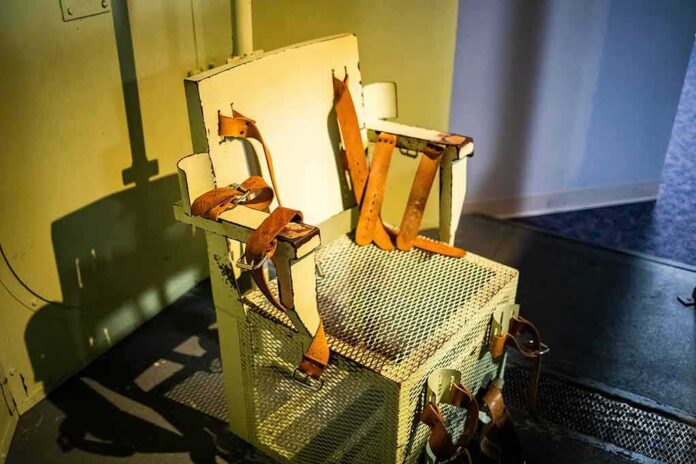
Tennessee tried twice to end a life in its execution chamber and instead ignited a statewide reckoning.
Story Snapshot
- Officials administered two doses of lethal injection drugs to Christa Pike; the execution did not succeed.
- The Tennessee Department of Correction said it followed every step of the approved protocol.
- Governor Bill Lee halted remaining 2026 executions and ordered an independent review.
- Witnesses and filings said Pike was still breathing and later taken to a hospital.
A failed execution, a swift halt, and a public trust test
Tennessee officials attempted to execute Christa Pike with a single-drug pentobarbital protocol and administered two doses, but the process did not result in death, according to court filings and media witnesses. The Tennessee Department of Correction told the state’s high court that Pike was transported by ambulance to a hospital for medical care. Governor Bill Lee responded within hours. He paused the state’s remaining executions for 2026 and ordered a third-party investigation into what went wrong.
The department said staff followed each step of the state’s approved execution protocol, which was revised after a prior, multi-year review of lethal injection procedures. That statement draws a hard line: either the protocol itself failed in practice, or something critical slipped in execution. Common sense says both possibilities are serious. A death sentence must be carried out lawfully, competently, and humanely. Anything less offends justice for victims and undermines public trust in the state.
What officials, witnesses, and filings agree and dispute
The area of agreement is stark. Two doses went in. The execution did not conclude as planned. Pike left the prison alive in an ambulance. Media witnesses reported that Pike appeared to be breathing, even snoring, after drug administration; their accounts matched the urgency that followed in the chamber and the legal filings that night. Where accounts diverge is why. The department points to adherence to protocol, while Pike’s lawyers allege failures like blown veins and degraded drugs. Those are claims, not findings, until the review confirms or rejects them.
Governor Lee’s decision to halt the remaining 2026 executions and bring in outside investigators aligns with conservative principles: verify the system before you use it again, fix what is broken, and be transparent about the results. Tennessee already revamped its protocol after earlier problems and adopted a single-drug method that other states had defended in court. Yet even the best manual cannot rescue poor practice, and even good staff can be let down by a flawed plan. The review must sort design from execution with precision.
The protocol backdrop: reforms, risk, and responsibility
Tennessee completed a major lethal injection protocol review in late 2024 and shifted to pentobarbital as a single drug, replacing the old three-drug cocktail. The policy change followed earlier revelations that the state had not followed parts of its own prior protocol, prompting a pause and leadership changes. These reforms aimed to reduce risk and standardize steps, but they also created a new baseline to test under pressure. The Pike event is that test in real time, with the added scrutiny that comes with a rare attempt to execute a woman in the state.
Tennessee failed to carry out an execution TWICE in 4 months.
❌ May 21: Tony Carruthers. They spent over an hour trying and failing to get a backup IV in. Called off.
❌ Sept 30: Christa Pike. Two doses of pentobarbital. She ended up in a hospital.
Lethal injection already…
— Kentucky Girl (@Kentuckygirl1) October 1, 2026
Critics now argue this is part of a wider pattern of botched lethal injections across states in recent years, with disputes over drug sourcing, storage, and intravenous access driving many failures. Supporters of capital punishment counter that the sentence remains lawful when courts have upheld the method, and that careful process fixes—not abandonment—are the answer. The only defensible path forward is clear standards, practiced teams, and documented compliance that the public can see and the courts can test.
How the review should proceed and what accountability looks like
The investigation should gather every record: drug chain-of-custody logs, storage temperatures, lot verification, staff rosters, training sign-offs, timing of each step, intravenous access notes, and any equipment alarms. Investigators should interview every staff member in the chamber, the pharmacy vendor, and state medical advisors. The report should make hard calls in plain language: what failed, why it failed, and who is accountable. If the protocol design failed, rewrite it. If training failed, retrain and certify. If personnel failed, replace them.
Law-and-order conservatives expect the state to do two things at once: honor lawful sentences and honor the Constitution. That means no shortcuts, no secrecy, and no experiments on the fly. Governor Lee’s pause is the right first step. The right second step is a timeline with milestones and a public-facing summary that explains, without jargon, how Tennessee will conduct executions that are swift, certain, and lawful. Anything less invites more court stays, more chaos in the chamber, and more pain for victims’ families.
What this moment demands from Tennessee
Tennessee must show that its justice system can carry out its most serious penalty with competence and dignity. The Pike attempt did not do that. The facts already on the record justify a pause and a hard look under the hood. The next report should not read like a press release. It should read like a checklist finished in ink, with fixes tested before any date is set. The state owes that to the law, to the public, and to the memory of the victim whose name still anchors this case.
Sources:
redstate.com, theguardian.com, usatoday.com, cnn.com, abcnews.com, bbc.com, yahoo.com, nbcnews.com, supremecourt.gov
© partiallypolitics.com 2026. All rights reserved.