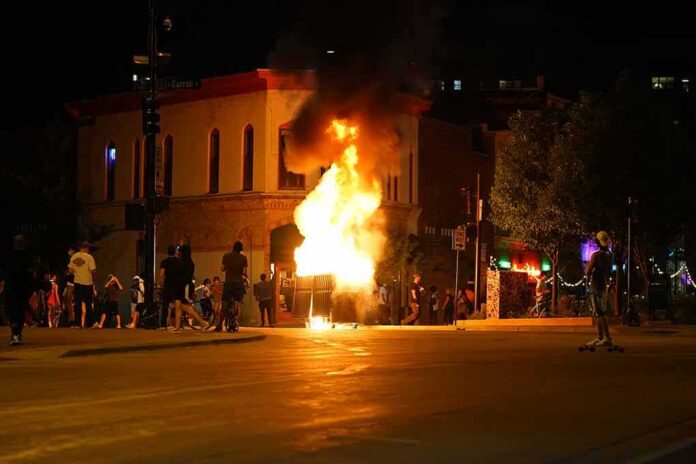
Italian police arrested 32 people, including 13 foreign nationals and 23 minors, after rioters tore through central Milan over two nights, injuring 14 officers.
Quick Take
- Police took 271 people to headquarters, including 220 minors and 60 foreign nationals, during the unrest
- 32 people face charges of aggravated resistance, vandalism, and looting
- Prosecutors say the rioters showed “absolute ease” in carrying out destructive acts
- Italy’s government approved a new security and youth crime decree in response
- The violence began on the edge of a peaceful cost-of-living protest before spiraling out of control
What Happened on Milan’s Streets
A demonstration over the rising cost of living in Milan turned violent over two nights in October. What started as a sanctioned march splintered into clashes, looting, and fires across the city center. Police reported 14 officers injured as crowds smashed shop windows and swarmed supermarkets. By the time order returned, authorities had brought 271 people to police headquarters for questioning.
Of those 271 people, 220 were minors and 60 were foreign nationals, according to police figures reported by the Italian news agency ANSA. That overlap shows many of those swept up were both young and not Italian citizens, though the numbers don’t tell us who started the violence or who simply got caught nearby.
Who Was Detained and Why It Matters
Thirty-two people were formally arrested. Among them were 23 minors and 13 foreign nationals, facing allegations that include aggravated resistance, vandalism, and looting. These aren’t vague accusations tied to simply attending a protest. They are specific criminal charges tied to specific conduct during the riots, which separates this group from the broader crowd that gathered that night.
A follow-up report confirmed that four young men remained in jail days later, with a fifth placed under house arrest, on allegations of devastation, looting, and aggravated resistance. Keeping defendants locked up after an initial court review signals that judges found the evidence against them serious enough to warrant continued detention rather than release pending trial.
Prosecutors Describe Rare Violence
The Lombardy Public Prosecutor’s Office did not mince words. In documents seeking to validate the arrests, prosecutors described an “absolute ease in improvising destructive acts of rare violence” and pointed to what they called “significant criminal capacity” among the adults involved. They also noted a lack of self-control among those accused, language rarely used so bluntly in official filings.
Italian and international media also reported that radical-left activists and students took part in the clashes and looting, with police identifying members of organized groups tied to Milan’s social centers among the demonstrators. One video circulating online showed looted goods handed to a homeless person, captioned “Proletarian expropriation in Milan,” a phrase lifted straight from old-school Marxist rhetoric.
A Political Response Takes Shape
Prime Minister Giorgia Meloni’s government moved fast. Within days, officials approved a new security and youth crime decree aimed directly at the kind of disorder Milan had just witnessed. The decree reflects a government position that existing laws weren’t equipped to handle coordinated youth violence of this scale, especially when minors make up such a large share of those detained.
If it keeps going at this rate, we might, for (I think) the first time in history, be about to witness the first continent-wide youth revolt in Europe – a "European spring" of sorts.
The sheer number of countries where it's **already** happening is pretty overwhelming. I count… https://t.co/WEfcsdR3cu
— Arnaud Bertrand (@RnaudBertrand) October 21, 2026
The response fits a broader pattern playing out across Europe, where cost-of-living frustration, youth disorder, and immigration politics increasingly collide in the same news cycle. Milan’s riots didn’t happen in a vacuum. They landed in a political environment already primed to debate who bears responsibility when protests turn destructive, and what that says about immigration and public order policy.
Separating Fact From Political Noise
It’s worth being precise about what the arrest numbers actually prove. They confirm that foreign nationals and minors were present among those charged. They do not, by themselves, prove that migrant-background youth as a group organized or led the violence, nor do they identify a single far-left organization that directed the riots. Those are separate questions still being sorted out through the Italian justice system.
What’s clear is this: real people got hurt, real property got destroyed, and real criminal charges followed. Fourteen officers went home injured. Shop owners woke up to broken windows and empty shelves. Prosecutors used rare language to describe the brutality they witnessed. Whatever the political debate becomes, those facts stand on their own, backed by police records and court filings rather than speculation.
Sources:
lifesitenews.com, ansa.it, hungarianconservative.com
© partiallypolitics.com 2026. All rights reserved.