
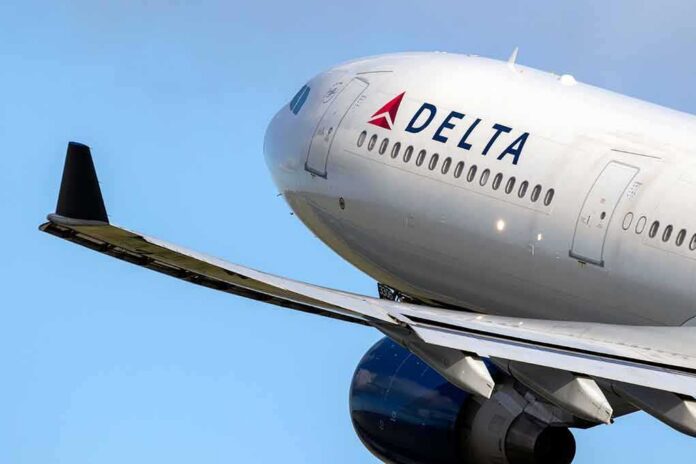
Delta Air Lines’ own weight-and-balance system went down on one of the busiest travel mornings of the year, forcing ground crews across Atlanta to calculate aircraft loads by hand while holiday travelers waited.
Quick Take
- Delta confirmed an automation failure hit its departing-flight weight-and-balance calculations on November 22, 2026, the Saturday before Thanksgiving.
- The airline said crews used manual workarounds to keep flights departing safely while technicians worked to restore the system.
- The Federal Aviation Administration (FAA) first ordered a ground stop for Delta flights headed to Hartsfield-Jackson Atlanta International Airport, then eased it into a ground-delay program.
- News outlets reported delay counts ranging from roughly 230 to more than 700 flights, reflecting different timestamps and tracking methods rather than one official total.
What Went Wrong At Delta’s Busiest Hub
Delta told the public its automated system for calculating weight and balance on departing flights had stopped working. That system determines how much an aircraft weighs and how that weight is distributed before it leaves the gate, a calculation pilots need to fly safely. Delta said its teams switched to manual workarounds so flights could keep departing while engineers worked to bring the automation back online.
Weight-and-balance numbers are not paperwork formalities. They shape takeoff speed, control response, and how an aircraft handles climbing out of busy airspace. Aviation safety researchers note that errors in this calculation can cause dangerous instability during takeoff and landing, which is exactly why airlines keep manual backup procedures on hand for moments just like this one.
Federal Air Traffic Controllers Stepped In To Manage The Backlog
The FAA responded by halting Delta flights bound for Atlanta, a step regulators can take at an airline’s request when ground operations need time to catch up. That full stop was later downgraded to a ground-delay program, a softer measure that spaces out arrivals instead of blocking them outright. The program was expected to run through roughly 12:50 to 1 p.m., giving Delta’s Atlanta hub time to work through the manual-calculation backlog.
Federal officials were clear that the slowdown traced back to Delta’s internal system, not a breakdown in the national air traffic control network. The Associated Press reported that the delays were unrelated to FAA air-traffic systems, placing the responsibility squarely on Delta’s own automation. That distinction matters for travelers trying to understand who dropped the ball, and the answer here is not shared blame between the airline and federal controllers.
Delay Counts Varied, But The Scale Was Real
FOX 5 Atlanta reported 364 delays at the airport, including about 200 inbound flights and 164 departures, with FAA data showing average delays near 57 minutes. Other outlets cited different numbers, from roughly 232 Atlanta-area flights to more than 400 flights nationwide, including 375 Delta flights, while some reports put the systemwide Delta total near 700. The spread likely comes down to when each outlet pulled its data and whether it counted only Atlanta or the whole Delta network.
Whatever the precise count, the timing could hardly have been worse. Thanksgiving week ranks among the heaviest travel periods of the year, meaning even a delay measured in minutes rippled out to thousands of passengers trying to get home for the holiday. Social media lit up with travelers comparing notes on canceled connections and long waits, a reminder that airport-level technical problems become personal family problems fast.
This Kind Of Outage Is More Common Than Travelers Realize
Delta’s Saturday scramble was not an isolated fluke in the airline industry. A Government Accountability Office review found 34 airline information-technology outages between 2015 and 2017 alone, touching 11 of the 12 major airlines studied, with about 85 percent of those producing delays or cancellations. That same review found no government system tracking how many passengers these outages affect, which helps explain why Saturday’s delay figures never quite lined up across news reports.
•Delta’s weight-and-balance automation system failed on November 22, 2026, requiring crews to perform manual calculations for aircraft loading, leading to roughly 700 flight delays across its network and a temporary FAA ground delay program focused on its Atlanta hub.
•The… https://t.co/bFarVTLOCW— B Wruble (@WrubleB) November 22, 2026
Airlines increasingly lean on software to handle weight-and-balance math that load planners once worked out with paper trim sheets and manual schedules. That shift brings speed and precision on a normal day, but it also means a single automation failure can stall an entire hub until crews fall back on the slower manual process Delta used Saturday. The fix worked. The bigger question for Delta, and for the industry watching, is how to keep digital convenience from becoming a single point of failure during the one week a year when air travel cannot afford to slow down.
Sources:
thegatewaypundit.com, fox5atlanta.com, abc7ny.com, wsls.com, nbcnews.com, gao.gov, acsf.aero, eplaneai.com, nbaa.org
© partiallypolitics.com 2026. All rights reserved.