Solar radiation just grounded half the world’s most popular airliner, and your holiday travel plans may never be the same.
Quick Take
- Airbus issued an urgent recall affecting 6,000 A320 aircraft after a mid-air incident exposed a flight-control software vulnerability caused by solar radiation exposure
- The European Union Aviation Safety Agency mandated immediate software rollbacks on the ELAC system, representing one of the largest corrective actions in Airbus history
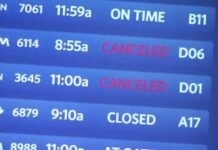
- Major carriers including American Airlines, Delta, United, and Lufthansa are implementing two-hour software updates, causing widespread flight cancellations and delays through early December
- A JetBlue A320 experienced sudden altitude loss on October 30, injuring passengers and triggering the investigation that uncovered the vulnerability
When the Sun Attacks Modern Flight Control
On October 30, 2025, a JetBlue A320 suddenly lost altitude mid-flight, injuring passengers aboard and diverting the aircraft to Tampa, Florida. What followed was a month-long investigation that revealed something aviation engineers never anticipated: intense solar radiation could compromise the aircraft’s primary flight control systems. The discovery sent shockwaves through the aviation industry and triggered the largest recall in Airbus’s four-decade history.
The vulnerability affects the ELAC system, which controls the aircraft’s elevators and ailerons—the surfaces essential for maintaining altitude and bank control. This wasn’t a minor navigation glitch or communication hiccup. This was a threat to the fundamental ability of the aircraft to stay level in the sky. When the European Union Aviation Safety Agency released its recall directive on November 28, 2025, it affected 6,000 aircraft from the A320 family, representing more than half of the 11,300 A320-family jets flying worldwide.
The Scale of Disruption
American Airlines alone operates 480 A320 aircraft, with 340 requiring immediate software updates. Delta, United, and Lufthansa reported significant fleet impacts. Japan’s All Nippon Airways cancelled 65 domestic flights on Saturday alone. Avianca suspended ticket sales entirely until December 8, signaling confidence that disruptions would extend well beyond the weekend. The aviation industry faced an unprecedented coordination challenge: update thousands of aircraft simultaneously while maintaining minimum operational capacity.
Each aircraft requires approximately two hours for the software rollback on the ELAC system. That’s two hours per jet multiplied across thousands of planes, all needing maintenance slots within days. Airlines scrambled to coordinate with maintenance facilities, prioritizing aircraft for critical routes while accepting that holiday travel would suffer collateral damage.
Why Solar Radiation Became the Enemy
Solar radiation has historically affected aircraft systems, but typically communication and navigation equipment rather than primary flight controls. The discovery that solar radiation could compromise the ELAC system represented a novel vulnerability in modern fly-by-wire architecture. The aircraft’s sophisticated electronic control systems, designed to replace mechanical linkages and improve efficiency, apparently lacked adequate environmental shielding against intense solar activity.
This vulnerability exposes a critical gap in aircraft certification protocols. Modern A320s undergo rigorous testing for countless scenarios, yet the environmental testing apparently didn’t account for solar radiation interference with flight-control software under specific atmospheric and solar conditions. The incident suggests that as aircraft systems become more electronic and less mechanical, they become susceptible to environmental factors previously considered irrelevant to flight safety.
The Regulatory Response
The European Union Aviation Safety Agency demonstrated swift and decisive action, issuing the recall directive within one month of the incident. This speed reflects effective aviation safety investigation protocols and international regulatory coordination. EASA’s mandate required airlines to perform immediate software rollbacks, leaving no room for gradual implementation or cost-benefit analysis. Safety trumped operational convenience.
The UK Transport Secretary noted that only a small number of aircraft in British airspace required more complex updates, suggesting that implementation challenges varied by fleet composition and aircraft age. This differentiated approach acknowledged that not all A320s were equally affected, though all required verification and potential updates.
What This Means Going Forward
The recall establishes precedent for rapid, coordinated response to fleet-wide safety vulnerabilities. It demonstrates that modern aviation safety systems can identify, investigate, and respond to emerging threats within weeks rather than years. However, it also highlights that even the world’s most widely-used commercial aircraft can harbor unexpected vulnerabilities in systems that engineers believed were thoroughly understood.
Airlines will likely demand enhanced pre-delivery testing protocols from manufacturers. Airbus may face increased scrutiny regarding software robustness and environmental factor testing. The incident could influence regulatory requirements for aircraft certification, potentially mandating more comprehensive solar radiation shielding in avionics systems across the industry. Competing manufacturers may use this incident to market superior environmental testing and system redundancy in their designs.
The Passenger Reality
For travelers, the recall means delays, cancellations, and rebooking complications during one of the busiest travel periods of the year. Holiday flights face disruption as airlines prioritize fleet maintenance over schedule optimization. The coordinated nature of the recall—affecting multiple carriers simultaneously—eliminates the possibility of simply switching to competing airlines, as many will experience similar disruptions.
Yet the swift regulatory response and manufacturer cooperation offer reassurance. Aviation safety experts generally support precautionary measures affecting primary flight control systems. The two-hour fix duration suggests the vulnerability was a software configuration issue rather than a fundamental design flaw, meaning the solution is straightforward once implemented. The A320’s safety record remains among the best in aviation history, and this recall represents the system working as designed: identifying threats and eliminating them before they become catastrophes.
Sources:
Airbus Announces Major A320 Recall Following Mid-Air Incident; Global Travel Disruptions Expected
2025 Airbus A320 Software Update