
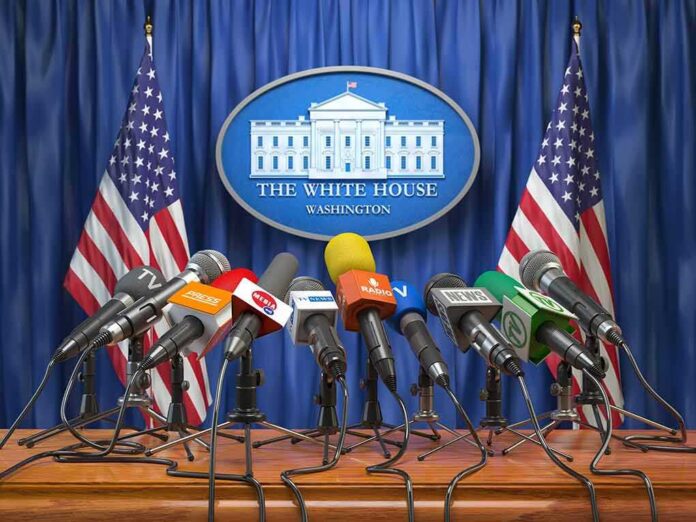
Fourteen minutes at the White House podium set off a week’s worth of noise—and a revealing test of what briefings are for.
At a Glance
- Katie Zacharia delivered prepared policy remarks, then took three questions on camera.
- The session lasted about 14 minutes, shorter than typical briefings, sparking criticism.
- She cited President Trump’s impending South Lawn Q&A before ending the briefing.
- Media reaction split: official praise inside, sharp reviews outside the building.
What Happened In The Room
The White House held an on-camera briefing on October 13, 2026. Press Secretary Katie Zacharia opened with prepared remarks that highlighted administration priorities and wins. She thanked President Trump for his trust and emphasized welcoming new media voices. After the statement, she took questions from reporters representing Breitbart, Fox News, and the Daily Mail, including a personnel update about Ambassador Kimberly Guilfoyle. The official video provides a record of the sequence, tone, and content for each exchange.
The briefing clocked in at roughly 14 minutes. Reporters asked questions for about the final third of that time. Several outlets underscored the abbreviated length and small number of questioners. The Associated Press characterized the appearance as short, while other coverage used words like brief, rocky, or bumpy. Those are assessments, but the time and the three recognized outlets are hard numbers and are not disputed in the reporting.
Why The Exit Became The Story
Zacharia ended the session after a handful of questions and offered a reason: President Trump was expected to take questions on the South Lawn before departing for Alaska. That explanation came from the podium during the event. Critics saw the quick wrap as evasive. Supporters saw it as normal sequencing on a travel day. Both views hinge on the same fact pattern, but only one cites the operational cue that the president would speak soon to the full press pack.
Media outlets focused on delivery risks that come with any debut. Reports said Zacharia relied heavily on notes, read at length, and looked nervous. Some commentary moved from style into ridicule. Claims like “brutal” or “stilted” came from unnamed advisers, which makes them hard to weigh. Style critiques are common for first briefings, yet the unanswered question on Ukraine intelligence sharing gave detractors a clean policy hook to point at beyond theater.
The Conservative Read: Process, Duty, And Results
Conservative readers judge briefings by clarity, accountability, and respect for the office. On clarity, the administration delivered a direct message with on-the-record video. On accountability, Zacharia answered several questions in the room and flagged follow-ups on complex foreign intelligence matters, which is responsible when facts implicate ongoing operations. On respect for the office, routing more questions to the president on a departure day kept the top decision-maker in front of the cameras, where the public can judge him directly.
President Trump’s new White House press secretary Katie Zacharia held an unusually short first briefing with the media, concluding after less than 15 minutes and calling on just three reporters, all from conservative outlets. https://t.co/rq1WH0mXp3
— NBC News (@NBCNews) October 14, 2026
Calls that the appearance was “not normal” rest mostly on the clock and the count of questioners. That argument lacks comparison across similar briefings on travel days or first outings by new press secretaries. The stronger fact case is narrower: the briefing was short, relied on prepared remarks, and ended after three reporters. Those points are fair to note. They do not, by themselves, prove intent to dodge or a failure of duty. They show a debut still settling into form.
What To Watch Next
Three markers will tell the real story. First, the follow-up on the Ukraine intelligence question should land with clear sourcing and a timestamp; that resolves the only substantive gap flagged on day one. Second, future briefings should show longer exchanges with a wider mix of outlets; that builds trust through repetition, not spin. Third, the White House framing should converge with independent coverage as cadence improves; performance narratives fade when answers are crisp and frequent.
Sources:
mediaite.com, nytimes.com, apnews.com, whitehouse.gov, rmb.reuters.com, thehill.com, bbc.com
© partiallypolitics.com 2026. All rights reserved.