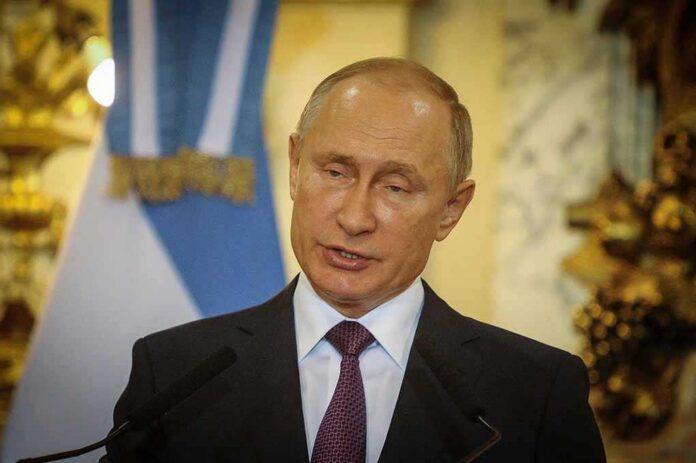
Russia’s Central Election Commission announced that Vladimir Putin’s ruling party, United Russia, would take 355 seats in the 450-seat State Duma, a number election chief Ella Pamfilova said would hand the party a constitutional supermajority.
Story Snapshot
- Central Election Commission chair Ella Pamfilova reported preliminary results showing United Russia winning 355 of 450 Duma seats.
- The party took just under 58% of the party-list vote and led in 208 of 225 single-member district races.
- A 355-seat total would clear the threshold needed for a constitutional supermajority in Russia’s lower house.
- The vote took place over three days in September, with the Kremlin describing it as a show of national unity amid the war in Ukraine.
What The Election Commission Announced
Pamfilova told reporters that after more than 95% of polling stations reported, United Russia stood at 355 seats. That figure combined two separate vote counts. The party captured close to 58% of the nationwide party-list vote, which fills half the chamber, and it also won the vast majority of individual district races that fill the other half.
News outlets covering the count, including the Associated Press and Euronews, repeated the same commission-sourced figure within hours of the announcement, treating it as the headline result of the election. A number that large, in a chamber of 450 members, puts United Russia well past the two-thirds mark needed to change Russia’s constitution without help from any other party.
How Russia’s Voting System Produces Lopsided Results
Russia elects its Duma through a mixed system. Half the seats go to parties based on their share of the national vote. The other half go to whoever wins each of 225 individual districts, winner-take-all. That structure tends to reward the best-organized party far more than its raw vote share would suggest, since a party can dominate district races even while its national vote number looks more modest.
Independent researchers have documented this pattern for two decades. United Russia has repeatedly turned a party-list vote in the high 40s or low 50s into a seat total near or above two-thirds of the chamber, largely by sweeping the single-member districts where local incumbency, state resources, and limited ballot access for rivals give it a built-in edge.
A Field Narrowed Before Voters Ever Cast A Ballot
The contest took place after Russia’s Supreme Court removed the anti-war Yabloko party from the ballot, and after independent media outlets were labeled foreign agents ahead of the vote. Coverage from the period described a campaign shaped by multi-day voting, expanded electronic balloting, and reduced incentive for opposition-minded citizens to turn out at all.
One caveat worth noting: Pamfilova’s 355-seat figure was described as a preliminary result, and later official tallies referenced in commission and parliamentary records show United Russia’s certified seat count settling closer to 324 seats once all districts were finalized. Either number clears the constitutional-majority bar, which is the political fact that matters most.
Why The Seat Count Matters Beyond The Headline
A constitutional supermajority means United Russia can, in theory, amend Russia’s founding legal document without negotiating with any opposition bloc. That kind of concentrated power is not a technicality. It is the mechanism that has let Putin’s government reshape term limits, security laws, and the balance between Moscow and the regions with minimal legislative friction.
For American observers, the lesson is not really about vote percentages. It is about what happens to a legislature when one party controls both the rulebook and the referees. The Central Election Commission that announced the 355-seat figure is the same body that ran the election, screened the ballot, and now certifies the outcome, a structure that leaves little room for independent checks.
The Broader Pattern Repeats Itself
Election analysts who reviewed the vote data pointed to statistical irregularities consistent with prior Duma elections, including estimates that millions of votes may have been artificially added to the official count. Estonian intelligence assessments from the same period concluded plainly that manipulation helped secure the ruling party’s majority, a conclusion consistent with years of similar findings about Russian parliamentary contests.
None of that changes the bottom line Moscow announced to the world. United Russia controls the Duma by a wide enough margin to govern without meaningful opposition input, and Putin’s government secured that outcome through a voting system, a narrowed ballot, and an election commission all operating firmly under Kremlin influence.
Sources:
apnews.com, stratnewsglobal.com, caliber.az, globalbankingandfinance.com, newsday.com, thinktank.4freerussia.org, data.ipu.org
© partiallypolitics.com 2026. All rights reserved.