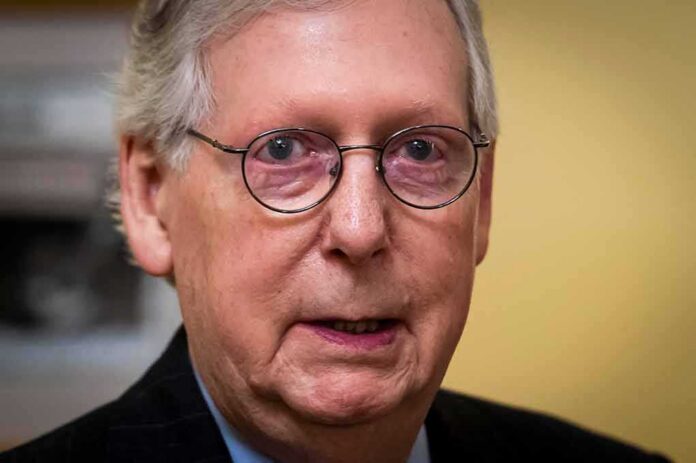
Senator Mitch McConnell rolled onto the Senate floor in a wheelchair and cast his first vote since June—ending months of absence with a single, concrete act.
Story Snapshot
- McConnell returned to the Capitol and cast his first vote since June 11.
- He arrived in a wheelchair and spoke briefly before heading to the floor.
- His office cited a long recovery and lingering effects of childhood polio.
- The vote concerned a real roll call on judicial confirmation, not a cameo.
A visible return tied to an actual vote
Senator Mitch McConnell of Kentucky came back to the Senate and cast an in-person vote, his first since June 11. C-SPAN floor footage shows the moment he returned to the chamber to vote, removing doubt about his presence and activity that night. ABC News reported he told reporters he looked forward to seeing colleagues before heading to the floor, marking the end of his months-long gap in voting. The act was routine for the Senate, but important for his caucus and the chamber.
Reporters and video crews captured him arriving in a wheelchair. The visual underscored his recovery but did not change the core fact: he was there to work. ABC News described him moving toward the chamber to make the vote after a short exchange with the press. A YouTube clip carried the same detail about the wheelchair, aligning with eyewitness accounts in the Capitol that evening. The image may lead headlines, but the vote was the point.
What his office says about the layoff
McConnell’s office explained the long break from the Capitol as a recovery period. He underwent physical therapy after a June fall and said childhood polio effects made the process harder. He added he was not yet at one hundred percent but was improving. That statement matches the long gap in the public schedule and the decision to use a wheelchair for the return trip. The framing aimed to set expectations without getting into private medical specifics.
The timeline fits public records and basic Senate rhythms. He had not cast a vote since June 11, then reappeared in mid-September to take part in a roll call. Coverage specified that the vote concerned a district court judge, which means this was not a ceremonial reentry but a counted decision in live business. That matters for governance. A majority leader emeritus showing up to vote signals ongoing engagement with the docket, not just optics.
Why the vote itself matters more than the wheelchair
Every Senate vote carries weight in a closely divided chamber. Showing up restores a predictable whip count and steadies committee math. It also signals to allies and rivals that he plans to stay in the trench of nominations and floor action. C-SPAN’s labeled clip anchors that signal in on-camera proof of service on the floor, which is the standard that counts in the Senate’s culture and record. Chairs and canes come and go; roll calls shape the courts and the code.
Coverage noted greetings from Republican colleagues as he moved to vote, a normal scene when a senior figure returns to duty. The summary reports align on the basics: he arrived, he spoke briefly, he voted, and he left. ABC News placed him back in the building that evening, connecting the dots from his public statement of intent to the action on the floor. The wheelchair drew eyes, but the roll call drew the line under the question of whether he would resume core duties.
The recurring lesson on health, privacy, and power
Congress does not require detailed health disclosures for members. That gap often shifts attention from policy to personality and from votes to visible symptoms. Analysts have long observed that coverage of leaders’ health tilts toward political stakes over clinical facts, especially when the calendar is busy and margins are thin. That pattern was present here in the weeks leading up to his return, but the act of voting resets the frame to what the Senate exists to do: record decisions.
Senator Mitch McConnell made his return to the U.S. Senate on Monday, ending a three-month absence following a fall at his Washington, D.C. home that resulted in hospitalization and a lengthy recovery. https://t.co/UuaI6J4pgX
— NewsRadio WHAM 1180 (@WHAM1180) September 15, 2026
The day’s bottom line is plain enough for anyone who prefers results over rumor. McConnell said he would return to vote, he arrived in a wheelchair, he reached the floor, and he voted. The chamber’s cameras captured it. The press confirmed it. The office explained the rehab and the role of past polio in slowing the comeback. For citizens who value work over theater, that checklist is the right measure of capacity and commitment.
Sources:
cnbc.com, yahoo.com, washingtonexaminer.com, youtube.com, c-span.org, lpm.org
© partiallypolitics.com 2026. All rights reserved.