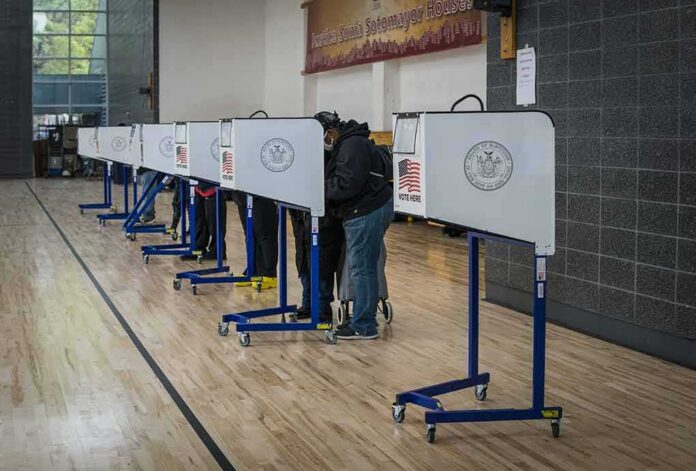
Four Republican senators crossed the aisle and helped Democrats stall the SAVE America Act, turning a debate about voter ID and citizenship checks into a referendum on access versus accountability.
Story Snapshot
- The SAVE America Act would impose documentary proof of citizenship to register for federal elections and tighten voter ID rules [11][15][17].
- Democrats framed the bill as voter suppression; Senate leaders touted blocking maneuvers that halted it again [2][7].
- Advocacy groups warned of burdens on eligible voters lacking passports or birth certificates, and of potential chaos for election offices [5][11].
- The White House-branded pitch emphasizes restoring confidence by ensuring only citizens vote, underscoring a national integrity-versus-access collision [12][11].
How a narrow election bill became a proxy war over trust
The SAVE America Act targets one seam: citizenship verification at registration and stricter identification at the polls. Nonpartisan explainers note it would require documentary proof of citizenship and preempt many existing state workflows, particularly those that rely on sworn attestations without hard documents [11][15][17]. Democratic caucus materials summarize the text as amending the National Voter Registration Act to allow or compel documentary proof where it is currently constrained, a sharp procedural turn with downstream effects for mail and online registration [16][17].
Democrats framed the bill as an anti-voter package and celebrated its defeat in the Senate. Senator Alex Padilla said the legislation would block common identification forms, burden mail balloting, and chill registration efforts, calling it voter suppression “plain and simple” [2]. The Campaign Legal Center echoed that the bill would dramatically restrict how Americans register and cast ballots, labeling it a sweeping contraction of access rather than a calibration of safeguards [7]. That narrative, once established, shaped the floor dynamics.
Why four Republicans broke ranks
The Republican defections signaled a tactical and administrative calculus more than an ideological conversion. The Bipartisan Policy Center warned that the bill could impose unfunded mandates and expose election officials to new penalties while forcing rapid redesigns of registration systems [11]. For risk-averse lawmakers, a vote to slow or block a complex federal preemption during an election cycle can read as prudence, not apostasy. That choice also neutralizes a Democratic line of attack that paints the measure as hurried and disruptive [2][11].
Another consideration: opponents argue millions of eligible citizens lack ready access to passports or certified birth records. The Brennan Center asserts that documentary requirements would delay or deny registration for a significant share of lawful voters, especially seniors, rural residents, and low-income Americans [5]. Even if supporters point to affidavit fallbacks in some drafts, the public-facing opposition claims those exceptions either do not apply broadly or shift friction to the voter and clerk, inviting errors, litigation, and distrust [11][5].
Conservative case for guardrails, and where this bill overreaches
Election integrity resonates with conservative common sense: show identification, verify eligibility, and keep rolls clean. The White House-branded description of the SAVE America Act leans into that appeal, asserting that Americans should not have to guess whether only citizens are voting [12]. But good policy also values federalism, clear implementation, and avoiding collateral damage to eligible voters. A top-down mandate that preempts well-functioning state systems and threatens clerks with penalties invites bureaucratic paralysis rather than confidence [11][17].
Sound reform starts with measured steps that validate citizenship with existing government data, provide low-cost document pathways, and give administrators time and funding to adapt. The National Conference of State Legislatures notes the proposal would override state rules and impose strict identification requirements, a red flag for conservatives skeptical of Washington one-size-fits-all fixes [17]. Build trust by closing demonstrated gaps with auditable processes, not by detonating registration pipelines weeks or months before ballots go out.
The path forward: precision beats spectacle
Congress can separate principle from posture. A targeted citizenship audit that uses federal and state databases, funded modernization of motor-voter interfaces, and a uniform, no-cost affidavit with post-election verification would advance integrity without throttling access. Independent assessments flagged in the policy debate recommend implementation studies, document-ownership analyses, and side-by-side workflow testing before sweeping changes land on county desks [11]. Voters deserve rules that are strict where proof exists, forgiving where bureaucracy fails, and clear enough that clerks will not need a lawyer at check-in.
McConnell and Tillis are gone. Get rid of Murkowski in the general election – make her wish she hadn't played games with ranked voting, and elect other Republican Senators so that Collins is irrelevant.
BREAKING: Senate Votes 48-50 to Reject SAVE America Act – FOUR Republicans…
— Patrick Casey (@PatrickJCasey) June 5, 2026
The four Republicans who tapped the brakes likely read the moment: this bill’s brand promises confidence, but its mechanics risk confusion. Better to deliver a focused integrity upgrade that survives scrutiny than a sprawling mandate that collapses under its own weight. Voters will reward leaders who secure the process and protect every lawful ballot—without turning registration into a paperwork scavenger hunt.
Sources:
[2] Web – The SAVE Act Status: Congress takes up even worse anti-voter bills
[5] Web – What Is the SAVE America Act and Why Is It Dangerous … – VoteRiders
[7] Web – SAVE Act Successfully Stalled in Senate as a Result of Tireless …
[11] Web – Stand Up AGAINST The SAVE Act – Rock the Vote
[12] Web – Five Things to Know About the SAVE America Act
[15] Web – On the floor to talk about why I’m voting against the SAVE Act. |…
[16] Web – Explainer: SAVE, SAVE America and MEGA Acts – Issue One
[17] Web – [PDF] SAVE Act Section-by-Section_BRANDED
© partiallypolitics.com 2026. All rights reserved.