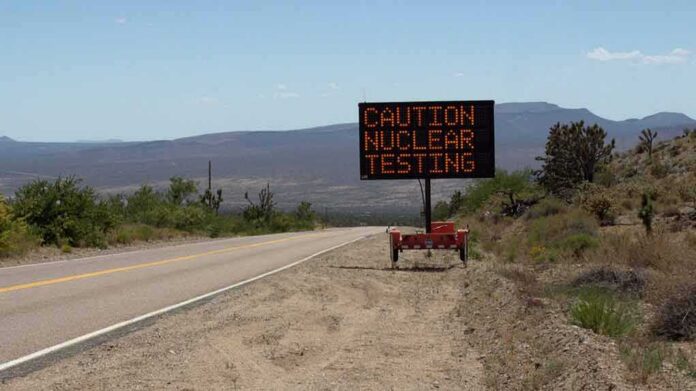
The United States quietly blew up a tunnel in Nevada to get better at catching cheaters who try to hide nuclear tests.
Story Snapshot
- Energy Department ran a non-nuclear blast at the Nevada National Security Site to sharpen detection of small or masked nuclear explosions.
- Engineers targeted “decoupled” scenarios that can muffle seismic signals and trick monitors.
- The shot occurred in the P Tunnel, Area 12, using chemical high explosives and radiotracers.
- Data will validate models and update algorithms used by U.S. detection networks.
What Happened Underground And Why It Matters
The National Nuclear Security Administration ran a subsurface, non-nuclear chemical explosion inside the P Tunnel at the Nevada National Security Site. The agency said the goal was to improve how the United States detects low-yield nuclear blasts around the world. The test used conventional high explosives and radiotracers, not a nuclear device. Collected data will help validate models and refine detection algorithms that feed U.S. monitoring systems and allies who rely on American sensors.
Officials framed the experiment around a tough problem: decoupled explosions. A nation can carve or use a large underground cavity to blunt the seismic punch of a small nuclear blast. That trick makes the blast look more like an earthquake or a mine collapse, or it can drop the signal below common thresholds. By mimicking the physics with a chemical shot, scientists can tune the math, check sensor layouts, and close known gaps in real-world monitoring.
Where The Data Comes From And How It Gets Used
Teams instrumented the site with accelerometers, seismometers, infrasound microphones, and electromagnetic sensors. They also used samplers for chemical traces and radiotracers, plus weather gear to capture how gases or dust might move. The mix lets analysts line up ground motion, air pressure waves, and other signals into a single time-tagged picture. That picture gets used to test and train the software that flags suspect events from the noisy stream of daily quakes and blasts.
Model validation sounds dull, but it is the fulcrum of deterrence. Clear math and clean data make it harder for any country to cheat a test ban and get away with it. The Nevada site offers known rock, mapped tunnels, and tight control, so results carry weight. Past national studies show broad detection is strong down to small yields in hard rock when networks are dense and tuned. Decoupling, geology, and sparse stations are the classic spoilers that these trials work to tame.
The Global Game: Cheaters, Masks, And American Leverage
Rogue actors try two plays: go small or hide the punch. Small, deeply buried yields can blur into background events. Decoupling inside a cavity can mute signals even more. The United States builds counterplays by testing those tricks with safe stand-ins, then pushing updates across its systems. That supports treaty goals without a nuclear shot. It also sends a message: the net is always getting tighter, and the odds of slipping through are shrinking each year.
🔴 U.S. detonates conventional explosives in Nevada tunnel to simulate concealed nuclear test
The National Nuclear Security Administration conducted a test yesterday in P Tunnel at Nevada National Security Site using chemical high-explosives and radiotracers to replicate a… pic.twitter.com/OMuxj3UUue
— NewsTongue (@NewsTongueX) October 1, 2026
Some outlets linked the drill to worries about covert testing by China or Russia. The agency’s public aim stayed broad: sharpen tools for low-yield and decoupled cases anywhere. That focus fits long practice. For decades, national labs have run controlled chemical blasts to benchmark sensors and code. The Nevada network and its tunnel stock make it a natural lab. The Department of Energy’s own readout underscores the routine but vital purpose: better models, better algorithms, better detection.
Common Sense Check: Security Without The Theater
This was not a nuclear test. It was a science test that helps law, order, and peace. It respects the line between research and weapons work while backing consequences for cheaters. That aligns with conservative principles: strength through readiness, clarity over wishful thinking, and spending that buys measurable safety. The payoff is concrete. Better sensing reduces surprise, backs sanctions with evidence, and lowers the chance that a quiet cheat becomes a loud crisis later.
Sources:
kolotv.com, washingtontimes.com, energy.gov, ground.news, newsnationnow.com
© partiallypolitics.com 2026. All rights reserved.