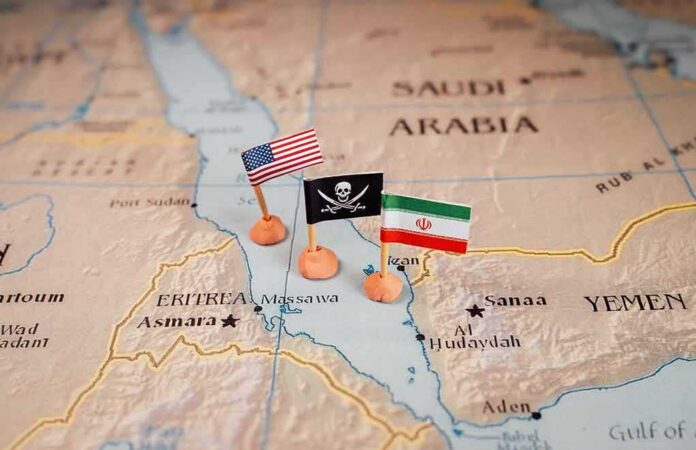
Yemen’s Saudi-backed leadership just declared a fight to pry the Bab al-Mandab gateway from Iran-backed Houthis and calm a Red Sea on edge.
Story Snapshot
- Yemen’s presidential council announced new military operations to retake Houthi-held areas.
- Saudi-supported planning centers on restoring control near the Bab al-Mandab Strait.
- Houthis recently gained ground along the Red Sea coast, boosting leverage over shipping.
- Analysts say Houthis can threaten traffic without owning the whole waterway.
What Was Announced And Why It Matters Now
Rashad al-Alimi, head of Yemen’s presidential council, said government forces launched operations to retake all remaining Houthi territory and restore state authority nationwide. Saudi-backed planners framed the push as a needed answer to recent losses along the Red Sea coast. The stated aim reaches beyond battlefield maps. It speaks to energy prices, trade routes, and the safety of ships that pass the narrow Bab al-Mandab every day. That choke point links the Red Sea to global markets.
Saudi and Yemeni officials described a plan led by Yemeni ground units, paired with Saudi airpower, to roll back Houthi positions that now sit astride key coastal corridors near the strait. The logic is simple: push the Houthis off terrain that lets them threaten ships, and you lower the odds of a wider crisis. That goal tracks with basic conservative principles—secure lanes, deter aggression, and reassert state control without endless war.
How The Battlefield Tilted Toward The Houthis
The Houthis seized momentum in September, racing down the Red Sea coast, reaching or crossing nodes that anchor control near Bab al-Mandab. Reports tied their advance to Mocha and districts near the strait, with government units withdrawing from positions like Perim Island and Dhubab during the surge. That run improved the Houthis’ bargaining power. It also put them in range to menace trade, even if navies still patrol the waterway itself. That is leverage, not full dominion.
The pattern tracks Yemen’s recent past: one side claims a coming turning point, then the front grinds back to attrition. Outside studies and news accounts have long called the war a lesson in limits, not easy wins. The last decade showed that airstrikes and proxies do not replace hard political work. Still, states act when choke points feel exposed. The Red Sea carries oil, goods, and food; delay there cascades into price spikes and jittery markets.
What Each Side Says About Risk To Shipping
Houthis argue that navigation stays safe and regular, casting control as compatible with trade and order. Analysts disagree on the level of risk, but many say Houthi control of shores and nearby islands gives them the ability to threaten, slow, or pick targets at will, without owning the sea itself. That gap matters. A single drone or missile near a narrow channel can change insurance rates, divert ships, and raise costs that hit American consumers.
🚨🇾🇪 Saudi-backed Yemeni government forces have launched a major offensive against the Houthis, with fighting spreading toward the strategic Bab el-Mandeb Strait. The escalation puts another key global shipping route under pressure. 🌊⚠️#Yemen #RedSea #BreakingNews pic.twitter.com/8dqqVXoqaZ
— Camila Rocha (@_camilarocha_1) October 5, 2026
Saudi and Yemeni officials say the counteroffensive reduces that risk by pushing launchers and scouts off the coastline. Critics will ask whether air raids alone can lock in gains or if ground units can hold difficult terrain. Common sense says logistics, discipline, and clear end goals decide that. If the campaign reopens secure corridors to Taiz and stabilizes the strait’s Yemeni side, that is progress. If not, ships will keep paying a fear premium while fronts shift.
The Near-Term Markers That Tell Us If This Works
Watch three things over the next weeks. First, control of Mocha, Dhubab, and Perim Island; those posts shape access to the strait. Second, the Taiz–Aden supply line; the government’s ability to keep it open signals staying power. Third, reported attacks on shipping and Saudi infrastructure; a decline would suggest pressure works, while a spike means the Houthis still hold cards. Officials claim momentum; hard, mapped terrain and calmer seas will prove it.
Sources:
youtube.com, reuters.com, english.aawsat.com, latimes.com, axios.com, ynetnews.com
© partiallypolitics.com 2026. All rights reserved.