Defense Secretary Pete Hegseth’s plane, mid-Atlantic, hurtling toward the ocean—not from enemy action, but from a crack in the windshield, forcing an emergency descent and landing that raises urgent questions about the safety of America’s aging executive airlift fleet.
Story Snapshot
- Defense Secretary Pete Hegseth’s Air Force C-32A, returning from a NATO Defense Ministers meeting in Brussels, was forced into an emergency landing at RAF Mildenhall, UK, after a windshield crack was detected mid-flight.
- This marks the third windshield-related incident involving senior U.S. officials in 2025, spotlighting concerns over the reliability of executive transport aircraft, many of which are deep into their service lives.
- All passengers and crew, including Hegseth, were unharmed; emergency protocols were executed flawlessly, but the incident disrupted critical defense coordination at a time of heightened NATO activity.
- The absence of Pentagon press corps on the flight, due to ongoing media tensions, left the public dependent on official statements, highlighting information asymmetry in executive branch operations.
The Incident: What Happened Over the Atlantic
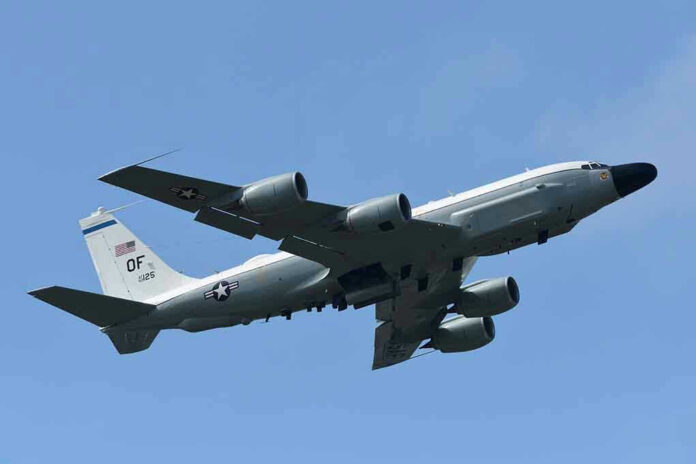
Defense Secretary Pete Hegseth boarded a U.S. Air Force C-32A—a modified Boeing 757-200—departing Brussels after high-stakes NATO meetings focused on Ukraine. Midway across the Atlantic, the crew detected a cracked windshield, triggering an emergency descent to 10,000 feet. The aircraft diverted to RAF Mildenhall, UK, where it landed safely. Hegseth later posted “All good. Thank God. Continue mission!” on social media, but the implications of the event reach far beyond a single safe landing.
Flight trackers confirmed the rapid altitude loss and emergency signal broadcast, standard procedure for potential cabin depressurization. The cause of the windshield crack remains unclear, but the crew’s response demonstrated textbook adherence to safety protocols. This incident, however, is not isolated. Earlier in 2025, Secretary of State Marco Rubio’s C-32 also turned back due to a windshield issue, and President Trump’s Marine One helicopter experienced a hydraulic failure, forcing an unscheduled landing just weeks before Hegseth’s episode.
The Fleet: Aging Workhorses Under Strain
The C-32A fleet, modified from commercial Boeing 757s, serves as the backbone of U.S. executive airlift, transporting the Vice President, Cabinet members, and other high-ranking officials. These aircraft are now well into the second half of their service lives, relying on upgrades to extend operational viability. While the 757 platform has a strong safety record, the frequency of recent incidents suggests wear and tear may be outpacing maintenance and modernization efforts. A replacement program is in its early stages, but the clock is ticking—each incident amplifies calls for accelerated procurement.
Windshield failures can result from bird strikes, extreme temperature shifts, manufacturing defects, or fatigue from repeated pressurization cycles. Three incidents in eight months point to a potential systemic issue, not just bad luck. The Department of Defense and the Air Force now face mounting pressure to ensure the reliability of aircraft entrusted with the nation’s top leaders, especially during periods of global tension and rapid decision-making.
Operational and Diplomatic Fallout
Hegseth’s diversion delayed his return during a critical moment for NATO and Ukraine defense coordination. The Ukraine Defense Contact Group meetings demand real-time, high-level decision-making; any interruption in the Defense Secretary’s availability risks cascading effects on alliance operations. The incident also highlighted the robust U.S.-UK military partnership, with RAF Mildenhall providing a safe haven, but it underscored vulnerabilities in continuity of government during international crises.
Pentagon spokesperson Sean Parnell emphasized that standard procedures were followed, and no injuries occurred. Yet, the absence of the Pentagon press corps—a result of ongoing disputes over journalist access—meant the public relied solely on official accounts. This lack of independent verification raises questions about transparency and accountability in executive branch operations, a concern that resonates with conservative values of open government and civilian oversight.
Public Confidence and the Path Forward
Repeated incidents involving the President, Secretary of State, and now the Defense Secretary erode public confidence in the safety of executive transport. While emergency protocols worked as designed this time, the pattern invites scrutiny of maintenance practices, inspection rigor, and fleet management. The C-32A’s advanced age is a known factor; the question is whether upgrades can keep pace with the demands of modern, high-stakes diplomacy.
Boeing, as the original manufacturer, faces indirect reputational risk, though the 757’s commercial safety record remains strong. The U.S. government must balance the cost of new aircraft against the risks of extending service life for critical assets. For taxpayers and policymakers, the equation is straightforward: invest now in next-generation executive transport or accept heightened risk during future missions.
This incident, while concluding safely, serves as a wake-up call. The U.S. cannot afford mechanical uncertainty when transporting its leaders across the globe. The solution lies not just in better maintenance, but in a clear, accelerated path to modernizing the executive airlift fleet—a move that aligns with conservative principles of preparedness, accountability, and prudent stewardship of national resources.
Sources:
The War Zone: C-32A Carrying Hegseth Makes Emergency Landing in England After Rapid Descent
ABC News: Pentagon chief’s plane diverted to UK due to cracked windshield