
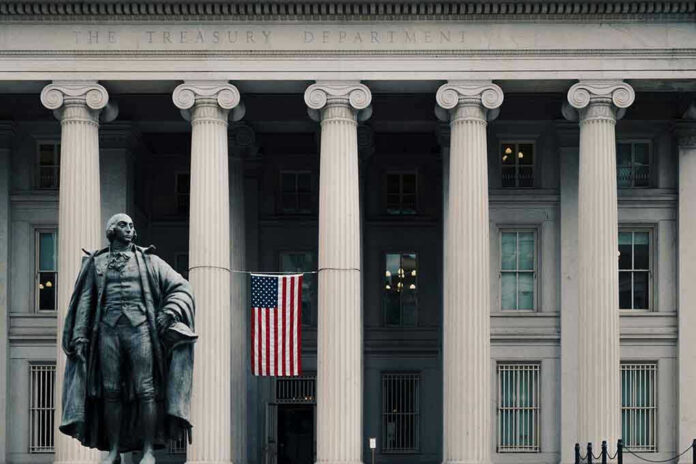
The real story isn’t a dramatic Treasury “portrait cover-up”—it’s how fast a made-for-outrage claim can outrun the boring discipline of evidence.
Quick Take
- No verified public record shows Judicial Watch suing the Treasury Department over Larry Summers’ official portrait.
- Summers appears in Epstein-related disclosures, but mention in files does not equal criminal wrongdoing.
- Judicial Watch’s documented Epstein-related actions focus on FOIA fights with agencies like DOJ and CIA, not Treasury portrait protocols.
- The gap between what people want to be true and what can be proved is where misinformation thrives.
What’s Actually Verifiable About the “Covered Portrait” Claim
The premise that Judicial Watch sued the Treasury Department for covering Larry Summers’ official portrait after his name surfaced in Epstein files collapses under basic verification. Searches of publicly available reporting and Judicial Watch’s own published actions show no matching lawsuit, no court breadcrumbs, and no clean timeline. When a claim can’t produce a docket number, a press release, or reputable coverage, it belongs in the “unsubstantiated” bin until proven otherwise.
That doesn’t mean the topic is harmless gossip. It is a case study in how modern political narratives get manufactured: pick a disliked institution, add Epstein’s name, sprinkle in “cover-up,” and watch the story move. Adults who lived through the Clinton-era scandals and the post-9/11 secrecy fights know this pattern. The lesson is not “trust government.” The lesson is “don’t outsource your judgment to viral certainty.”
Why Larry Summers’ Name Creates Heat Even Without Charges
Larry Summers served as U.S. Treasury Secretary from 1999 to 2001 and later held prominent academic roles. Epstein’s network reached into elite circles, and file references have revived scrutiny of people who interacted with him socially or professionally. Summers has not been charged, and file mentions do not automatically imply wrongdoing. Still, reputational damage doesn’t wait for indictments, and institutions often act defensively to reduce controversy rather than to prove a legal claim.
That defensive reflex matters because it fuels a second-order problem: it creates “plausibility fog.” When universities, foundations, or agencies tighten access to records, change websites, or manage public-facing honors, observers may assume a cover-up even when mundane reasons exist. Conservatives are right to demand transparency from powerful institutions. Common sense also demands a basic standard: claims should match documented actions, and accusations should track verifiable facts, not vibes.
What Judicial Watch Has Actually Been Doing on Epstein Transparency
Judicial Watch has a recognizable playbook: use Freedom of Information Act requests, then sue when agencies stall. That approach reflects a conservative instinct I share—bureaucracies don’t volunteer embarrassing information, and courts often become the only lever that forces compliance. Publicly documented Judicial Watch actions related to Epstein have targeted agencies that hold investigative or intelligence materials, where records and resistance predictably concentrate.
That focus makes the supposed Treasury-portrait lawsuit stick out as odd. Treasury is not the primary custodian of Epstein investigative files in the way DOJ, FBI, or CIA can be. A portrait controversy would also require a clear, provable act—an order, a policy memo, a facility decision—something concrete that could be challenged. The absence of those markers is the tell. Real litigation leaves a paper trail because the whole point is to create one.
How Misinformation Wins: A Claim Built to Be Shared, Not Checked
The “portrait covered after Epstein files” storyline works because it hits three emotional triggers at once: elite impunity, institutional secrecy, and symbolic erasure. A covered portrait sounds like a movie prop—visual, humiliating, and instantly legible. Readers don’t need to understand FOIA timelines or agency record systems to feel they’ve grasped the scandal. That’s exactly why such stories spread: they minimize mental effort and maximize moral certainty.
People over 40 have a hard-earned advantage here: you’ve watched news cycles generate villains, then quietly move on when facts don’t cooperate. The conservative approach to information warfare should not be “believe nothing.” It should be “reward receipts.” Docket numbers, agency letters, dated statements, and consistent reporting across outlets create credibility. When those are missing, the claim might be entertainment—but it shouldn’t be treated as evidence.
What the Summers-Harvard Episode Signals About Institutional Risk Management
The more defensible, evidence-backed development is simpler: scrutiny around Epstein associations has had real-world consequences for reputations and institutional roles. Summers’ departure from Harvard-related positions amid renewed attention illustrates how organizations try to cut risk when the public conversation turns toxic. Universities, in particular, live on donor confidence and prestige, so even non-criminal associations can become a governance problem they want off the front page.
This dynamic creates a political trap. If institutions act, critics say, “See, they’re admitting guilt.” If institutions don’t act, critics say, “See, they’re protecting their own.” That’s why precision matters. Accountability should be proportional to facts: wrongdoing deserves consequences; mere mention in files warrants scrutiny and questions, not automatic conviction. Conservatives should insist on that distinction, because abandoning it hands cultural power to rumor.
A Practical Standard for Readers: How to Tell FOIA Reality from Internet Theater
Use a three-question filter before buying a claim like the Treasury-portrait lawsuit. First: where is the filing—case number, court, date? Second: who confirmed it outside the interested party, and do they provide documents? Third: does the alleged target agency even make sense as the keeper of the disputed material? Applying that standard doesn’t weaken skepticism of government. It strengthens it by keeping skepticism tethered to proof.
The open loop in all Epstein-related transparency fights remains unresolved: what relevant records still sit behind redactions, delays, and institutional self-protection? Judicial Watch’s real cases aim at that question through FOIA, where law—not narrative—sets the rules. The fake story about a covered portrait is a distraction. The harder, slower story is the one worth following: who has the documents, who won’t release them, and what the courts ultimately force into daylight.
Sources:
Former US Treasury Secretary to resign from Harvard amid Epstein investigation
Judicial Watch Sues CIA for Jeffrey Epstein Records