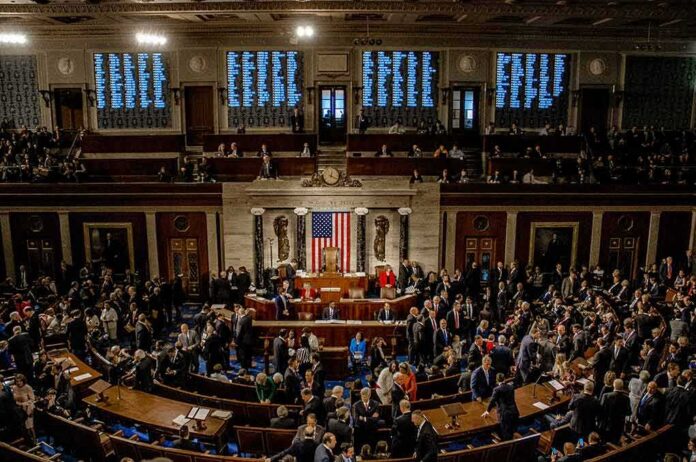
Senate Republicans kept John Thune in charge even as they prepared to move into the minority.
Story Snapshot
- John Thune won another term as Senate Republican leader with no announced challenger.
- Republicans voted 31-15 to hold the election now, rejecting a delay push led by Ron Johnson.
- The choice signaled continuity as Democrats were set to control the next Senate.
- Closed-door rules left no public vote total for Thune’s support, beyond acclamation.
Thune Retained To Steer Republicans Through Minority Transition
Senate Republicans reelected John Thune as their leader for the 120th Congress, and they did it without an announced challenger. Thune thanked colleagues for their support and said the conference had an “open, honest, and transparent conversation” before the vote. Democrats were set to hold the majority in the new Congress, so the decision locked in a steady hand for a tougher map. The conference presented a clear signal: stay the course during a change in power.
Before backing Thune, Republicans faced a first test on timing. Senators voted 31-15 to proceed with the leadership election rather than delay it, an effort pushed by Senator Ron Johnson and others after sharp midterm setbacks. That margin showed most Republicans wanted to settle leadership fast. It also showed a real minority wanted more time to study what went wrong. The vote set the stage for Thune’s smooth retention as leader.
What The Process Shows About Power Inside The Senate
The Senate runs leadership elections inside party conferences, not on the chamber floor. That means the public sees the outcome, not all the steps. Reports described the Thune selection as unopposed or by acclamation, and no official tally for his support was released. That process is not new. Conference-elected leaders have guided floor action for more than a century, and parties pick them at the start of each Congress under their own rules.
History says continuity after losses is normal in the Senate, not a shock. Party leaders often survive setbacks because colleagues judge them on inside work, not just election night. Robert Byrd stayed leader when Democrats lost power in 1980. Republican Bob Dole kept his role after the 1986 shift. The pattern teaches a simple lesson: senators prize steadiness when leverage is thin and margins are close.
Why Republicans Chose Steady Over Flash
Republicans faced a choice between two messages. One was to pause and reopen the map of leadership. The other was to close ranks and start planning for minority fights on judges, amendments, and must-pass bills. They chose the second path. Thune framed the moment as a chance to align and prepare, telling colleagues he valued direct talk inside the room. The party now owns that bet and its results in the next session.
Some conservatives had argued for more time, saying the party needed a deeper look at losses and strategy before locking leadership. Their push failed on the timing vote. From a common-sense conservative view, the majority’s case is clear: stability can raise bargaining power when numbers are against you. The counter-case is also plain: delay might have forced sharper reforms. The conference weighed both and moved ahead.
What To Watch Next: Leverage, Unity, And Measurable Wins
The test now moves from the cloakroom to the floor. Watch whether Republicans keep high unity on close votes, shape bipartisan deals on terms that reflect core promises, and slow or reshape the other side’s priorities when needed. Also track how leadership handles judicial and executive nominations. Minority leaders earn trust when they protect red lines and cut smart trades. That is where this decision will show its value or its limits in real time.
Just a key bit everyone needs to remember.
John Thune is Leader because OTHER SENATE REPUBLICANS VOTED HIM INTO THAT POSITION!!
It’s not just him, it’s ALL OF THEM!
— Erik Kiehle For Congress 🇺🇸 (@Kiehle4Congress) November 11, 2026
The number that lingers is 31-15. It does not measure Thune’s support directly, but it marks the size of the faction that wanted more time. That bloc can still steer debates inside the conference if it stays organized. The leader’s job is to harness that energy, not ignore it. If he converts it into sharper tactics and clearer goals, Republicans can punch above their weight. If not, the pressure to revisit leadership will return.
Sources:
pjmedia.com, thune.senate.gov, politico.com, inquirer.com, rgj.com, washingtonpost.com
© partiallypolitics.com 2026. All rights reserved.