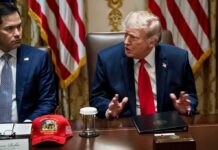
President Trump said he and Israeli Prime Minister Benjamin Netanyahu agreed to end roughly $4 billion in yearly U.S. support for Israel by the close of 2026, and he framed it as a mutual decision rooted in Israel’s strength.
Story Snapshot
- Trump said a deal with Netanyahu ends about $4 billion a year in U.S. support.
- He set the target as the end of 2026, while saying help could still flow if needed.
- He argued Israel is strong and does not need regular payments.
- The long-standing 10-year framework has guided Israel aid since 2019.
What Trump Announced, When He Said It, and Why It Matters
Trump told Fox & Friends on November 3, 2026, that he and Netanyahu agreed “months ago” to stop annual U.S. support of about $4 billion by year’s end. He tied the plan to Israel’s economic and military strength and said, “they don’t need it,” calling the regular payments wasteful. He also said the United States would still help if Israel needed support and could keep buying U.S. weapons. Multiple outlets reported his remarks the same day.
Trump described the $4 billion as a blend of “things and money,” which differs from how most analysts describe the current arrangement. For years, coverage has centered on the 2016 ten-year framework that totals $38 billion from fiscal year 2019 through fiscal year 2028. That framework is often summarized as $3.8 billion each year, mostly through a grant program called Foreign Military Financing and joint missile-defense funds, all subject to Congress.
How This Fits the Long Arc of U.S.-Israel Aid
U.S. support to Israel usually runs through stable, multi-year understandings rather than ad hoc checks from the White House. Since 1999, the two countries have used ten-year memoranda of understanding that set aims and levels, while Congress provides the money each year. The current plan, signed in 2016, covers fiscal year 2019 through fiscal year 2028 with a $38 billion total, shaping annual spending but still tied to appropriations votes in Congress.
Past transitions show a pattern. The first ten-year plan phased out economic aid but kept military support, creating a glide path instead of a cliff. That history explains why Trump’s timeline grabs attention. Ending routine grants by the end of 2026 would compress the final years of the existing framework. It would also shift the center of gravity to arms sales and case-by-case support, which he said would still be on the table if Israel asked.
The Numbers, the Timeline, and the Moving Parts
The figure Trump used, about $4 billion, lands close to the widely cited $3.8 billion commitment under the current plan. The higher round number likely reflects weapons and support beyond a single grant line. Still, many readers will ask what exactly ends and what continues. Trump said the routine payments stop, but Israel can still buy U.S. weapons and receive help if needed. That points to a pivot from guaranteed yearly grants to demand-driven support.
Brent crude fell ~3% to about $101 a barrel Tuesday, its lowest since Oct 8, after Trump said the US will stop ~$4bn a year in military aid to Israel by end-2026. Traders read it as lower escalation risk in the US-Iran war. Details of the "deal" are still unclear. #Oil
— Flags & Filings (@FlagsAndFilings) November 3, 2026
The timeline centers on the end of 2026, which intersects with the back half of the 2019–2028 framework. Congress shapes the money each fiscal year, and the framework guides those choices. If the regular aid ends sooner than the plan’s sunset, the policy path would need to align with appropriations. That is not a barrier by itself; it is the normal way defense funding moves. The point is simple: a clear decision, paired with a clear process, gets results without drama.
Why Trump’s Framing Resonates With Conservative Priorities
Trump’s case centers on strength, self-reliance, and value for taxpayers. Allies that build strong economies and capable militaries should carry more of their own load. That matches common sense and a long-standing conservative view of foreign aid: support friends, but do not write automatic checks forever. If Israel does not need the yearly grant, ending it looks like fiscal discipline. If a crisis hits, the United States can surge targeted help, which avoids waste while keeping deterrence credible.
What to Watch Next
Watch for clarity on three items. First, the exact makeup of the “$4 billion” and which parts shut off. Second, how Congress handles the next appropriations cycle in light of the end-2026 target. Third, the channel for any future help—whether through arms sales, joint missile-defense projects, or one-time emergency packages. The picture that emerges will show whether this is a clean stop, a phased glide path, or a pivot to a leaner toolbox that still keeps Israel’s edge.
Sources:
cbc.ca, bloomberg.com, ctvnews.ca, en.globes.co.il, gao.gov, congress.gov
© partiallypolitics.com 2026. All rights reserved.