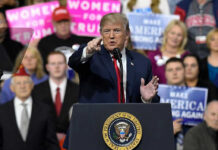

A stunning policy shift now threatens to split the conservative movement, as President Trump declares openness to allowing 600,000 Chinese students into the United States—raising alarm over national security, American jobs, and the consistency of “America First” principles.
Story Snapshot
- Trump’s statement about admitting 600,000 Chinese students marks a sharp reversal from prior hardline visa policies.
- Security officials and Trump’s own base voice concerns about espionage and the erosion of “America First” priorities.
- US universities, financially dependent on international students, stand to benefit if the policy becomes reality.
- No formal policy change has yet occurred; visa scrutiny remains high and the situation is fluid.
Trump’s Announcement: A Dramatic Policy Reversal
On August 25, 2025, President Trump publicly declared support for allowing up to 600,000 Chinese students to study in the United States, a number more than double the 277,000 enrolled in 2023-2024. This surprise announcement comes after years of tightened visa controls and mounting skepticism toward Chinese nationals in academia, particularly in sensitive STEM fields. The move is widely interpreted as a dramatic rhetorical shift and has sparked immediate debate among conservative commentators, national security officials, and university leaders.
Trump’s rationale hinges on the potential diplomatic and economic benefits of restoring and even expanding Chinese student enrollment, provided that national security is not compromised. This new openness stands in stark contrast to the policies enacted both during his first term and the early months of his second, which included aggressive visa revocations and scrutiny, especially for students with alleged Chinese Communist Party ties. Many in Trump’s political base and conservative media now question whether this policy signals a departure from core “America First” values, highlighting the tension between economic interests and security priorities.
Security Concerns and Conservative Pushback
National security officials, including Secretary of State Marco Rubio, maintain a hard line on Chinese student visas, insisting on aggressive scrutiny and rapid revocation for any applicants with links to the Chinese Communist Party or sensitive research fields. These measures remain in effect as of late August 2025, with no immediate policy change beyond Trump’s public remarks. Conservative commentators and right-wing outlets have been especially vocal, arguing that such a large influx of Chinese students risks intellectual property theft and undermines American sovereignty. The contradiction between Trump’s statement and his earlier restrictions has generated confusion and frustration among supporters who expect consistency on immigration and security.
University administrators, however, warn that further tightening would be a “serious blow” to academic research and institutional finances. Many US universities, particularly in STEM and graduate programs, rely on international tuition revenue and talent pipelines. If Trump’s proposal moves from rhetoric to concrete policy, institutions could see a dramatic financial boost, but only at the risk of intensifying scrutiny from both the government and the public.
Economic Impact and Political Fallout
Admitting 600,000 Chinese students would provide a major economic lift to US higher education and local economies, reversing the enrollment declines of recent years. However, this prospect also raises social and political questions—namely, whether American students might lose opportunities, and whether communities could see increased anti-Asian sentiment or backlash. Politically, Trump’s announcement has exposed a rift between economic pragmatists and hardline nationalists within the conservative movement. As debate intensifies, the policy’s implementation remains uncertain: no official changes to visa issuance have been made, and aggressive security vetting continues across federal agencies.
Trump Says He’ll Allow 600,000 Chinese Students To Study In US https://t.co/HXaAdOQC3y via @dailycaller
— Jonathan D. Pratt, Ph.D. (@jondpratt) August 25, 2025
For now, the situation remains in flux. Trump’s statement may be a trial balloon to gauge public reaction or a signal of intent to Chinese negotiators. Until concrete action follows, universities, students, and conservative voters are left navigating uncertainty, watching for signs of a definitive policy direction. The decision will test Trump’s ability to balance security, economic interests, and the core values of his base at a moment of intense scrutiny for US-China relations.
Sources:
US welcoming 600k Chinese students: Trump’s statement riles MAGA base
Universities face impact of Trump policy on Chinese students
Donald Trump opens door to 600,000 Chinese students in US: What does it mean for both nations?
Trump Says He’ll Allow 600,000 Chinese Students To Study In US