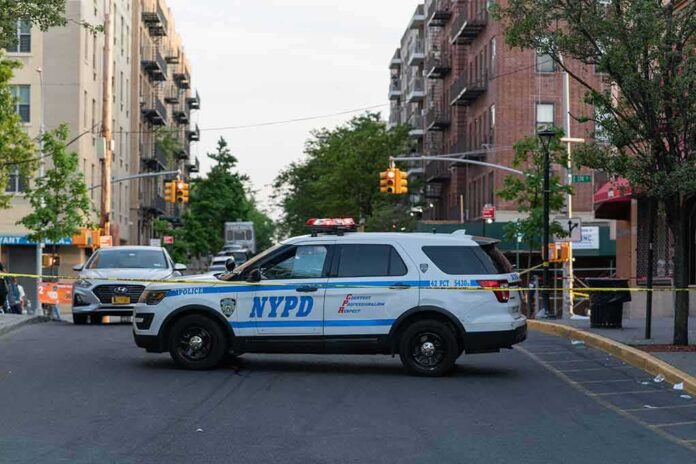
A Bronx Supreme Court judge was arrested after a late-night traffic stop and refused a breath test, police said.
Story Snapshot
- Police stopped the judge around 12:35 a.m. near 189th Street and Webster Avenue.
- Officers accused her of driving while impaired by drugs and driving while ability impaired.
- She refused a breath test, which can trigger an immediate license suspension under state rules.
- No plea or court outcome has been reported as of publication.
What Police Say Happened On The Bronx Corner
Police attributed an impaired-driving arrest to the judge after a stop near 189th Street and Webster Avenue in the Fordham section of the Bronx around 12:35 a.m. Officers alleged impaired operation and said she refused a breath test at the scene. The officers listed charges that included operating a motor vehicle while impaired by drugs and driving while ability impaired. The account was attributed to law-enforcement officials and a police source in contemporaneous reporting.
The allegation of a breath-test refusal matters on its own in New York. State Police guidance says drivers are deemed to consent to a chemical test for alcohol or drugs. Refusal can lead to an immediate administrative suspension, separate from any criminal case. That means a person can beat the impaired-driving charge but still lose a license for refusing the test. The rule is meant to protect the roads and discourage drivers from withholding evidence.
Charges, Consequences, And What Refusal Really Triggers
The listed charges track two distinct lanes: criminal and administrative. The impaired-driving counts move through court and require proof beyond a reasonable doubt. The refusal moves through the Department of Motor Vehicles and uses a lower standard. Many readers mix these up. The law separates them on purpose. New York designed the refusal rule to backstop enforcement when time is short and evidence can fade fast. That is common sense road safety, not a legal trick.
Drug-impaired-driving cases also bring unique proof problems. Alcohol has a breath number most people accept. Drug impairment often lacks a single reliable roadside tool. The United States Government Accountability Office has noted there is no validated roadside device that matches alcohol breath testing for drugs. That gap raises the stakes on officer observations, body-camera footage, and later toxicology. Prosecutors must knit these parts together to convince a jury.
Why A Judge’s Arrest Hits Different
A judge sits at the center of public trust. When a judge faces an impaired-driving arrest, three separate questions arise. First, did police have grounds for the stop and the arrest. Second, can the state prove impairment in court. Third, does the conduct call for judicial discipline even if the criminal case ends with a lesser result. Those are distinct tracks with different standards and different remedies. They should not be collapsed into one verdict.
New York’s Commission on Judicial Conduct has said that a first alcohol-related driving offense without aggravating facts often leads to public reprimand or admonition. That is not a free pass. It is the baseline, and facts can push discipline up or down. Past New York cases show the range. Some judges received censure. Others, such as the Rochester city court judge removed years after a DWI conviction and further violations, lost their seat. Conduct, not title, drives the outcome.
What Comes Next In Court And At The License Window
The court case will test the evidence on impairment. The state must show the judge operated a vehicle while her ability was impaired by a drug or that she drove while ability impaired. Without a chemical test number, the case can hinge on driving behavior, officer observations, and any lab work that follows. Defense counsel will stress gaps, timelines, and procedures. Jurors will weigh whether the state’s proof leaves a real doubt on actual impairment.
The license side moves faster. A refusal sets up a Department of Motor Vehicles hearing on whether the warning was given and the refusal was clear. If an administrative law judge upholds the refusal, the suspension can stand even if the criminal case fizzles. That may feel harsh, but it aligns with common sense priorities: keep unsafe drivers off the road and deter refusals that block evidence needed to protect the public.
Bottom Line For The Bench And The Street
Police said a Bronx judge faced impaired-driving charges and refused a breath test after a midnight stop. The criminal case and the license process now take their separate paths. New York law treats refusal as a serious, stand-alone issue, and the judiciary treats alcohol and drug driving as conduct that can merit public discipline. The facts will sort out in court and at the Department of Motor Vehicles. Accountability should be even-handed, swift, and based on evidence.
Sources:
nypost.com, khq.com, us.headtopics.com, gordongazettega.com, apps.pittcountync.gov, judicialfinder.com, courtlistener.com
© partiallypolitics.com 2026. All rights reserved.