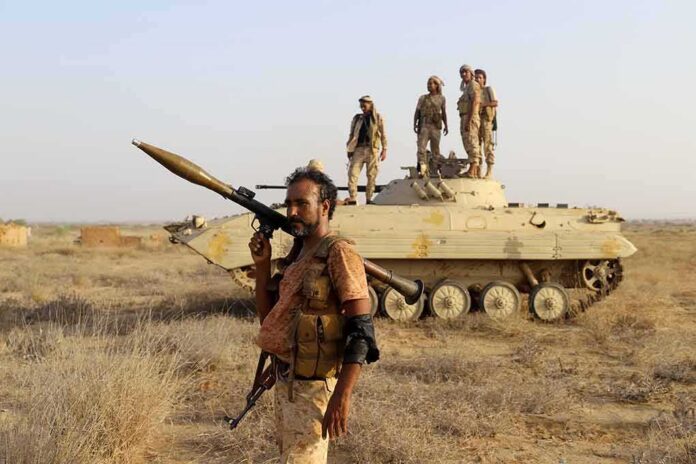
Yemen’s Houthi rebels fired missiles at Saudi Arabia’s capital on November 8, striking a high-rise tower that houses offices for the state oil giant Aramco in the heart of Riyadh’s financial district.
Story Snapshot
- Saudi officials say an Aramco administrative building in Riyadh suffered minor damage from falling shrapnel during an attempted attack.
- No injuries or deaths were reported, according to the kingdom’s Energy Ministry.
- Saudi air defenses intercepted several ballistic missiles, cruise missiles, and a drone aimed at Riyadh and other regions.
- A Reuters witness saw blown-out windows across multiple floors of the Aramco Tower after the attack.
- The Houthis claimed responsibility, framing the strike as proof Riyadh is not untouchable.
What Happened In Riyadh’s Financial District
The attack hit the King Abdullah Financial District, a glass-and-steel showcase meant to symbolize Saudi Arabia’s modern economy. Saudi Arabia’s Energy Ministry said “an administrative building belonging to Saudi Aramco in Riyadh was subjected to an attempted attack” and that falling shrapnel caused minor damage, with no injuries or fatalities reported. The statement was carried by the kingdom’s official press agency within hours of the barrage.
Witnesses on the ground described a different visual than the ministry’s brief wording suggested. A Reuters witness saw blown-out windows spread across several floors of the tower, even as officials stuck to language describing the damage as limited. Saudi Arabia’s coalition spokesperson, Colonel Turki al-Maliki, said air defenses intercepted three ballistic missiles, two cruise missiles, and one drone aimed at Riyadh and other regions that day.
Houthis Claim A Symbolic Victory
Yemen’s Houthi movement quickly claimed the attack, calling it a strike against a major Saudi economic target. The group has spent months shifting its campaign away from strictly military sites toward energy, transport, and financial infrastructure, a pattern analysts say is meant to raise the economic cost of the war for Riyadh. France 24 reported the Houthi claim within hours of the Energy Ministry’s statement.
The Aramco Tower itself carries outsized symbolic weight. It sits inside a district built to project Saudi financial strength to the world, and Aramco remains the kingdom’s most valuable company. Even limited physical damage to a building bearing that name draws global attention, because the target was chosen for what it represents, not just what it contains.
A Pattern Of Escalating Strikes Across The Kingdom
This was not an isolated event. Saudi coalition forces have reported repeated interceptions of Houthi missiles and drones aimed at Riyadh, Najran, Madinah, and other cities in recent weeks, often followed by statements that falling debris caused damage while assessments continued. The pattern suggests a deliberate Houthi strategy: launch enough projectiles that even a high success rate for Saudi air defenses still leaves debris falling on populated areas.
Earlier strikes this year hit Saudi oil infrastructure and Riyadh’s international airport, broadening the apparent target list beyond the battlefield. Analysts tracking the conflict have described this shift as an attempt to impose economic pain on Saudi Arabia at a moment when energy markets are already sensitive to Middle East instability.
The Houthis have struck Aramco tower in the King Abdullah Financial District (KAFD) in Riyadh, Saudi Arabia.
Drones, ballistic missiles and cruise missiles were used in the latest Houthi attack on Saudi Arabia https://t.co/C2JvTtfYAr pic.twitter.com/kEwr4oRNZO
— शून्य 🚩 (@Dave_Gaur) November 9, 2026
The contest over how to describe the Riyadh strike reflects a broader reality of wartime reporting. Saudi officials emphasize successful interceptions and limited damage, while Houthi messaging highlights the strike landing on a flagship building in the capital. Both descriptions can be true at once: missiles intercepted overhead, debris still reaching the ground, and a tower built to symbolize strength now needing new windows.
Why This Attack Resonates Beyond Riyadh
Americans watching from afar should see this as more than a regional skirmish. Saudi Arabia remains a key partner in Middle East stability and global energy supply, and Iran-backed Houthi forces have shown growing reach and persistence. A missile landing near one of the world’s largest oil companies, inside a capital city, signals that the threat environment in the Gulf keeps shifting, with real consequences for energy markets and American interests tied to them.
No casualties were reported from this strike, and Saudi defenses stopped most of the incoming fire before it reached the ground. That outcome reflects real investment in air-defense capability. But the images of shattered windows on an Aramco tower, regardless of the ministry’s calm wording, carry their own message about how exposed even protected capitals can be.
Sources:
wsj.com, news.sbs.co.kr, abcnews.com, upi.com, bbc.com
© partiallypolitics.com 2026. All rights reserved.