Eight lives ended in minutes on Flatbush Avenue, while firefighters carved tunnels through a mountain of brick to reach the living and the lost.
Story Snapshot
- Firefighters launched a large rescue at 1321 Flatbush Avenue after a 4:01 p.m. 911 call.
- Deaths climbed in stages as crews worked through the night; officials updated counts as they confirmed them.
- The site drew more than 250 responders and multiple city agencies in a coordinated push.
- Investigators are examining nearby construction and the building’s history; the cause is under review.
What Happened And When
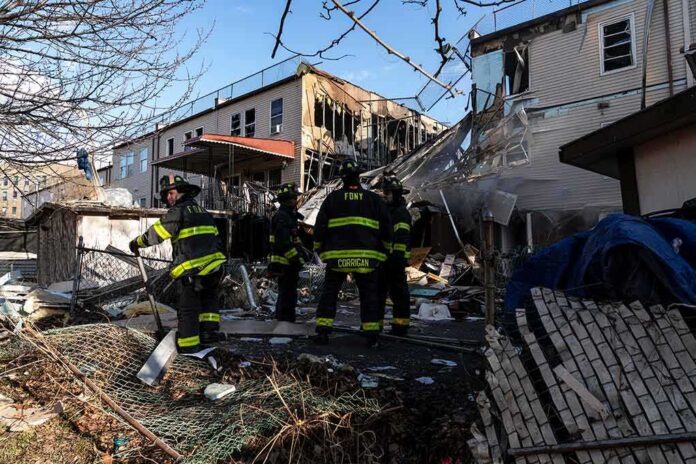
New York City’s emergency system lit up at 4:01 p.m. with a report of a collapse at 1321 Flatbush Avenue. Firefighters arrived within a minute and found a three-story mixed-use building reduced to voids, dust, and twisted floors. Commanders ordered a major technical-rescue operation and began tunneling into tight spaces to reach people who were trapped. Officials confirmed deaths and injuries in waves as searches moved from one pocket to the next and as medical teams triaged victims on scene.
The address was not a mystery. City records had long listed it as a mixed-use building with four residential units and five total units. The street-level use sat below apartments stacked above. That clarity helped officials build a fast plan: isolate utilities, brace unstable walls, and assign search teams by grid. Crews used cameras, acoustic sensors, and long-handled tools to probe voids without shifting debris onto survivors. Every move aimed to speed rescues while avoiding a secondary collapse.
The Scale Of The Response
More than 250 Fire Department and Emergency Medical Services members poured into the block, joined by the Police Department, the Department of Buildings, the Department of Housing Preservation and Development, utility companies, and the Red Cross. The Red Cross opened a reception site for displaced residents while utility crews cut gas and power to stabilize the scene. Police controlled a tight perimeter and moved onlookers back to protect both rescuers and the public from falling debris and airborne dust.
Officials did not lock in a casualty number and walk away. They reported what they knew as they knew it. Early counts noted people still trapped. Then the numbers shifted as teams reached deeper areas and brought out victims. Media briefings captured that change: deaths rose, critical injuries rose, and the total injured climbed. One firefighter suffered injuries during the effort and received treatment. That cadence mirrors how complex rescues unfold in every city: confirm, then update, then confirm again.
Why The Building Failed Is Still Under Review
Investigators from the Department of Buildings and engineering staff examined the rubble, the remaining structure, and the site next door. City records and reporters noted that a construction project with excavation and demolition had been underway beside the building. Officials issued a stop-work order, pulled permit files, and interviewed contractors. Leaders stressed that they would determine cause through evidence, not hunches, and that the formal finding would follow a complete review, not a snap call at the curb.
Brooklyn Building Collapse Kills Two, Injures 17 as Rescue Teams Search for Survivors
A devastating building collapse in Brooklyn has claimed two lives and left 17 others injured. Firefighters continue searching the wreckage for survivors.
👇 For more details, click this link:… pic.twitter.com/pevsjVyDpJ
— News Maximum (@newsmaximumng) November 12, 2026
Adjacent excavation can threaten a neighbor if soil support shifts or if work removes lateral restraint too soon. New York has seen that pattern before, which is why the city requires engineered support and strict sequencing. That said, proximity alone does not prove fault. The key question is whether the work next door, the building’s own condition, or both combined to trigger failure. Officials signaled that they would test those ideas against records, photos, and the physical evidence on site.
What The Numbers Mean For The City
Eight dead demands clear lessons and steady leadership. The strongest conservative value in moments like this is simple: do the work, show your math, and hold people accountable based on facts, not headlines. The city moved fast to save lives and to secure the evidence. That is the right order. When the report lands, it should map each decision to a rule, each failure to a person or process, and each fix to a deadline the public can track.
How To Read Official Updates Without Whiplash
Casualty counts that rise over hours do not show confusion; they show progress. Rescuers must first make the site safe, then search, then confirm identities and conditions. That takes time and caution. Treat early numbers as floor, not ceiling. Watch the agencies that own the facts: the Fire Department, the Police Department, and the Department of Buildings. Their updates carried the most weight here because they ran the rescue, secured the scene, and opened the investigation.
What Comes Next
Expect three tracks now. First, final recovery and identification, with support for families and displaced tenants. Second, a formal engineering determination that explains the failure sequence and cites records, inspections, and photos. Third, any enforcement or reforms: permits, penalties, training, and field checks tied to excavation and shoring work. The only decent tribute to the eight who died is a blueprint that stops the next failure, street by street and site by site.
Sources:
abc7news.com, ny1.com, abc12.com, nydailynews.com, abc7ny.com, whmi.com
© partiallypolitics.com 2026. All rights reserved.