
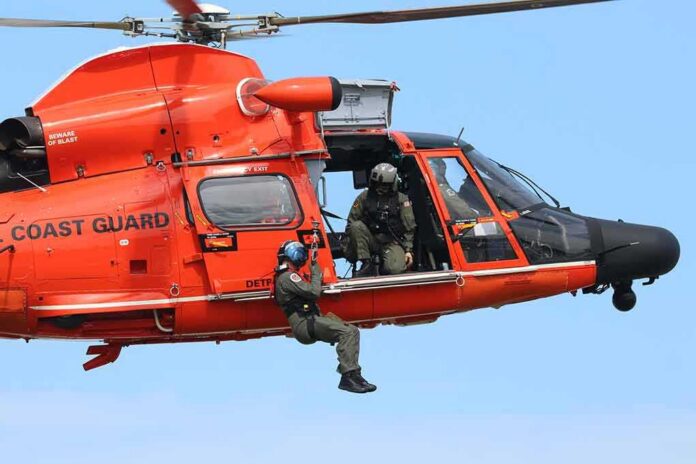
A small plane carrying four adults and two children went down in the water off Mississippi’s Horn Island, triggering a massive multi-agency search for everyone on board.
Quick Take
- Six people, four adults and two kids, were aboard a Cessna when it crashed northeast of Horn Island, the U.S. Coast Guard confirmed.
- The plane left New Orleans Lakefront Airport and was headed to Page Field Airport in Fort Myers, Florida.
- Search crews found the aircraft cabin, three life vests, and a life raft about two nautical miles northeast of Horn Island.
- The Coast Guard, Mississippi Department of Marine Resources, Federal Aviation Administration (FAA), and National Transportation Safety Board (NTSB) are all involved in the response.
What Happened Over the Mississippi Sound
The U.S. Coast Guard confirmed six people were aboard the aircraft that went down near Horn Island, a barrier island off the Mississippi coast. CNN identified the plane as a Cessna Centurion 210, a single-engine aircraft often used for personal and regional travel. The flight carried four adults and two children, though several outlets have not pinned down their exact identities yet.
Local reporting tied the flight to a specific route. The plane departed New Orleans Lakefront Airport and was bound for Page Field Airport in Fort Myers, Florida, according to Coast Guard information relayed by WLOX and WDSU. That stretch of flying crosses the Gulf coastline and the Mississippi Sound before reaching Florida airspace, a route general aviation pilots fly often.
Timeline Points to a Fast-Moving Emergency
Reports place the incident around 3 p.m., with the FAA losing contact with the aircraft near 3:45 p.m. That gap likely reflects the difference between when trouble started and when air traffic controllers realized the plane had gone silent. Either way, the window between last contact and the search launch was short, which matters for survival odds in water landings.
Responders pinpointed the crash site about two nautical miles northeast of Horn Island, a location confirmed across multiple contemporaneous reports. That consistency across separate outlets gives the public a solid picture of where the emergency unfolded, even while other details, like the aircraft’s exact model, remain described slightly differently from one report to the next.
Debris Field Confirms Water Impact
Crews recovered the aircraft’s cabin, three life vests, and a life raft in the search area, hard evidence that the plane entered the water and that at least some safety equipment deployed or floated free. CNN and WDSU both reported these findings, which give investigators physical material to examine as they piece together what happened in the moments before impact.
Finding survival gear does not settle the question of what happened to the people on board. The search for the four adults and two children was still active as of the latest reporting, with no confirmed recovery of passengers included in available accounts. That part of the story remains open, and responsible reporting should treat it that way rather than guessing at an outcome.
Why Water Crashes Are Not Always Fatal
History offers a reason for hope here. A review of ditching incidents in motorized aircraft between 1989 and 2022 found that in cases where search and rescue information was available, over a third of occupants were pulled out by the Coast Guard, and more than a quarter were rescued by other boats or bystanders nearby. Water landings, while dangerous, do not automatically mean the worst outcome for everyone aboard.
🇺🇸 UPDATE: LIFE JACKETS, LIFE RAFT, and CABIN located after Mississippi plane crash
A Cessna 210 flying from New Orleans to Fort Myers suddenly lost altitude about 30 minutes after takeoff.
Flight data shows the aircraft descending from 8,800 feet at a staggering 18,000 FEET… https://t.co/YaTGBMo9aT
— Mario Nawfal (@MarioNawfal) November 25, 2026
That same research found search and rescue information simply was not available for a large share of ditching cases studied, which is a reminder that early hours after a water crash are often the most uncertain. The Coast Guard, Mississippi Department of Marine Resources, and FAA have all been named as part of the response effort, a sign of the resources being thrown at finding answers quickly.
What Comes Next in the Investigation
The NTSB is the lead agency responsible for determining what caused the crash, a process that typically takes time and involves wreckage recovery, maintenance records, and weather data. A preliminary report from the agency generally follows roughly a month after an accident, offering the public the first official account beyond what responders can confirm in the immediate aftermath.
Until that report lands, the confirmed facts stand on their own. Six people were aboard a Cessna that went down off Horn Island on a flight from New Orleans to Fort Myers. Crews found debris and safety equipment at the scene, and a full search for the passengers continues under the direction of federal and state responders working the Mississippi Sound.
Sources:
ksl.com, aircrashdb.com, nola.com, edition.cnn.com, wlox.com, data.ntsb.gov
© partiallypolitics.com 2026. All rights reserved.