
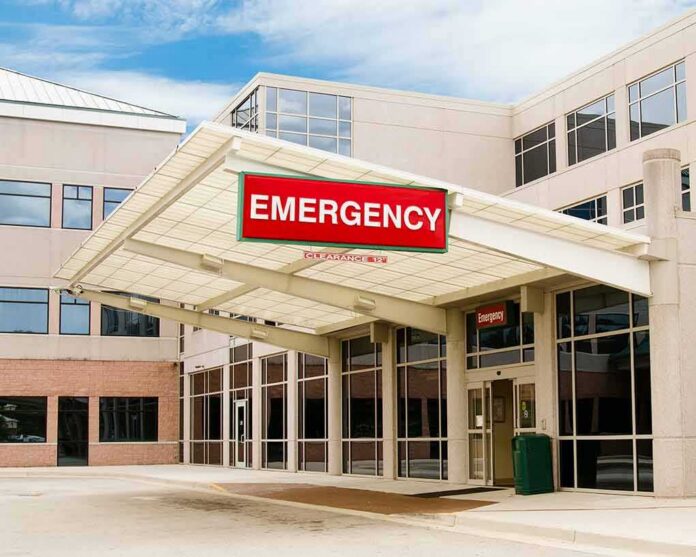
More than a million older people in England now spend up to half a day or more stuck in Accident and Emergency, turning what should be a safety net into a slow-motion crisis that feels less like healthcare and more like abandonment.
Story Snapshot
- Over 1.15 million people aged 60-plus faced 12-hour A&E waits in a single year.
- Older patients are far more likely than younger ones to endure the longest, most dangerous delays.
- “Corridor care” means some seniors wait one to three days on trolleys before reaching a ward bed.
- These extreme waits trace back to blocked hospital beds, thin social care, and years of ignored warnings.
Elderly patients now bear the brunt of England’s longest A&E delays
Hospitals across England are seeing a shocking rise in very long Accident and Emergency waits, and older people are carrying most of that burden. Freedom of Information data analysed by the Royal College of Emergency Medicine shows that in 2024–25, 1,148,666 patients aged 60 or over waited more than 12 hours to be transferred, admitted, or discharged from major emergency departments. Age UK’s campaign report calls these delays routine now, not rare, with roughly one in ten major A&E visits ending in a 12-hour stay.
The age pattern is brutal and simple: the older you are, the more likely you are to be stuck for half a day or longer. For patients aged 60 to 69, about one in seven face 12-hour waits. By age 90 and above, it is roughly one in three. The Guardian’s coverage of the same data reports nearly 150,000 people aged 90-plus enduring these marathon waits each year, a number that would fill a medium-sized town with frail patients parked in corridors.
From four-hour target to twelve-hour reality
Accident and Emergency was once judged by a four-hour standard: see, treat, and admit or discharge the vast majority of patients within that window. That benchmark now looks like nostalgia. Analysis for Age UK shows a 525-fold increase since 2015–16 in “corridor care” episodes where patients wait 12 hours or more after the decision to admit them has already been made. Official data collated by Nuffield Trust and others now show around one in ten major A&E attendances ending in a 12-hour wait, and the numbers keep peaking every winter.
These waits are not just uncomfortable; they are dangerous. Age UK’s briefing cites research showing that people who spend more than 12 hours in A&E are more than twice as likely to die within 30 days compared with those seen within two hours. That risk hits older people hardest because they are more likely to have frail health, multiple conditions, and a lower reserve to cope with stress, pain, and missed medication. The “longest wait” is not an abstract metric; it is a survival curve.
Corridor care and the rise of one-to-three day delays
Behind the 12-hour statistics sits a more disturbing picture: older patients stuck not just for half a day but for one, two, even three days between the decision to admit and a proper bed on a ward. Age UK’s new corridor-care analysis, based on Freedom of Information requests to National Health Service England, found over 100,000 instances in 2024–25 of people aged 65 and over waiting between one and three days in A&E after staff had already agreed they needed admission. These seniors spend that time on trolleys in corridors, side rooms, or crowded bays, with staff doing their best in conditions that look more like disaster zones than planned care.
Lot of waste/inefficiency in the system, eg:-
UK-wide, roughly 40% of ambulance calls do not warrant an emergency response.
NHS England: Roughly 40% of A&E attendances are preventable.
Health tourists cost at least £300m (probable under estimate)
Etc, etc
We mistreat the NHS!— Alan 'Alfie' Spaletto (@TestingTime17) July 30, 2026
Reports collected by Age UK describe older people washing in toilet sinks, lying on the floor, and witnessing other patients deteriorate and sometimes die nearby while they wait. Emergency doctors have described five-day A&E stays for the elderly as a “national scandal,” pointing out that such delays would have been almost unthinkable a decade ago. For many families, it means watching a grandparent fade in a fluorescent-lit hallway, with no clear sense of when a bed will open or who is accountable.
Why the system keeps failing older emergency patients
Think tanks and professional bodies largely agree on the main drivers of these long waits, even if they debate which matters most. A chronic shortage of staffed ward beds means A&E becomes a holding pen, because there is simply nowhere to send admitted patients. At the same time, thousands of beds stay blocked by people who are medically ready to leave hospital but cannot be discharged safely into the community, because home care, residential care, or rehabilitation support is not available.
From a common-sense, conservative point of view, this looks less like a mysterious crisis and more like the predictable result of a system that let capacity lag while demand grew. Emergency care is being asked to carry the weight of every upstream failure: underfunded social care, slow community services, and a planning culture that treats bed numbers as “fat” to trim instead of core infrastructure. When politicians claim everything is just “seasonal pressure,” that reassurance does not line up with a 525-fold rise in 12-hour corridor waits over a decade. For older people and their families, the message is clear: plan ahead, because the safety net is fraying.
Sources:
theguardian.com, rcem.ac.uk, bbc.com, caremark.co.uk, lowdownnhs.info, independent.co.uk, nuffieldtrust.org.uk
© partiallypolitics.com 2026. All rights reserved.