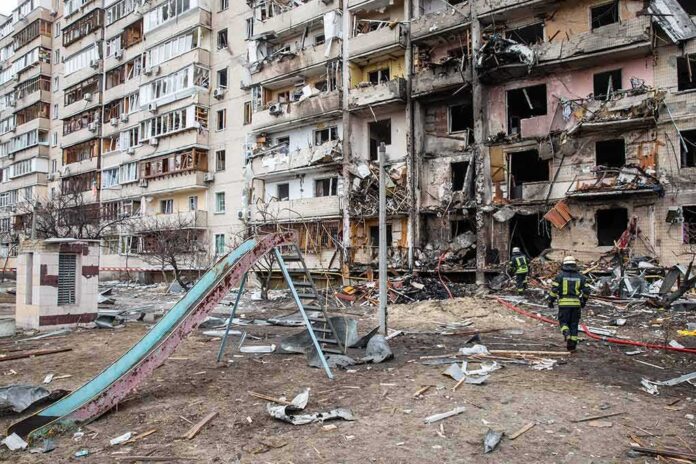
Hundreds of drones hit the Moscow area overnight, killing two people and rattling the capital’s prized sense of safety.
Story Snapshot
- Authorities reported hundreds of drones targeted Moscow and nearby regions.
- Two people died in the wider Moscow region; several were reported injured.
- Officials said air defenses downed most drones near the capital.
- An oil refinery facility in Moscow was damaged during the strikes.
What Moscow Officials Say Happened
City and regional leaders described the largest drone wave yet near the Russian capital. Moscow Mayor Sergei Sobyanin said air defenses intercepted large numbers headed for the city. The Moscow regional governor, Andrei Vorobyov, reported two deaths in the region and multiple injuries after falling debris and blasts. Local emergency teams evacuated residents from affected areas. Officials also reported damage on the grounds of the Moscow Oil Refinery, a site tied to fuel supply for the capital and nearby industry.
Reuters reported that two people died in the Moscow region and confirmed damage at a refinery site in the capital, quoting regional authorities as voting concluded in national parliamentary elections. That timing matters because election periods tighten security and strain public nerves. Russian media and international outlets carried images of smoke and emergency crews working through the night. The scope of the attack signaled that long-range drones can still reach Moscow’s core, even after months of reinforced air defenses.
Why This Strike Matters Now
The raid targeted Moscow’s political and economic heart on a sensitive date. Hitting an oil facility goes beyond symbolism, because even brief outages ripple into fuel logistics and prices. Russian officials claimed extensive shoot-downs, yet the reported deaths and damage show some drones got through. That mix tracks with recent patterns across the war: defenses stop many drones, but not all, and even a handful can cause outsized disruption at high-value sites.
Numbers about intercepts vary by outlet and official, which is common during fast-moving air attacks. The Associated Press cited hundreds of drones across the city and region. Reuters focused on casualties and the refinery hit. Other international reporting echoed both the scale and the refinery damage claim. The consistent through-line remains clear: a mass drone wave reached Moscow’s perimeter, left two people dead in the region, and scarred a key energy site in the capital.
The Strategic Signal Behind Drones
Long-range drones are cheap, adaptable, and hard to stop at scale. They force expensive defenses to react again and again. They also hunt soft spots—fuel depots, power assets, and logistics hubs. The Moscow strike underscores how drones can bend the map, turning distant capitals into reachable targets. Leaders in any country should read this as a warning: layered defenses, hardening of energy nodes, and redundancy in supply lines are not “nice to have,” they are a must.
Ukraine Drone Attack Targets Moscow Oil Refinery; 2 Killed In Overnight Strike#RussiaUkraineWar #MoscowDroneAttack #UkraineWar #Russia #VolodymyrZelenskyy #Kyiv | @sriya_kundu pic.twitter.com/fTcvsb2sVI
— IndiaToday (@IndiaToday) September 20, 2026
The American conservative lens values border security, energy resilience, and deterrence. This event hits all three. First, border and airspace control cannot be a slogan; it needs sensors, shooters, and clear rules to act fast. Second, energy assets are war targets now; regulators and companies should harden facilities, disperse critical spares, and plan for rapid repair. Third, deterrence works best when the cost of attacking rises. That takes credible defense and the will to respond on terms that stop repeat strikes.
Sources:
youtube.com, usnews.com, apnews.com
© partiallypolitics.com 2026. All rights reserved.