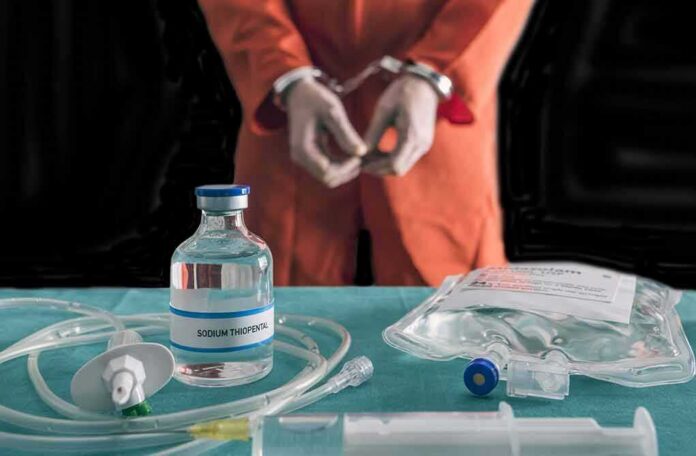
Texas needed more than an hour to carry out one execution because the team could not find a vein, and the man on the gurney cried out in pain as it dragged on.
Story Snapshot
- Staff spent over an hour establishing two intravenous lines before the lethal drug flowed.
- Witnesses reported repeated cries of pain and violent movement on the gurney.
- Texas officials said procedures were followed and the final IV sites were proper.
- The clash fits a larger pattern of disputed lethal-injection distress claims.
What Happened Inside the Chamber
Reporters on site said the execution of Reinaldo Dennes exceeded an hour as staff tried and failed to start two intravenous lines, which are needed to deliver pentobarbital under Texas’s method. A spiritual adviser described Dennes shifting and contorting on the gurney and saying, “My leg, my leg, my leg,” while also claiming the drug was not working as it should. Journalists reported groans, then snoring sounds, then about a dozen faint breaths before death was called at 7:08 p.m..
Reporters and the Los Angeles Times captured statements from Dennes that pointed to pain and doubt about the process: “The pain,” “My right leg is killing me,” “I don’t think this is normal,” and “Don’t let me suffer like this”. These words matter because they suggest perceived pain during the period when the drug should bring quick unconsciousness. The extended IV hunt also invites questions about needle sites, infiltration, and whether the drug reached the bloodstream as intended.
What Texas Officials Say Went Right
The Texas Department of Criminal Justice said the team followed procedure and used approved sites after earlier attempts failed. A spokeswoman said the intravenous lines were set in the left foot and the left side of the neck, locations she said comply with the state’s rules. She also said Dennes complained of pain before the lethal dose began and in places where no intravenous line was placed, suggesting his comments did not prove a delivery failure or an abnormal event from the state’s perspective.
This response frames the cries and movement as expected stress or unrelated pain, not proof of a broken process. That stance reflects a common official posture: recognize difficulty in starting lines, but deny that the drug phase was flawed. It also points to a key factual tension. Witnesses saw distress and heard the man say, “It’s not working.” Officials counter that the final setup was proper and that the timeline and behavior do not show a violation of protocol.
The Clash of Narratives and the Facts That Matter
The split between witness accounts and state assurances is not new. The Death Penalty Information Center’s historical review lists dozens of cases classed as “botched,” with many tied to intravenous access problems and visible distress in the chamber. That broader record supports two truths at once. First, trouble finding a vein is common enough to plan for. Second, movement and moans alone cannot prove the exact medical cause, such as infiltration, hypoxia, or anxiety, without clinical records or toxicology.
Texas execution took over an hour as staff struggled to find vein; Reinaldo Dennes moaned about pain https://t.co/2xfEXfYF3Q
— CTV London (@CTVLondon) November 20, 2026
Common sense asks a tight question here: if the process is designed to be fast and certain, why did it start with an hour of hunting for a vein while the condemned man lay strapped to a bed? A justice system that wields the ultimate penalty must clear a higher bar for competence and transparency. That means a full timeline, the drug details, and the intravenous notes—released, not summarized—so the public can judge whether the state met its own standard this time.
What To Watch Next
Key documents can close the gap between the two stories. An execution-room log with times for each intravenous attempt, the exact locations used, and when the pentobarbital entered the line would anchor the timeline. Nursing notes and photos could confirm whether needles infiltrated tissue. Toxicology, if taken, could show drug levels. Without these, the event will sit as another chapter where people heard pain, the state said “procedure followed,” and the truth sits behind a glass wall.
Sources:
newsfromthestates.com, wtop.com, fox26houston.com, foxsanantonio.com
© partiallypolitics.com 2026. All rights reserved.