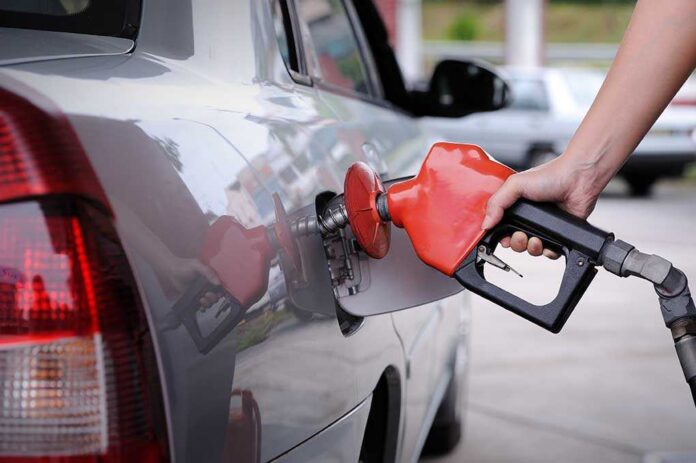
On America’s 250th birthday, millions of drivers are quietly “celebrating” with a higher tax on every gallon they buy.
Story Snapshot
- Gas taxes and fees went up in many states heading into 2026, and they hit every driver at the pump.[3][6]
- Some hikes are tiny per gallon, but they stack up fast over a year of commuting.[3][6]
- State leaders say they need the money for roads and bridges, but laws often make hikes automatic.[3][6]
- Voters see the price jump now; the promised pavement shows up later, if at all.[2][4][6]
America’s big birthday and the quiet tax on every mile
America turns 250, but while politicians give speeches about freedom, many states give you a higher gas bill. The Energy Information Administration reports that from early 2025 to early 2026, twenty-six states changed their gasoline taxes; nineteen raised them, and only seven lowered them.[6] State gas taxes and fees now average about 33.5 cents per gallon, up from last year.[6] That is on top of the long-frozen 18.4 cent federal gas tax drivers already pay.[7]
NerdWallet found that gas taxes increased on January 1 in Florida, Georgia, Massachusetts, Minnesota, Nebraska, New Jersey, and Utah.[3] The per-gallon hikes look small, often less than 3.3 cents.[3] That sounds harmless until you multiply it. A family that burns 1,000 gallons a year pays $33 more for a three-cent hike. In many states, drivers already pay around the national average of about 33 cents per gallon in state gas taxes alone.[2]
How states raise gas taxes without ever asking you again
Most drivers think of a tax hike as a big vote with lots of noise. Gas taxes now move in a quieter way. Many states use “variable” or inflation-tied formulas that change the rate automatically once those formulas are on the books.[5][9] NerdWallet notes that several 2026 increases came from exactly this kind of adjustment, where state law links the tax to inflation or other factors.[3][5] Lawmakers voted once, years ago; the pain keeps arriving every January or July.
Illinois shows how this works in detail. The state revenue bulletin for 2026 sets the motor fuel tax at 49.6 cents per gallon from July 1, 2026, through June 30, 2027.[3] That bulletin explains that the rate rises each year based on inflation, without another high-profile debate.[3] The National Conference of State Legislatures has tracked how states shifted toward these variable gas taxes over the last decade as a way to keep revenue growing even when fuel use levels off.[9] From a budget view, that is smart planning; from a voter view, it feels like a shadow tax escalator.
Why this money matters, and why trust is wearing thin
State officials defend these hikes by pointing to roads that crumble and bridges that age faster than budgets grow. USAFacts reports that the average state gas tax rose from 27 cents per gallon in 2015 to 33 cents in 2026, and notes that these levies are a key and steady source of transportation funding.[2] Groups that study tax policy say that as cars get more fuel efficient and construction costs climb, flat per-gallon taxes fall behind, forcing states back to the well again and again.[4]
Yet the record in this set of documents does not clearly tie each 2026 increase to a proven funding gap or list of projects.[2][3][6] Illinois posts the new rate, but the bulletin does not spell out exactly which roads that extra money will fix.[3] The Energy Information Administration explains which states changed their rates and by how much, but not where each dollar ends up.[6] That missing link feeds public doubt. Drivers see a higher line item on every receipt but have to hunt through budget books and agency reports to find out whether that money is locked into asphalt, or quietly feeding general spending.
Small hikes, big picture: the slow boil for middle America
Defenders often point out that many 2026 changes were “only” a penny or two.[3][6] Technically, they are right. NerdWallet’s seven January hikes ranged from less than 1 cent to 3.3 cents per gallon.[3] The Energy Information Administration describes most recent moves as slight, noting only a few big jumps like Washington’s 6.2 cent increase and Michigan’s 5.2 cent increase.[6] But taxes do not live in a vacuum. They stack on top of higher food, housing, insurance, and everything else families face.
Common sense says that when states can quietly skim a bit more every year through formulas, the pressure to cut waste elsewhere fades. Gas taxes are also blunt. That extra 3 cents hits the nurse driving thirty miles to a night shift just as hard as it hits the lobbyist in a luxury SUV. Policy experts have suggested targeted gas-tax holidays during price spikes as a tool for relief.[6][9] That alone shows leaders know this tax is heavy enough that rolling it back, even briefly, feels like real help.
Sources:
[2] Web – State Gas Taxes: What They Are And How Much You Pay – NerdWallet
[3] Web – How much do you pay in gas taxes? – USAFacts
[4] Web – FY 2026-23, Change in the Motor Fuel Tax Rate, Effective July 1 …
[5] Web – Most States Have Raised Gas Taxes in Recent Years – ITEP.org
[6] Web – Many states slightly increased their taxes and fees on gasoline … – …
[7] Web – Federal Gas Tax Holiday: June 1, 2026 – Penn Wharton Budget Model
[9] YouTube – Your State Just Raised Gas Taxes | See the New Pump Prices
© partiallypolitics.com 2026. All rights reserved.