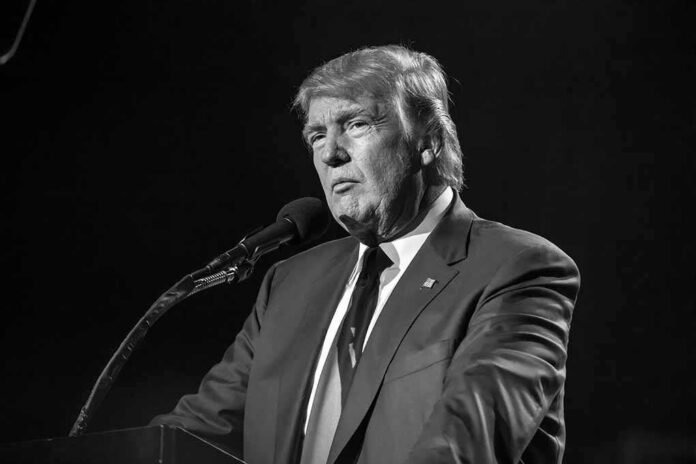
A former Miss Switzerland contestant told House Judiciary Committee Democratic staff that President Trump raped her in a Plaza Hotel suite during a 1993 pageant event, detailing torn clothing, bleeding, and bruising.
Story Snapshot
- Beatrice Keul gave a named, time-stamped account tied to the 1993 American Dream Pageant.
- Her account places the events at the Trump-owned Plaza Hotel and describes injuries.
- Coverage says Trump promised help with a visa and New York University before the alleged assault.
- The White House denied the allegation in press statements cited by multiple outlets.
Detailed allegation set within a specific 1993 pageant scene
House Judiciary Committee Democrats reported that Beatrice Keul described a rape by Trump in November 1993 at the Plaza Hotel during the American Dream Pageant period. The report says she identified Trump, the setting, and the month and year, and described being grabbed from behind, a torn dress, bleeding, and bruising. The account links to a press luncheon tied to the pageant. Keul also described encountering Jeffrey Epstein in the surrounding events, placing the allegation within that social circle.
Reporting from People states Keul told committee staff that Trump promised to help her with a United States visa and entry to New York University, then invited her to his suite, where she says the assault occurred. Those details offer a possible motive-and-opportunity narrative: a powerful sponsor opens a door, then abuses access. The described sequence aligns with patterns often seen in abuse-of-power cases. Each claim is specific enough that records, if they exist, could test parts of it.
Earlier 2024 public account and the later committee description
Coverage in The Independent in 2024 reported Keul’s earlier account. She said she visited Trump’s Plaza Hotel suite in 1993, and he kissed her, grabbed her, and tried to lift her dress. Her 2026 committee description alleges rape in the same setting, with added physical injury details. The core facts match on time, place, and person; the severity expanded in the later telling. That shift invites follow-up on medical, travel, or diary records that might clarify the extent of harm.
Mediaite, People, and others reported the allegation within the context of a Democratic staff report on Trump and Epstein. Those outlets noted the committee’s write-up and the specificity of Keul’s identification of Trump, the Plaza Hotel, and the pageant window. The narrative names who was present and when, which allows basic event verification: press luncheons, guest lists, pageant programs, and hotel calendars can confirm the broader scene even if they cannot prove the assault.
Denial from the White House and the political frame
Mediaite reported a categorical White House denial. The statement said the allegation is not true, reflecting the administration’s firm rejection of the report’s claims. That denial sits inside a larger political fight over the Democratic committee’s report, which also addresses alleged ties between Trump and Epstein. The clash ensures intense scrutiny. The best path forward for clarity is sunlight on records that can anchor who was where, who met whom, and what was said in real time.
Looks like predator. Walks like a predator. Talks like a predator. Must be a predator. •E. Jean Carroll: alleged an assault in a department store in the mid-1990s. A civil jury found Trump liable for sexual abuse and defamation in 2023.
•Jill Harth: a makeup artist who alleged… https://t.co/NRgBI5YY24— Gordon Leith – CoachingwithGordon.com (@CorkusDean) October 27, 2026
Readers have seen this kind of dispute before. Delayed reporting is common in sexual-violence cases, especially when a powerful person is involved. One study found only about a third of incidents were reported to police, and delays were more likely when the alleged perpetrator was known to the victim. That pattern does not prove any one claim, but it shows why some accounts surface years later, as careers and power shift and safety to speak changes.
What evidence can still be tested three decades later
Event verification can start with the pageant itself: programs, press credentials, and photographs from November 1993 can confirm the luncheon and the roster. Hotel records, if retained or archived in media coverage, can place participants at the Plaza Hotel. Investigators can also seek pageant staff and contestants for sworn statements about the approach, the suite invitation, or any visible injuries after the alleged assault. Immigration and university files, with consent, can check any visa or New York University help.
House Judiciary Committee Democrats could release the full interview record to establish exact wording, timing, and any exhibits. A transcript or signed declaration would let the public compare the 2024 and 2026 accounts line by line. That level of detail is how serious claims get assessed in a way that respects both the accuser’s story and the accused’s rights. Transparent records help cut through partisanship and keep focus on facts that can be checked.
Sources:
mediaite.com, democrats-judiciary.house.gov, economictimes.com, rawstory.com
© partiallypolitics.com 2026. All rights reserved.