
partiallypolitics.com — A deadly interstate crash has ignited a hard question: why was a commercial bus piloted by a driver who could not speak English, and who may have slipped through licensing safeguards meant to keep families safe? [2][1]
Story Snapshot
- Five people were killed when a tour bus failed to slow in a work zone on Interstate 95 in Virginia, striking multiple vehicles. [1][5]
- U.S. Transportation Secretary Sean Duffy said the driver “doesn’t speak English,” calling that unacceptable for commercial drivers. [2]
- Federal officials are reviewing the driver’s licensing and training records after the crash. [8]
- Investigators from the National Transportation Safety Board opened a probe into causes and compliance. [4]
Crash Mechanics Reported By Authorities
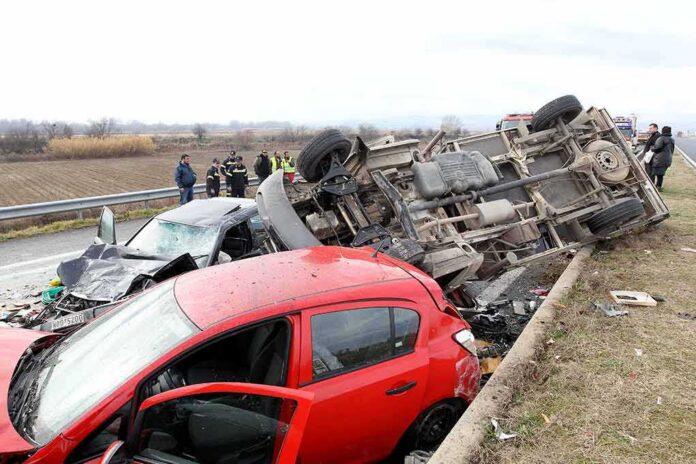
Virginia State Police reported the bus failed to slow for traffic near a work zone on Interstate 95, then plowed into vehicles ahead, leaving five dead and dozens injured. Early accounts describe a chain-reaction collision caused when the tour bus did not reduce speed as cars braked for construction activity. Those details establish an immediate mechanism—failure to slow in a work zone—while the broader questions about qualifications and compliance remain under federal review. [1][5]
News footage and eyewitness accounts across local outlets showed the damaged bus and vehicles scattered across lanes, with first responders working through the night to triage victims and clear wreckage. The scope of injuries and the presence of children among the dead intensified public concern, increasing pressure on authorities to determine whether the carrier and driver met every requirement for commercial passenger service. Officials said the death toll reached five and injuries topped thirty. [6][5]
English Proficiency And Commercial Driver Rules
U.S. Transportation Secretary Sean Duffy publicly tied part of the safety concern to the driver’s inability to speak English, stating that drivers who cannot read road signs or communicate with law enforcement have no business driving a bus. That statement signals an enforcement focus on a longstanding federal requirement that commercial drivers be able to understand English sufficiently for safety. The Department of Transportation’s review centers on whether licensing and training standards were followed in New York and beyond. [2][8]
Officials emphasized that English proficiency is not merely paperwork; it is a frontline safety control that enables drivers to follow work-zone instructions, heed detour signs, and interact with police or roadside crews. When a driver cannot understand written and verbal warnings, the margin for error narrows dangerously, especially in dynamic highway conditions. Duffy’s comments underscored that a breakdown in basic communication skills is, itself, a safety violation that regulators cannot ignore following a mass-casualty crash. [2]
Investigative Track: Causation Versus Qualification
The National Transportation Safety Board initiated a formal safety investigation that will test competing narratives: immediate crash mechanics such as speed and situational awareness versus broader qualification failures like language proficiency and training records. Early reporting links the fatalities to the bus’s failure to slow in a work zone, a finding independent of language. At the same time, federal scrutiny of the driver’s credentials could reveal rule violations that, while not yet proven as the cause, still represent unacceptable risk for passenger carriers. [4][1][8]
🚨5 Dead, 34 Injured in Virginia Bus Crash.
The identify of the bus driver has not yet been released. Law enforcement has stated that "Charges are Pending". pic.twitter.com/90zxcFS5L6
— American Truckers United (@atutruckers) May 29, 2026
The emerging picture reflects a familiar pattern after high-casualty roadway disasters: investigators build the technical timeline while policymakers examine whether gatekeeping safeguards broke down. For conservative readers, the priority is clear—hold carriers fully accountable, insist that drivers meet every standard, and reject any leniency that treats language proficiency as optional. Safety rules only work when states rigorously enforce them and when federal authorities back those rules with swift, transparent consequences. [2][8]
Accountability And Policy Implications
Families traveling American highways deserve drivers who can read road signs, comply with work-zone instructions, and communicate with police without delay. If the investigation verifies that the driver lacked required English proficiency or that licensing reviews were lax, then enforcement must tighten immediately. That means real penalties for carriers that cut corners, real audits of state licensing records, and clear federal guidance that language proficiency is a nonnegotiable public-safety standard for passenger transportation. [2][8]
Conservatives should also insist on separating hard facts from speculation while the investigation proceeds. The immediate failure to slow in a work zone is documented, and five people are dead. Whether language barriers contributed remains under review. The right response is not new bureaucracy but serious enforcement of existing rules, transparent findings from investigators, and accountability for anyone who put unqualified drivers behind the wheel of a bus carrying dozens of souls down one of America’s busiest corridors. [1][2][8]
Sources:
[1] Web – Duffy Now Vowing Action After Non-English Speaking Driver’s Deadly VA …
[2] Web – 5 killed, dozens injured when bus plows into several vehicles near …
[4] YouTube – Fire department spokesperson answers questions about bus crash …
[5] YouTube – Virginia bus crash: NTSB investigating, bus driver could face charges
[6] Web – Bus hits cars in Virginia, killing 5 people and injuring 34, state …
[8] Web – Sean Duffy calls Virginia bus crash driver’s lack of English …
© partiallypolitics.com 2026. All rights reserved.